National Assembly Labor Forum holds debate on labor exemption provisions
Labor: 'Don't turn special zones into overwork zones'
Business: 'Limited workforce operations require swift discussion'
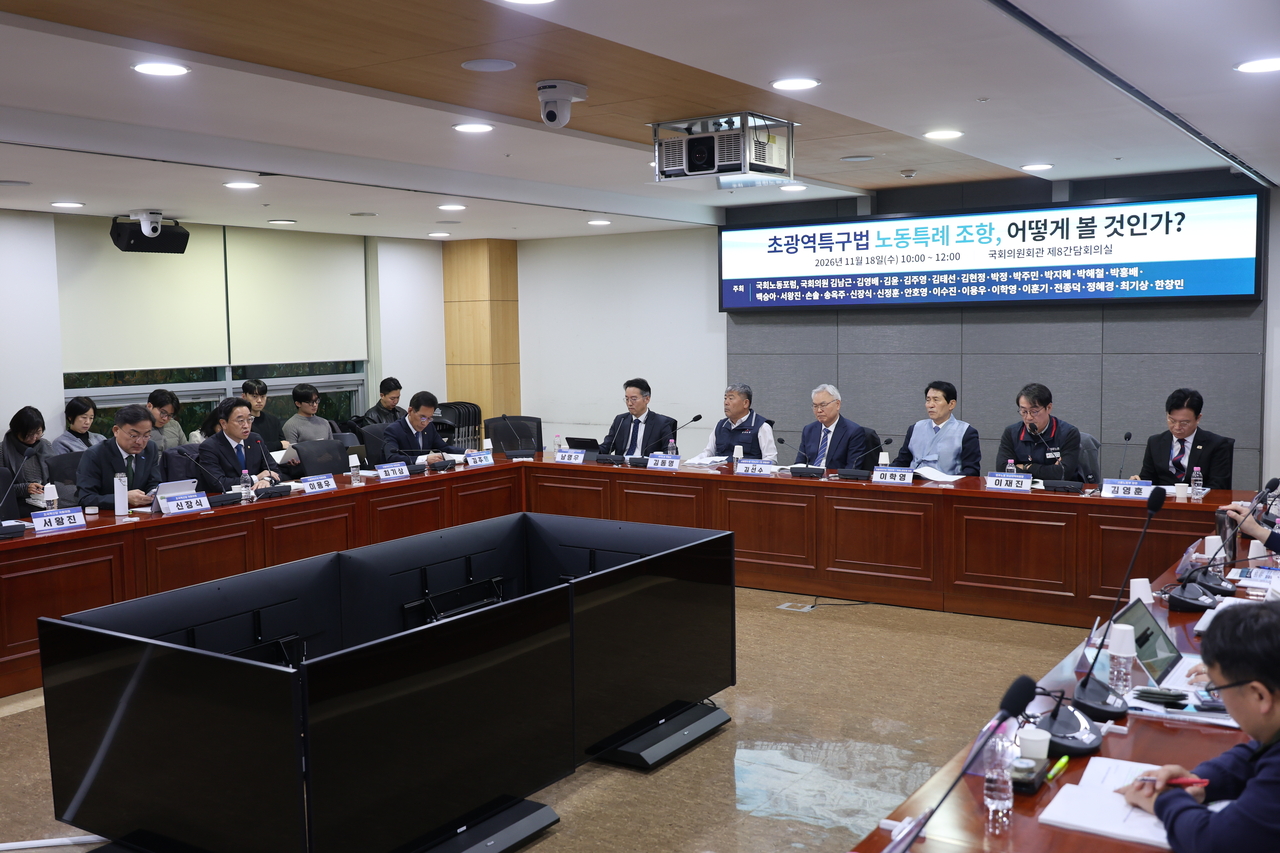
If labor exemptions — such as exclusions from the 52-hour workweek or expanded fixed-term employment under a "2+2" contract scheme — are introduced through the proposed mega-special economic zone bill, the core requirements and worker protections must be spelled out in the legislation itself rather than left to enforcement decrees, a legal expert said Wednesday.
Kwon Oh-sung, a professor at Yonsei University School of Law, made the remarks as a presenter at a National Assembly Labor Forum debate titled "How Should We View the Labor Exemption Provisions of the Mega-Special Zone Bill?" The forum was co-hosted by Democratic Party of Korea lawmaker Lee Yong-woo and others at the National Assembly members' office building.
"Broadly delegating fundamental matters — such as caps on working hours, minimum rest periods and employment stability — to presidential decrees or administrative agency notices should be approached with great caution," Kwon said. "Core requirements and protective measures must be defined directly in the law."
Kwon argued that because the 52-hour workweek exemption serves as the baseline for calculating overtime, rest periods, holidays and additional pay, the specific jobs and circumstances subject to the exemption must be clearly defined.
"If the law does not set out a sufficient minimum standard of protection, the result could be that lawmakers are leaving important decisions — ones they should make themselves — to subordinate regulations and individual agreements," Kwon said. He added that any working-hour exemption for high-income professionals should be limited strictly to roles that combine a high degree of expertise with genuine worker autonomy over their own hours.
On the proposed expansion of fixed-term employment periods and the scope of dispatched workers, Kwon said the provisions "affect the structure of employment stability and employer accountability" and therefore "must be subject to stricter scrutiny."
Jeong Heung-jun, a business administration professor at Seoul National University of Science and Technology, noted that labor-related discussions in the current tripartite social dialogue have not been moving quickly. He suggested one option would be to pass the special zone bill first without the labor exemptions, then work out labor-related alternatives by next year.
Yoo Jeong-yeop, head of policy division 1 at the Federation of Korean Trade Unions, criticized the direction of the proposals. "If labor standards are lowered in a specific region, other regions will demand the same exceptions, and that will trigger a race to the bottom on working conditions as areas compete to attract businesses," Yoo said. "It is wrong to turn a mega-special zone into an overwork zone."
Kim Dong-hee, head of the working standards policy team at the Korea Enterprises Federation, said companies operating in special zones would inevitably face situations where they must work with a limited workforce, making it difficult to deliver sufficient results within the 52-hour limit. "Investment in advanced industries is a race against time, so the National Assembly must move quickly on this discussion," Kim said.
Employment and Labor Minister Kim Young-hoon, in congratulatory remarks at the forum, said good jobs are created when companies grow and that innovation is sustained only when workers are healthy and fairly compensated. "The discussion on labor exemptions must also proceed on the basis of these principles," Kim said.
addressh@heraldcorp.com