Public trial on Route 178 begins Tuesday; five lidar sensors, six radars aboard with safety operator
Level 4 pilot expands on 2019 truck platooning tests
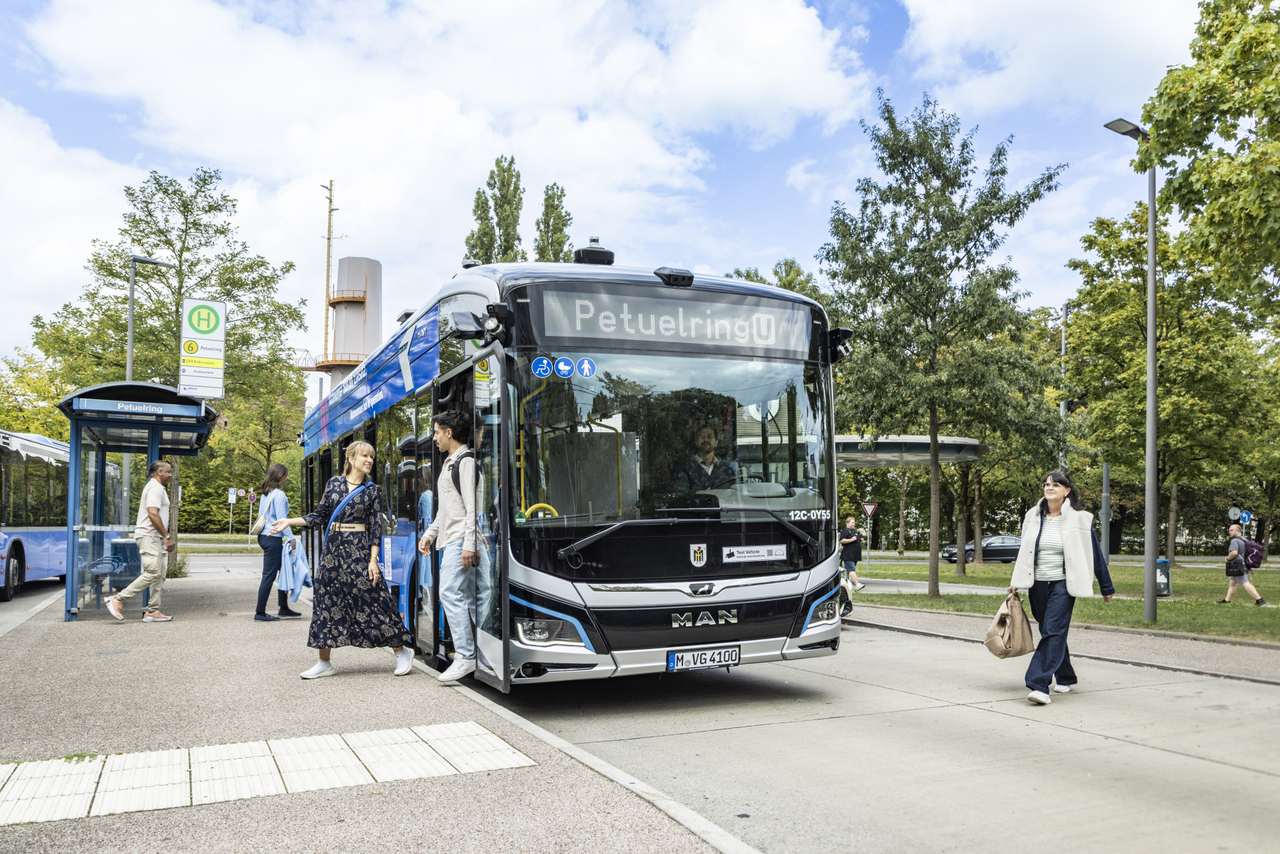
German commercial vehicle manufacturer MAN Truck Bus Group is launching a passenger-carrying autonomous electric bus trial in downtown Munich, giving residents a chance to experience the technology on an existing bus route. The company plans to assess safety performance and rider response through June next year.
MAN Truck Bus Group said Tuesday it is beginning public test rides on Munich's Route 178 with an autonomous electric bus.
The trial is part of MINGA, an autonomous public transit research project conducted together with Munich's municipal utility company and the city's public transport operator, among others.
Launched in 2023, MINGA aims to integrate autonomous buses, ride-sharing and platooning — in which multiple buses travel in close convoy — into existing public transport systems. A total of 16 organizations are participating, including transport operators, companies and research institutions.
The trial route runs along Route 178, connecting Petuellring in northern Munich with Freimann Hölzl. The autonomous bus will operate on weekdays as an additional service on the existing line.
The trial runs through June next year. Rides are not open to the general public on a walk-on basis; only pre-selected participants chosen from prior applicants may board. More than 2,000 people have applied so far.
Even with passengers on board, the vehicle will not operate fully unmanned. A trained safety operator will ride at all times to monitor driving conditions and take manual control if an unexpected situation arises.
The trial uses the MAN Lion's City 12 E, a 12-meter electric bus equipped with an autonomous driving system co-developed by MAN Truck and US autonomous driving technology firm Aedastech.
The vehicle carries five lidar sensors for detecting the distance and shape of surrounding objects, six radars, eight cameras and a satellite-based positioning system.
Data from the sensors are combined to recognize surrounding vehicles, pedestrians and road conditions, allowing the bus to steer and adjust its speed independently. Within the designated route, it can also accelerate and brake automatically.
Before the passenger trial, MAN Truck tested the vehicle's driving performance at its own proving ground. Since September, the bus has been running on Route 178 without passengers to collect real-world driving data and fine-tune the autonomous system.
The vehicle has also passed inspections by German technical inspection authority TÜV and cleared the relevant regulatory approval process.
On actual city streets, the bus will encounter a range of driving conditions beyond ordinary traffic and pedestrians — including 30-kilometer-per-hour speed zones, roads near parks and underpasses. The trial will determine whether autonomous buses can operate reliably under such conditions.
Passenger response is also a key area of evaluation. Researchers from the Technical University of Munich and the University of Stuttgart will conduct pre- and post-ride surveys and observations to analyze public acceptance of autonomous driving technology, safety perceptions and accessibility for passengers with mobility challenges.
"It is a very significant step forward that passengers can now experience MAN's autonomous driving technology firsthand in their daily lives through these test rides," said Dr. Frederik Zohm, executive board member responsible for research and development at MAN Truck Bus Group. "Autonomous vehicles require not only safe and reliable technology but also people's trust, and we will actively apply the experience gained from this project to the development of next-generation vehicles and the broader application of autonomous driving technology."
MAN Truck is also testing autonomous driving technology in freight transport, not just in buses.
In 2019, the company completed a truck platooning trial on German highways with global logistics firm DB Schenker. The technology allows following vehicles to automatically match the speed and following distance of the lead truck.
During that trial, the convoy covered about 35,000 kilometers in real logistics conditions, and the following vehicles recorded a fuel consumption reduction of roughly 3 to 4 percent.
MAN Truck has also pursued autonomous driving research linked to rail freight. Through the ANITA project, carried out with German railway company Deutsche Bahn and others from 2019 to 2023, the company developed autonomous trucks to automate container transport between road and rail.
In highway driving, MAN Truck tested Level 4 autonomous driving technology through the ATLAS-L4 project. Level 4 refers to the stage at which a vehicle can drive itself without driver intervention under defined operating conditions.
In 2024, MAN Truck became the first German commercial vehicle manufacturer to receive a Level 4 autonomous driving test permit and conducted trial runs on actual highways. Building on that, the company is developing autonomous freight transport technology for routes between logistics hubs.
kwater@heraldcorp.com