'One-strike rule' to bring admission cancellation, criminal charges
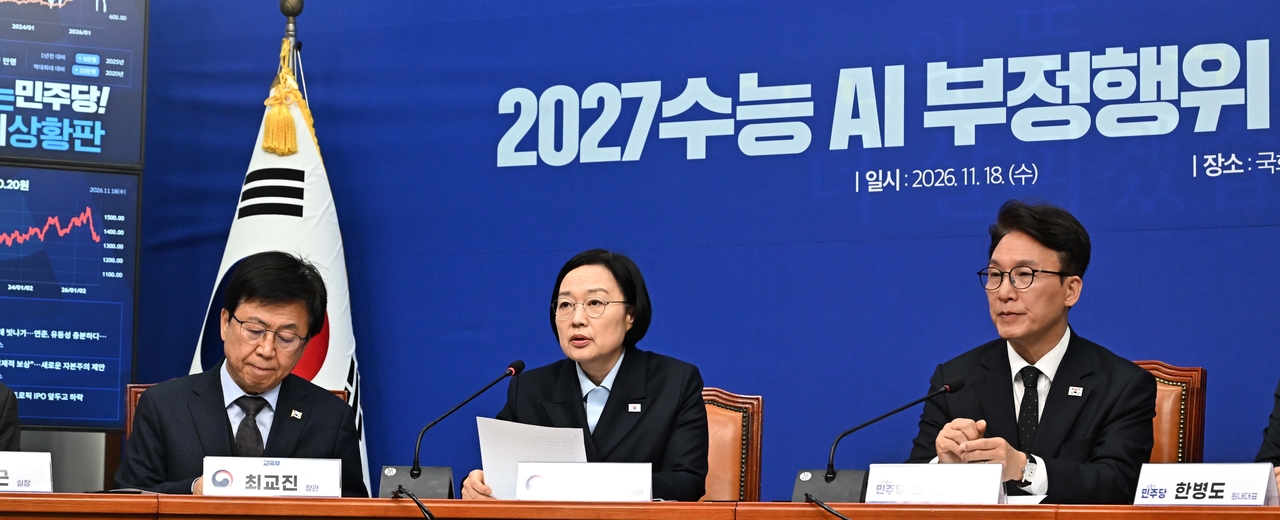
Amid growing public anxiety over AI-assisted cheating on standardized tests, the government and the ruling Democratic Party announced additional countermeasures Wednesday, one day before the 2027 College Scholastic Ability Test. The government asked the party to amend the law to extend the exam-eligibility ban for cheaters to a maximum of 10 years and to apply the change retroactively starting with this year's exam. The Democratic Party said it would pursue strong sanctions, including admission cancellation and criminal punishment.
Prime Minister Han Seong-sook, attending a ruling party-government consultative meeting on AI cheating countermeasures held at the National Assembly, said the government was requesting legislative action. "For matters that require legal backing — such as extending the exam-eligibility ban to a maximum of 10 years when cheating is detected on the CSAT — we ask that you amend the relevant laws and actively consider retroactive application so that the changes take effect starting with this exam," Han said.
Han added that public concern was running high. "With the exam just around the corner, there is widespread worry about whether anti-cheating measures can actually be effective, and whether they may instead only heighten anxiety among test-takers," Han said. "The government will do its utmost to develop technical and systemic measures that can fundamentally block all forms of exam fraud, and to uphold the trust and values of a society where those who work hard are fairly rewarded."
Democratic Party leader Kim Min-seok explained why the emergency meeting had been convened. "With the exam just one day away, public concern over cheating using AI devices such as smart glasses, earphones and ultra-compact cameras is extremely serious," Kim said. "We called this emergency high-level party-government consultative meeting to once again review our full state of preparedness."
Kim said the party would move quickly to enact legislation. "We will pass the relevant laws to enable a strong response to AI-based cheating and apply them to this year's CSAT immediately," Kim said. Kim added that the party would "expand the eligibility ban for cheating to up to 10 years, and establish a legal basis for strong sanctions — including admission cancellation and criminal punishment — if cheating is confirmed even after the exam is over," and said the party would "enforce a one-strike rule on exam fraud."
Kim went on to say the party would also crack down on misinformation. "We will respond sternly to the production and spread of false and manipulated information that causes unnecessary anxiety and social confusion," Kim said. "The party and government will make every effort to fundamentally block AI cheating and ensure the fairness of the CSAT so that test-takers can take the exam with peace of mind."
The consultative meeting at the National Assembly was attended by Han and Kim, along with Education Minister Choi Kyo-jin, Office for Government Policy Coordination Director Im Gi-geun, Democratic Party floor leader Han Byung-do, Democratic Party Secretary-General Han Jeong-ae and Democratic Party Policy Committee Chairman Kwon Chil-seung.
addressh@heraldcorp.com