Task force launched 'immediately' — but ministries in charge of staffing and budget left out
Govt must show its staffing and funding plan before reviewing exam scores
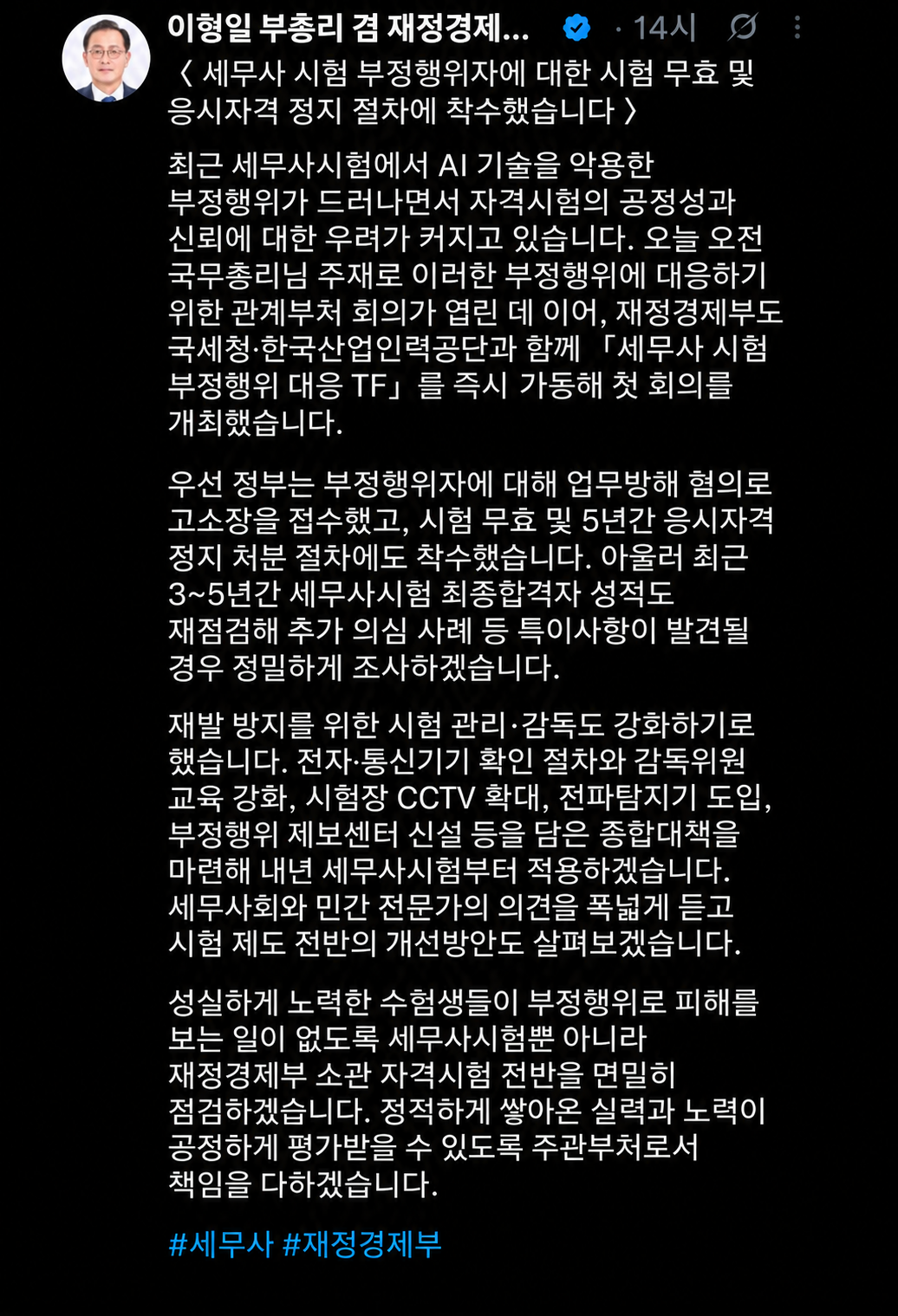
"As the supervising ministry, we will do our utmost to ensure that skills and effort built up honestly are evaluated fairly."
That was the message Deputy Prime Minister and Minister of Economy and Finance Lee Hyung-il posted on SNS as he laid out the government's response to AI cheating on the certified tax accountant exam. The announcement was accompanied by a string of measures: criminal complaints against those suspected of cheating, the launch of procedures to invalidate exams and suspend eligibility, a review of pass results from the past three to five years, and a pledge to tighten exam oversight.
The Ministry of Economy and Finance said it had "immediately activated" a task force to handle the response.
Punishing cheaters and verifying further allegations are necessary steps. But the real test of whether the government can prevent a recurrence lies in securing the people and money needed to run the exam properly — and neither Lee's post nor the ministry's announcement offers a clear answer on that front.
The task force's composition raises questions from the start. The ministry's director general for tax policy leads the TF, with the National Tax Service and the Human Resources Development Service of Korea participating. Notably absent from the publicly disclosed membership is the ministry's own public policy bureau, which handles staffing levels and grade adjustments at public institutions. The Ministry of Employment and Labor, which oversees the Human Resources Development Service, and the Ministry of Planning and Budget, which draws up the government's spending plan, were also left out.
Inter-agency consultations can happen even without formal TF membership. The problem is that no plan has been presented for how much additional staffing is needed, how the extra costs will be covered, or when those discussions with the relevant ministries will take place. The government's role does not end with ordering the Human Resources Development Service to step up its oversight.
The staffing situation at the Human Resources Development Service is laid bare by the numbers. Public disclosure data from the Alio system show that the agency's total authorized headcount for regular full-time employees rose by 23 from the end of last year to the third quarter of this year. Yet the actual number of staff on the payroll — measured on a full-time-equivalent basis including part-time workers — fell by about 18 over the same period. The gap between authorized positions and actual hires is a problem that also needs to be addressed.
A large share of exam supervisors are outside contractors.
According to the agency's own work report, of the 435,000 cumulative exam committee members used last year, 386,000 — about 89 percent — were external. Recruiting, training, evaluating and managing those external members all require staff and budget from the Human Resources Development Service. The Ministry of Employment and Labor has acknowledged that a full-scale investigation would exceed the agency's current capacity and said it is considering reinforcing its personnel.
The budget picture also warrants scrutiny. The government's draft budget for next year cuts spending on the qualification examination project by about 14.3 billion won ($10.7 million), or 10.3 percent, from this year's level. Part of that reduction reflects lower information-system costs and the transfer of some programs elsewhere, so the entire cut cannot be attributed to reduced oversight funding. Even so, the government still needs to separately spell out how many additional supervisors and detection devices are required and how those costs will be covered.
If the National Assembly takes up discussions on increasing the relevant budget, the government will also need to explain what role it intends to play.
By contrast, the scope of the score review is specific: pass results from the past three to five years. Answer sheets are kept for only one year, meaning those from earlier years no longer exist.
Score data do exist, so it is possible to compare year-by-year and subject-by-subject results to flag anomalies. As the Human Resources Development Service has explained, past scores could also be used to identify unusual cases from this year and then examine this year's answer sheets. But the same method cannot be applied to verify past exams for which no answer sheets remain. The announcement also falls short on explaining how a statistically unusual score can be linked to actual evidence of AI use.
Lee said that if anomalies are found, the government will "investigate with precision." The verification tools and procedures must be equally precise. Extending the range of years under review does not by itself improve investigative capacity.
The promise to protect "skills and effort built up honestly" also requires clear procedures. It has not yet been determined how large a score increase should trigger further scrutiny, or how exam difficulty will be factored in. If a rise in scores is to serve as a red flag, the government first needs criteria that distinguish the results of genuine study from cases warranting suspicion. Protecting diligent students who improved their scores through hard work from unnecessary scrutiny is also the supervising ministry's responsibility.
The Ministry of Economy and Finance says it will also explore extending the period for retaining answer sheets — a move that would itself require additional space, digitization and the staff and money to manage the records. Critics note that if the agency's workload keeps growing while its resources stay the same, the same problems are bound to resurface.
fact0514@heraldcorp.com