Seven unions at Korea Workers' Compensation and Welfare Service plan rally Tuesday with 2,500 members; 71 positions approved in 2008 never included in total payroll base; unions demand 6.43 billion won in next year's budget; joint strike of 8,000 set for Nov. 26
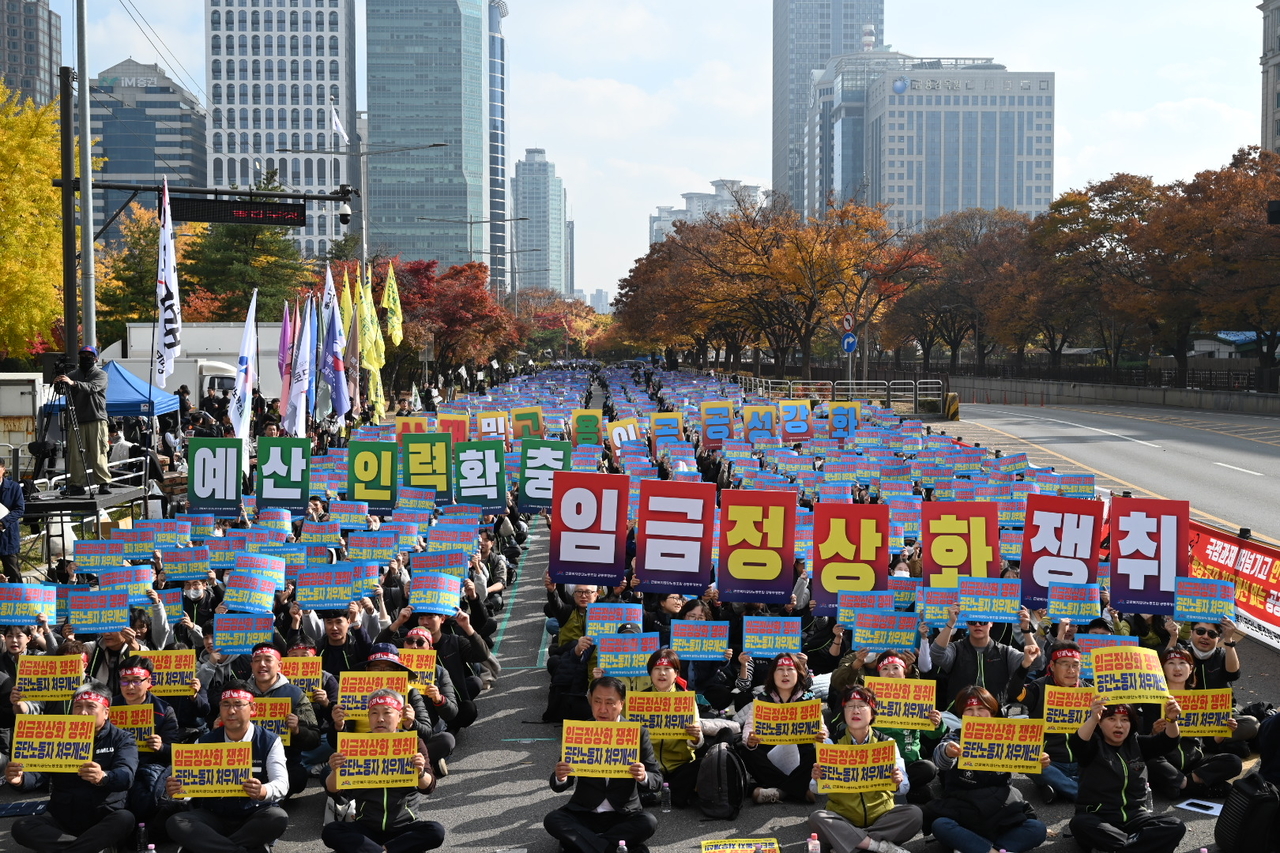
Seven unions at the Korea Workers' Compensation and Welfare Service are holding their second major rally outside the National Assembly in Yeouido, Seoul, on Tuesday — nine days before a planned general strike.
The unions plan to demand that the government include in the agency's total payroll base the labor costs for 71 positions the government approved in 2008, and that 6.43 billion won ($4.82 million) for those positions be reflected in next year's budget. The unions argue that the agency has been covering those salaries out of existing funds for 18 years, accumulating a burden of 98.5 billion won that it can no longer absorb.
According to the Korea Workers' Compensation and Welfare Service unions' joint struggle committee, Tuesday's rally will draw members from the agency's headquarters and from Busan, Gwangju, Daegu and Daejeon. The first rally, held at the same location Thursday, brought together 2,500 members from Seoul, the Gyeonggi-Incheon area and Gangwon Province. Combined attendance across both rallies is expected to reach 5,000.
Headcount grew by 71 in 2008, but payroll base stayed the same
The joint struggle committee said it will press the government and the National Assembly to correct the payroll calculation standard and secure additional field staff and operating funds while the Assembly reviews the 2027 budget.
The problem traces back to July 2008. Under amendments to the Industrial Accident Compensation Insurance Act, the agency established an occupational disease adjudication committee and an industrial accident review committee, creating a need for dedicated staff to assess occupational diseases and handle accident reviews. The government responded by approving an expansion of 71 positions at the agency.
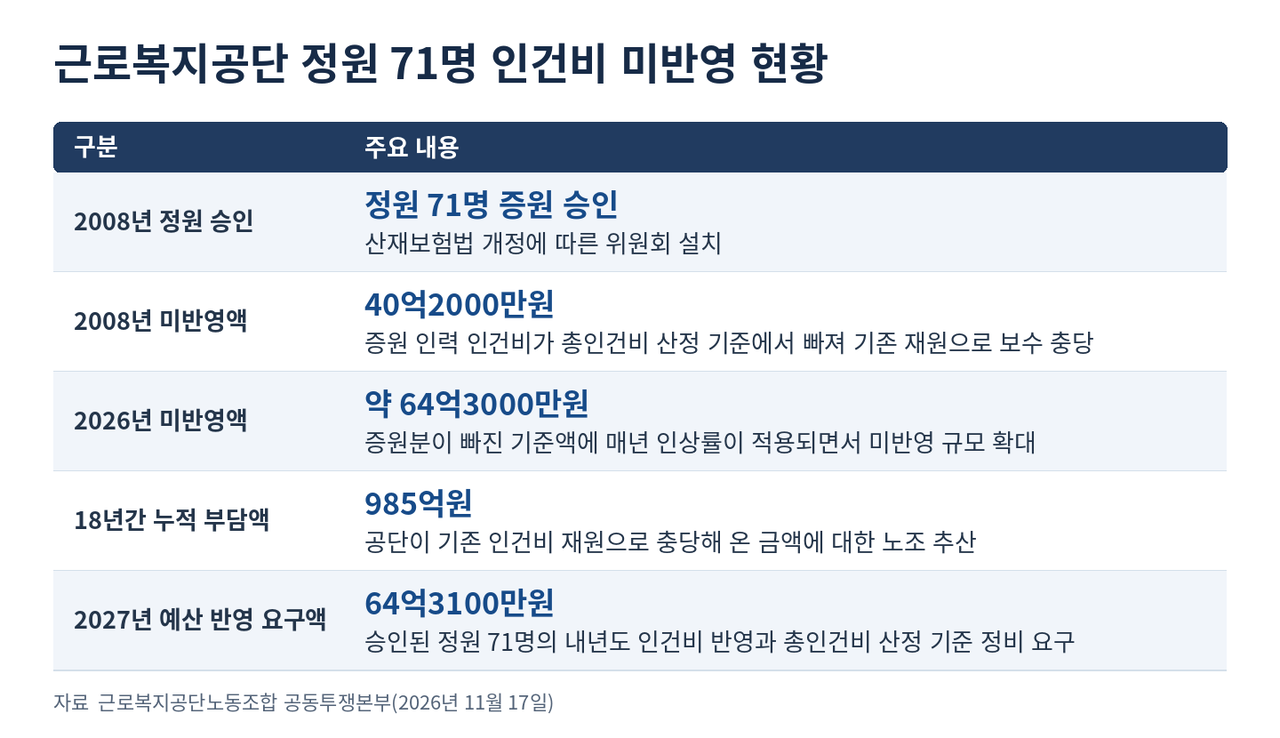
However, the 4.02 billion won in labor costs required for those new positions was never included in the base figure used to calculate the agency's total payroll. The agency has been covering their salaries out of existing payroll funds, the unions said.
The unions said the burden compounded because the amount omitted at the outset was never added back in subsequent years.
Each year, the government-set payroll increase rate was applied to a base figure that still excluded the 71 positions. The unions estimate the annual shortfall grew from 4.02 billion won in 2008 to about 6.43 billion won this year. Over the same period, the cumulative labor costs the agency covered from existing funds reached 98.5 billion won, by the unions' estimate.
The 6.43 billion won the unions are asking to be reflected in next year's budget represents the 2027 labor costs for the 71 already-approved positions. The unions also called on budget authorities to reform the system so that those positions are permanently incorporated into the agency's total payroll base going forward.
Wage gap driving staff departures; first joint strike set for Nov. 26
The joint struggle committee said the prolonged payroll shortfall has made it harder to close the wage gap with other social insurance agencies. Based on 2025 figures from Alio, the government's public institution management disclosure system, the average pay per employee at the agency — excluding physicians — is about 13.77 million won lower than at the National Pension Service.
The unions said the pay disparity is driving staff turnover, which could strain the agency's capacity to handle occupational disease adjudications and industrial accident reviews — work that requires experienced personnel.
The committee also called for additional field staff and operating funds to support the shift to an income-based employment insurance system and to ensure prompt treatment and rehabilitation for workers injured on the job. "Expanding national policy tasks without the staffing or budget to support them will increase the burden on frontline workers and cause inconvenience for the public," the committee said.
Labor and management held their first main bargaining session on June 25 and conducted 18 working-level sessions, but failed to reach an agreement at the third main session on Sept. 9. The unions filed for labor dispute mediation with the National Labor Relations Commission on Sept. 15; the commission held two mediation sessions before suspending the process on Sept. 28. A strike authorization vote held Oct. 27-28 passed with 94.93 percent in favor.
The joint struggle committee, comprising seven unions and about 9,000 members across the agency, has held a series of rallies since kicking off with a demonstration outside the Ministry of Employment and Labor on Nov. 4. On Nov. 26, about 8,000 members are set to take part in a first joint strike and a nationwide general assembly.
The Korea Workers' Compensation and Welfare Service is a public institution under the Ministry of Employment and Labor that addresses risks workers may face throughout their working lives, including job loss, workplace injury, unpaid wages and retirement.
The agency reviews whether injuries or illnesses sustained at work qualify as occupational accidents and pays insurance benefits accordingly. It also operates industrial accident hospitals and rehabilitation facilities to help injured workers recover and return to work. When an employer is unable to pay wages, the agency handles advance wage payments made by the state on the employer's behalf under certain conditions. It additionally administers retirement pension programs for workers at small and medium-sized enterprises, including the SME retirement pension fund known as "Pureun Siat" (Blue Seed).
fact0514@heraldcorp.com