Polish director Lukasz Twarkowski brings 'ROHTKO' to LG Arts Center Seoul
Production runs Friday through Sunday
Work draws on 2004 Knoedler Gallery forgery scandal
Hybrid theater layers Han Byung-chul's 'Shanzhai' over the Rothko case
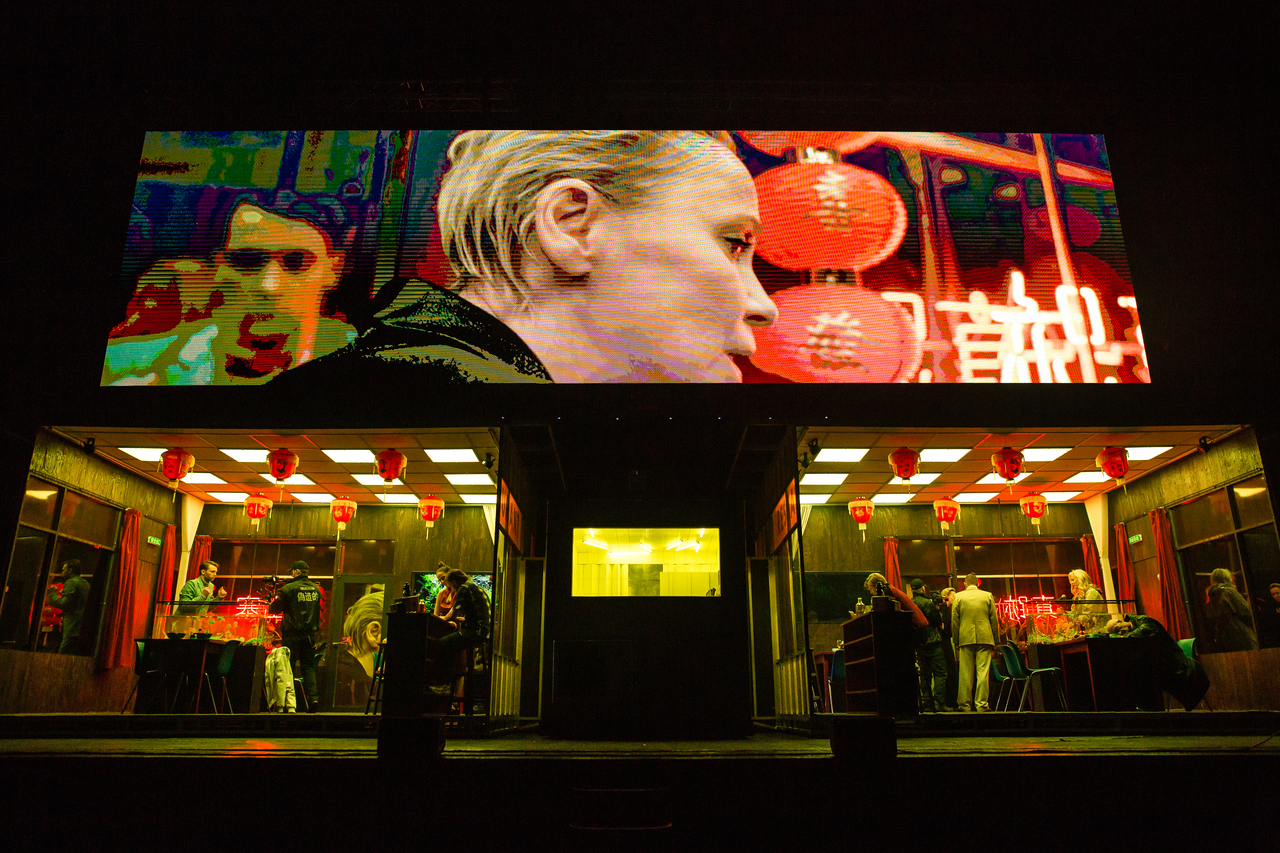
"A perfect replica that preserves every detail of the moment a painting was made, versus a faded original that has lost the effect the artist intended — which one is closer to the original?"
With that single question, Lukasz Twarkowski has turned one of art history's most notorious forgery scandals into a four-hour theatrical work.
The Polish director posed the question at a press conference for "ROHTKO" held recently at LG Arts Center Seoul in Gangseo-gu. "Rothko used pigments that don't last, and some of his paintings faded completely over time," Twarkowski said. His point: the original and the copy each carry their own truth, and the two paradigms can coexist.
The question Twarkowski raises has already played out in real life inside a museum. Five murals Rothko painted for Harvard University in 1962 lost their color through the 1960s and '70s because of an unstable red pigment called lithol red. In 2014, the Harvard Art Museums rehung the works after projecting precisely calibrated light onto them to restore their original hues — without a single brushstroke. Whether that light-applied color constitutes a copy or a restoration of the original is a question the museum has left open for research and debate.
"ROHTKO" was produced by the Dailes Theatre of Latvia and premiered in Riga in March 2022, going on to win the UBU Award for best foreign production in Italy in 2024. It is Twarkowski's second visit to Korean audiences, following "The Employees," which he brought to the Seoul International Performing Arts Festival last year. The production runs through Sunday at LG Arts Center Seoul and is performed in four languages — Latvian, English, Chinese and Polish — with a total running time of three hours and 55 minutes including an intermission.
An $8.3 million fake, and a 'shanzhai' set in a Chinese restaurant
In 2004, the Knoedler Gallery in New York sold a work titled "Untitled (1956)" attributed to Rothko for $8.3 million. The buyers were Domenico De Sole, a former CEO of Gucci, and his wife — prominent collectors. The painting was later revealed to be a forgery made by Chinese-born artist Pei-Shen Qian in the garage of a home in Queens, New York. According to the De Soles' attorney, the gallery had acquired the work for just $950,000.
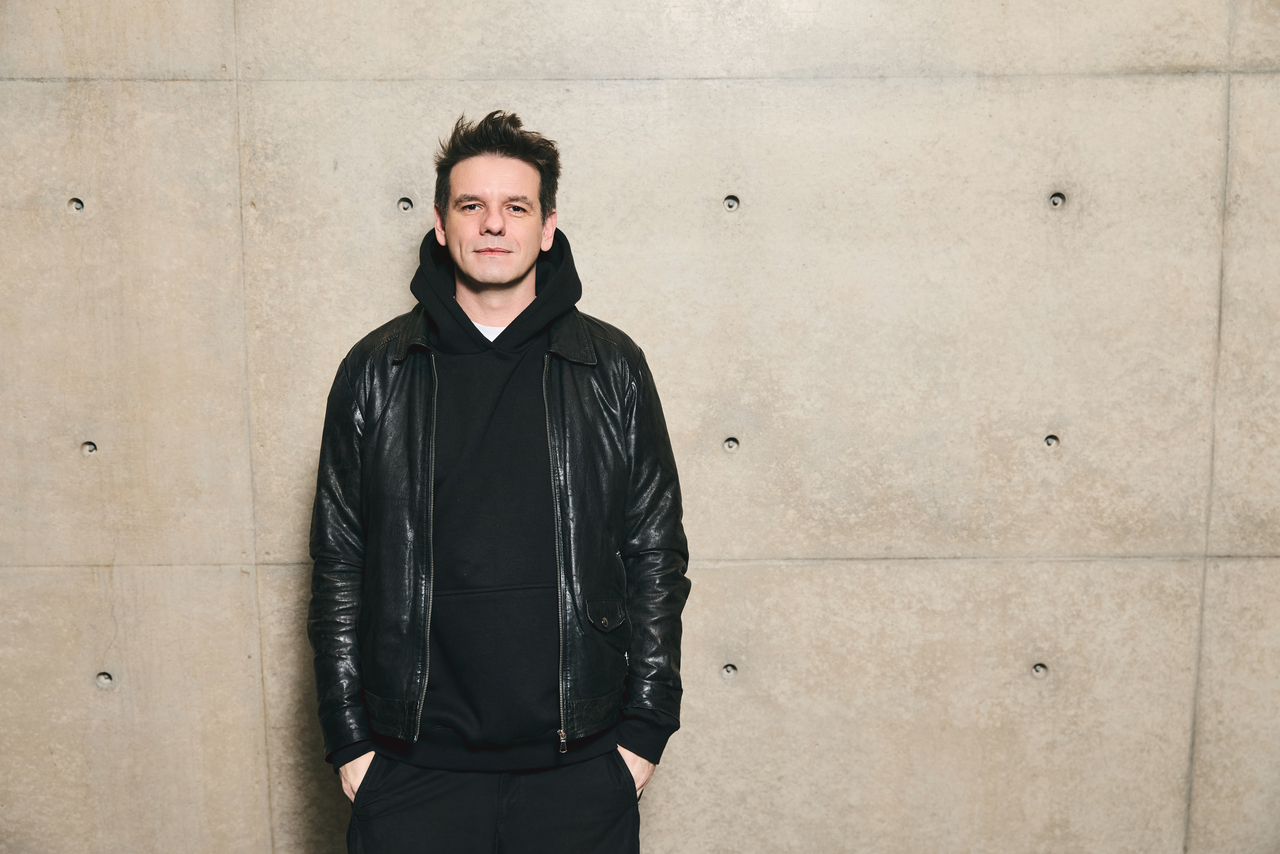
The clue that exposed the fake was a white ground layer on the canvas — one Rothko did not begin using until a decade after the painting was supposedly made. It took just one hour to identify the work as a forgery. The 165-year-old Knoedler ultimately closed in 2011, and the full scope of the fraud was found to be roughly $80 million. The lawsuit filed by the De Soles was settled during trial in 2016.
Twarkowski approached the scandal through "Shanzhai: Deconstruction in Chinese," a work by Korean-German philosopher Byung-Chul Han. The word "shanzhai" — derived from "mountain stronghold," a term for a bandit's lair — has come to denote China's culture of imitation and knockoffs. "In Han's writing I found an idea impossible in Europe: that a copy can have equal or even greater value than the original," Twarkowski said. "It may be a worldview far closer to the digital world we live in now than Europe's very old habit of placing the original at the center of everything," he added.
What brought the shanzhai perspective into the present was the NFT craze that erupted in 2021 and 2022, just as he was developing the piece. Anyone could hold an identical file, yet only the single copy bearing a certificate of authenticity was recognized and sold as the original. Twarkowski found himself thinking of Marcel Duchamp's "Fountain." Of all the urinals found in any Parisian restaurant, only the one Duchamp named and placed in a gallery commands its current value — a value Twarkowski described as "purely symbolic" and "attached to it because it is Duchamp's."
The same thinking underlies the production's choice to set the action in a Chinese restaurant rather than a museum. "The Chinese restaurant is connected to the protagonist, a Chinese immigrant," Twarkowski said, adding that the space evokes Mr. Chow, the historic New York restaurant where avant-garde artists such as Jean-Michel Basquiat and Andy Warhol once gathered. A Chinese restaurant, he noted, carries a symbolic charge: with their near-identical menus, décor and red lanterns, such spaces are themselves endlessly replicated wherever they appear. Within that setting, the play weaves together several storylines — the conflict over Rothko and his wife's mural commission, a gallery owner and a collector trading blame after the forgery is exposed, actors auditioning for a film about Rothko, and an artist trying to collect the tears shed in front of a Rothko painting.
Even the title is a deliberate distortion. The painter's name is ROTHKO, but the production is called ROHTKO — the T and H transposed. As long as the first and last letters are in place, the brain reads the word correctly. Audiences have already read the fake as "Rothko" before they even enter the theater.
The director who fired his AI collaborator, 'Daisy'
The line between original and copy has grown even more precarious in the age of generative AI. In "Oracle," which premiered last year, Twarkowski brought AI in as a creative partner — a work dealing with Alan Turing and the early computing efforts at Bletchley Park during World War II. An AI agent named Daisy joined the production as a co-creator in the rehearsal room.
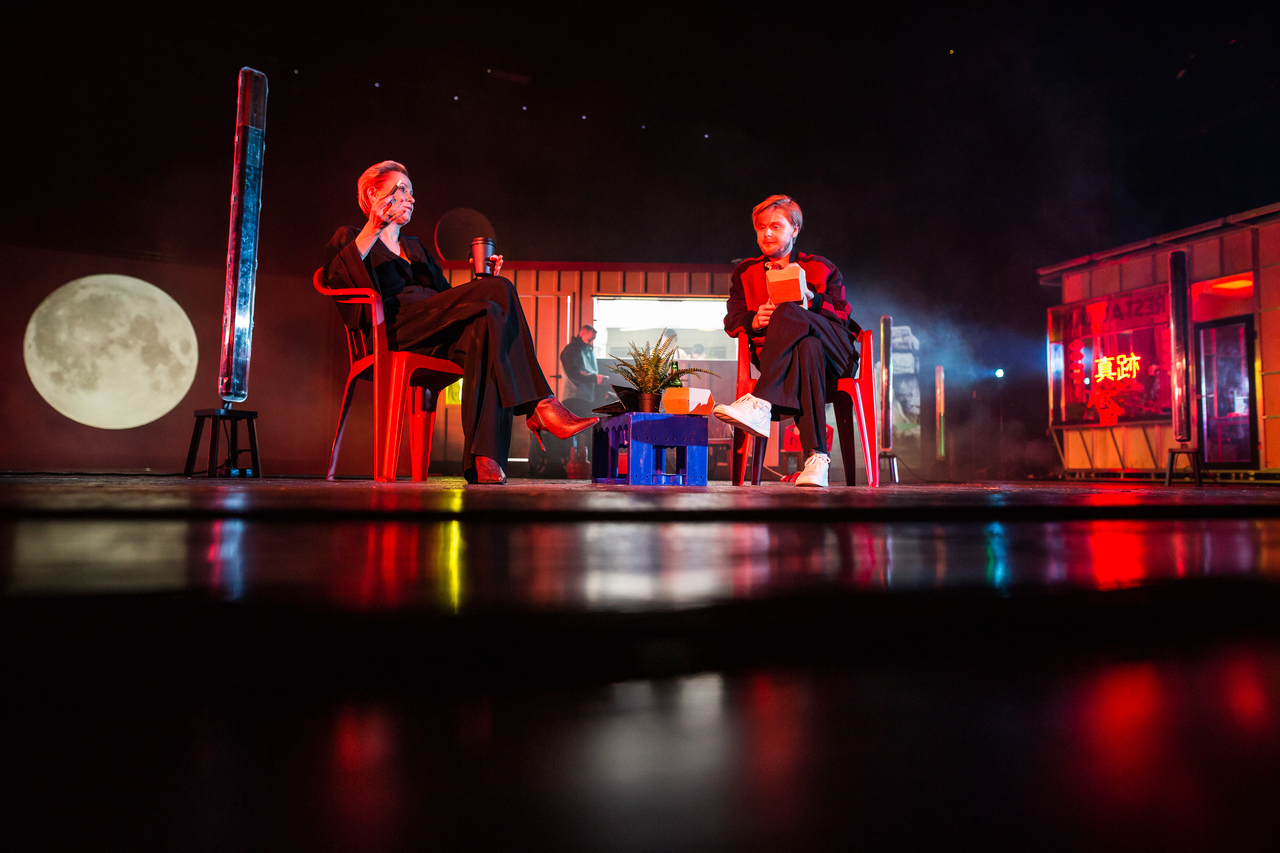
The creative team gave Daisy responsibility for directing scenes and committed to physically realizing every idea it proposed, no matter how absurd. "It was quite fun, but there were no great artistic results," Twarkowski said with a laugh. "We ultimately fired Daisy from the production." On the question of AI and copyright, he drew a line: "I have no ready answer."
On the broader questions of AI, copyright and creative authorship, he said the issues were "too complex for a prepared answer." He did allow, however, that AI, used appropriately, could be an excellent tool and a working partner.
What concerns him more is the unchecked spread of AI-generated misinformation. "We are not in control of the way AI hallucinates with its own data," Twarkowski said. "In Europe, portals mass-producing AI content for advertising revenue are multiplying rapidly. It may soon become difficult to find a trustworthy source of information at all," he warned.
Even so, his view is that human life has always been built on things with no physical substance. "Money, religion and traditional art do not physically exist, yet for centuries they have governed human behavior and at times driven people to kill one another," he said. "Long before the internet was invented, we were already living inside a kind of symbolic virtual system."
The camera's 'false promise' — 'Humans are expensive, but beautiful'
Twarkowski began his career as assistant director and video artist under Polish theater master Krystian Lupa before making his directing debut in 2011. Having crossed over from the visual arts, he resists the hegemony of text on the theatrical stage. "Literature should be left to literature," he said. "To be faithful to a writer, you sometimes have to betray the text."
In "ROHTKO," three modular set pieces move to become a restaurant, a gallery and a club. Cameras push into corners of the set invisible from the audience, and actors' faces appear on large screens in real time. The audience watches the entire filming process unfold. "Because you can see everything being made, there is no magic — and yet, conditioned by screens, we end up believing what we see on the screen is more real than the live action happening right in front of us," Twarkowski explained. The moment an audience trusts the copy on screen over the original before their eyes, the work's theme becomes their own lived experience.
What Twarkowski focuses on is what lies outside the frame. On stage, it is clear exactly where the set ends and the backstage begins. The moment a camera imposes its frame on the image, everything outside that frame becomes unknown territory. Twarkowski calls this "a kind of false promise that this world is infinite." Where film records a single moment in time and movement, on stage the time captured on screen and the time passing before the audience's eyes exist simultaneously.
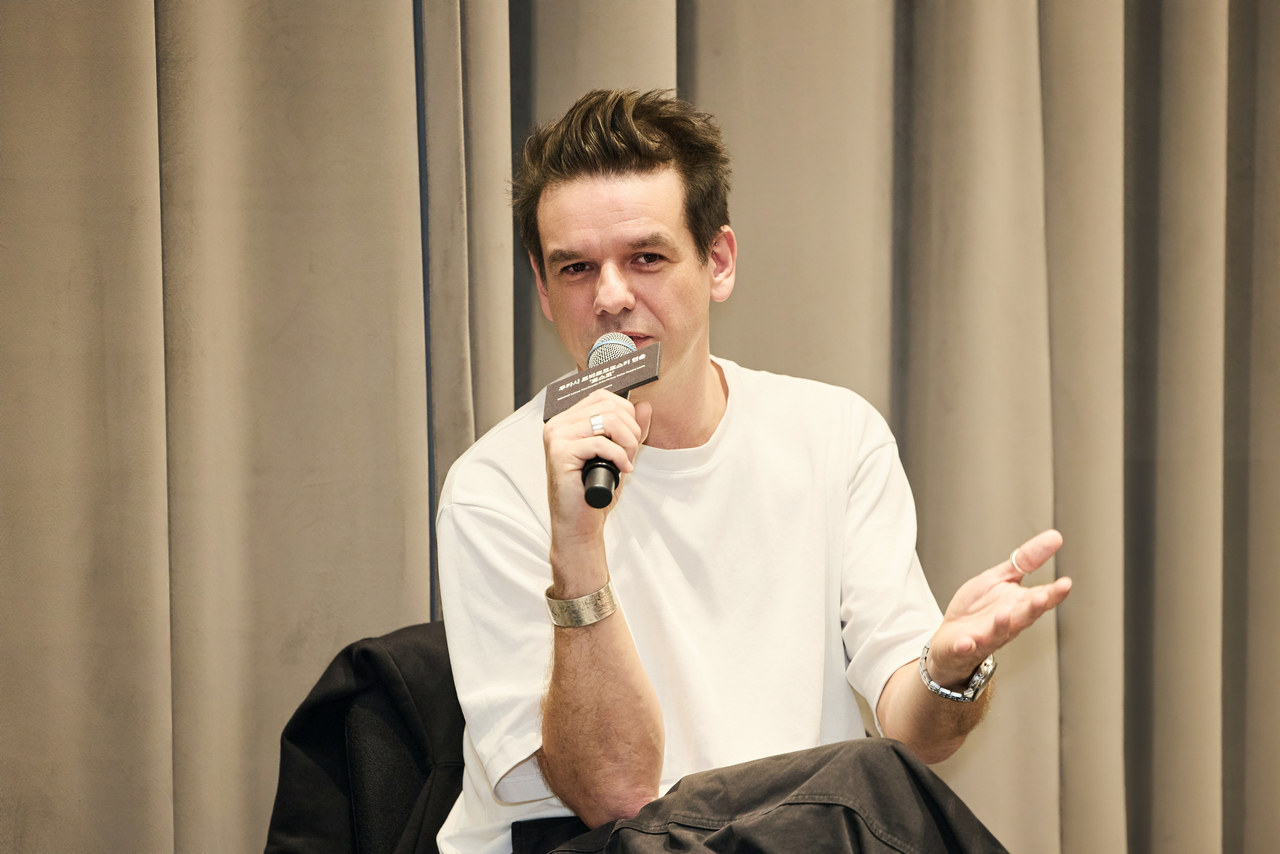
Twarkowski is regarded as a leader in video theater, yet he does not embrace technology unconditionally. "If you can do it without video or technology, do it without — that is far better," he said. At the same time, he argued that in an era where digital and physical reality can no longer be separated, turning away from technology means failing to capture the full complexity of the human condition today.
The nearly four-hour running time was not planned from the outset. "I have never deliberately made something long," Twarkowski said, noting that "ROHTKO" began as a small experimental project. New scenes and storylines kept growing through the making of it, and no matter how much he cut, the work would not come down below a certain length. "Time itself is the main tool and the main mystery of our research," he said.
In his experience, the performances that fell short were usually the shorter ones. On nights when the actors' rhythms quickened and the running time shrank by five or ten minutes, what happened on stage felt reproduced rather than truly occurring. "The magic of theater lies in the moment something actually happens on stage, with no one knowing how it will turn out," Twarkowski said. To bring an audience into a state that resembles dreaming, the senses need time to absorb — and that time cannot be rushed.
His outlook is that as technology advances, the live presence of performing arts will only become more precious. At the same time, he voiced concern that the experience of direct human contact could one day become a luxury. "It is becoming far easier to make things without the human element. We need to look seriously at this danger and protect living art. Humans are expensive, but beautiful."
shee@heraldcorp.com