Ministers meet in Beijing for first time in 3 months
Next week's Shenzhen APEC summit to set stage for leaders' talks
Cho urges stronger communication on peninsula affairs
Wang marks 35th anniversary of ties, calls for expanded cooperation
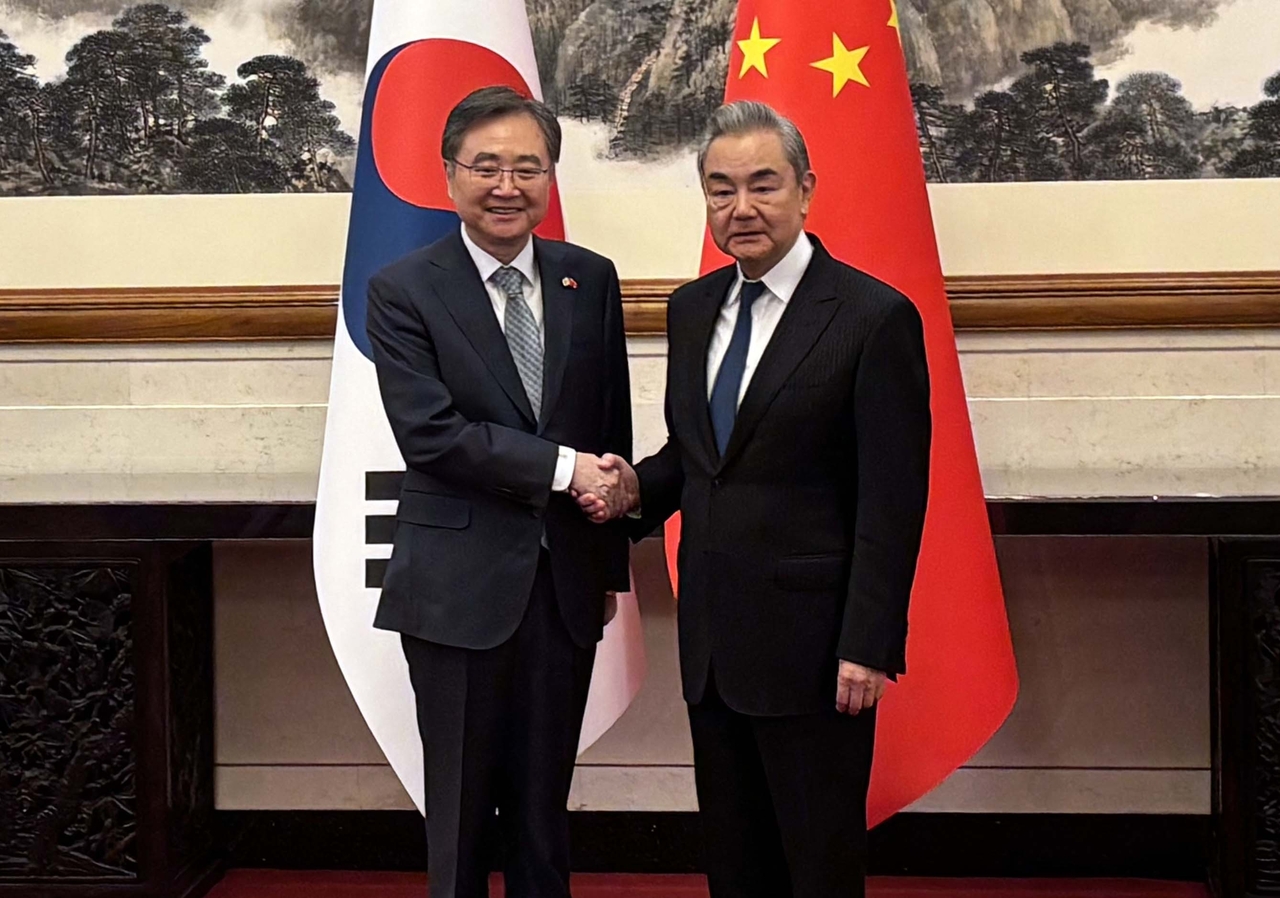
South Korea and China's top diplomats met for the first time in three months Friday, reaffirming their commitment to cooperation on Korean Peninsula peace and the development of bilateral ties. The two sides agreed to strengthen communication on key issues, including the situation on the peninsula, as they prepare for a leaders' meeting on the sidelines of next week's Asia-Pacific Economic Cooperation summit in Shenzhen, China.
Foreign Minister Cho Hyun and Wang Yi, director of the Office of the Central Foreign Affairs Commission of the Chinese Communist Party and Chinese foreign minister, held talks at the Diaoyutai State Guesthouse in Beijing on Friday afternoon.
The meeting came roughly three months after Wang visited Seoul in August. Cho traveled to China for a two-day visit Friday and Saturday at Wang's invitation.
In his opening remarks, Cho underscored China's role in maintaining peace and stability on the Korean Peninsula.
"The Korean Peninsula issue is a matter of vital interest to the Republic of Korea, and peace and stability on the peninsula are a shared interest of both countries," Cho said. "I hope we will continue to strengthen strategic communication between our two countries to advance the situation on the Korean Peninsula."
Cho also said the momentum of improving relations must be sustained on the basis of trust between the two countries' leaders.
"I expect that when the two leaders meet again in Shenzhen next week for the first time in 10 months, it will serve as an important opportunity to further develop the Korea-China strategic cooperative partnership," Cho said. "I hope the story of friendship and trust between the two leaders — which began in Gyeongju and continued through Beijing — will carry on to Shenzhen, deepening the Korea-China relationship further."
The remarks were seen as an effort to build on the improving trajectory in bilateral ties — marked by Chinese President Xi Jinping's visit to South Korea last November and President Lee Jae Myung's visit to China in January — and carry that momentum into next week's summit.
Cho said tangible results have emerged in economic and people-to-people exchanges since the two leaders' reciprocal state visits.
Cho said people-to-people exchanges between the two countries are expected to surpass 10 million this year, and that bilateral trade has grown by more than 40 percent.
"This is the result of close communication and joint efforts by both governments to fulfill the shared understanding between our leaders on fully restoring bilateral relations," Cho said.
China, too, assessed that the relationship has entered a phase of recovery and expressed expectations for expanded high-level exchanges.
"The successful reciprocal visits by President Xi Jinping and President Lee Jae Myung at the end of last year and the beginning of this year have brought China-Korea relations back onto the normal track of improvement and development," Wang said.
Wang added that "it is very necessary to prepare for the next stage of high-level contacts," and said the two sides should take next year's 35th anniversary of diplomatic ties as an opportunity to advance the relationship to a new level.
Wang also offered a positive economic outlook, expressing confidence that bilateral trade would hit a record high this year and that annual people-to-people exchanges would recover to around 10 million.
Wang particularly highlighted the significance of South Korea and China hosting consecutive APEC summits — South Korea last year and China this year.
Wang said South Korea had successfully hosted last year's APEC summit in Gyeongju and had actively cooperated in China's preparations for this year's meeting. "Since China and South Korea are hosting APEC meetings in succession, we should join hands to jointly promote the building of an Asia-Pacific community and foster common development and prosperity in the region," Wang said.
The talks also covered preparations for the bilateral leaders' meeting on the sidelines of next week's Shenzhen APEC summit, as well as the situation on the Korean Peninsula and other pending bilateral issues.
North Korea's external activities and the prospect of resumed North Korea-US dialogue were among the key points of attention. With recent high-level contacts between North Korea and China continuing, Seoul is seeking to work with Beijing on ways to manage the peninsula situation in a stable manner.
However, before departing for China, Cho told reporters that he did not see a high likelihood of North Korea engaging in a leaders' meeting with the United States on the sidelines of APEC.
Asked about China's willingness to mediate North Korea-US dialogue, Cho said: "There is some, but how much? Whether China will actively invite North Korea to this APEC for that purpose — I don't think that's very likely, though it's still hard to say for certain."
Sensitive bilateral issues also drew attention. These include Chinese-built structures in the West Sea and the informal ban on Korean cultural content in China, commonly referred to as the "hallyu ban."
South Korea's Ministry of Foreign Affairs said ahead of the talks that it has been consistently raising the West Sea structures issue with the Chinese side, and indicated that the hallyu ban could also be addressed in the context of cultural exchange.
Earlier, Cho held a separate meeting with US Secretary of State Marco Rubio on the sidelines of the G7 foreign ministers' meeting in France on Tuesday, where they discussed North Korea and ways to advance the South Korea-US relationship.
kwater@heraldcorp.com