For-sale listings in the three Gangnam districts hit nearly 30,000 — double a year ago
For-sale supply doubles while jeonse supply stays tight
Eunma and other reconstruction projects set to drive relocation demand next year
The 84-square-meter unit at Jamsil Elce Apartment in Songpa-gu, Seoul — the most common floor plan — hit a record sale price of 3.7 billion won ($2.78 million) on a high floor earlier this year, but distressed listings have recently appeared with asking prices below 3 billion won. The jeonse market tells a different story. Jeonse at the same complex set a new high of 1.6 billion won last month, and even discounted jeonse listings are now asking around 1.3 billion won — well above the 1.1 billion won range seen at the start of the year.
Amid a near-freeze in transactions, apartments across the three Gangnam districts — Gangnam-gu, Seocho-gu and Songpa-gu — are under mounting price pressure on the sale side, while jeonse supply is shrinking, producing a split where home prices fall but rental deposits keep rising. As the wave of move-ins at newly built complexes winds down and reconstruction-related relocations in the Gangnam area begin simultaneously, analysts expect the divergence to persist into next year.
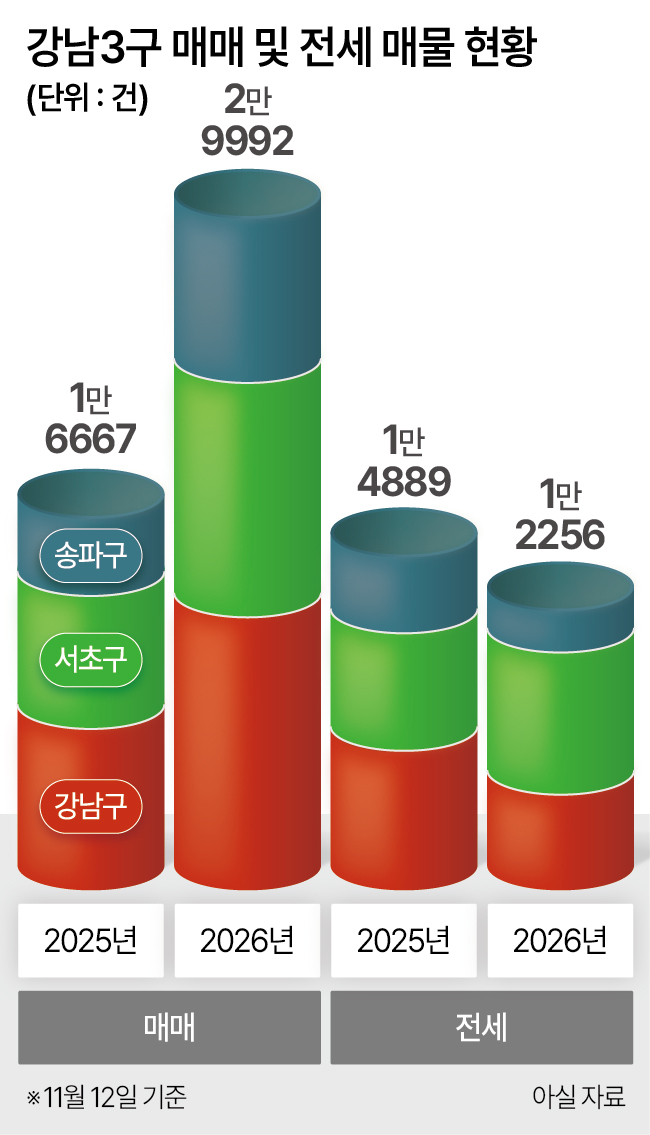
For-sale and jeonse listing counts in the three Gangnam districts are moving in opposite directions. According to real estate data platform Asil, as of Thursday for-sale listings in the three districts stood at 29,992 — nearly double the 16,667 recorded a year earlier. Jeonse listings, by contrast, fell to 12,256 from 14,889 a year ago, a drop of 2,633 units.
Songpa-gu saw the steepest increase in for-sale listings, with the count rising from 3,517 to 7,262 — a 107 percent jump — while jeonse listings plunged by half, from 3,403 to 1,664. The decline is largely attributed to the near-exhaustion of jeonse supply at the newly built Jamsil Raemian I'Park and Jamsil Le'El complexes.
In Gangnam-gu, for-sale listings climbed 71.4 percent over the same period, from 7,121 to 12,205, while jeonse listings fell 31 percent. Seocho-gu was the only district where both categories rose — jeonse listings increased 21 percent, from 5,144 to 6,230, and for-sale listings rose 75 percent, from 6,029 to 10,525 — reflecting move-in activity this year at new complexes including DiH Bangbae and Banpo Raemian Triinone.
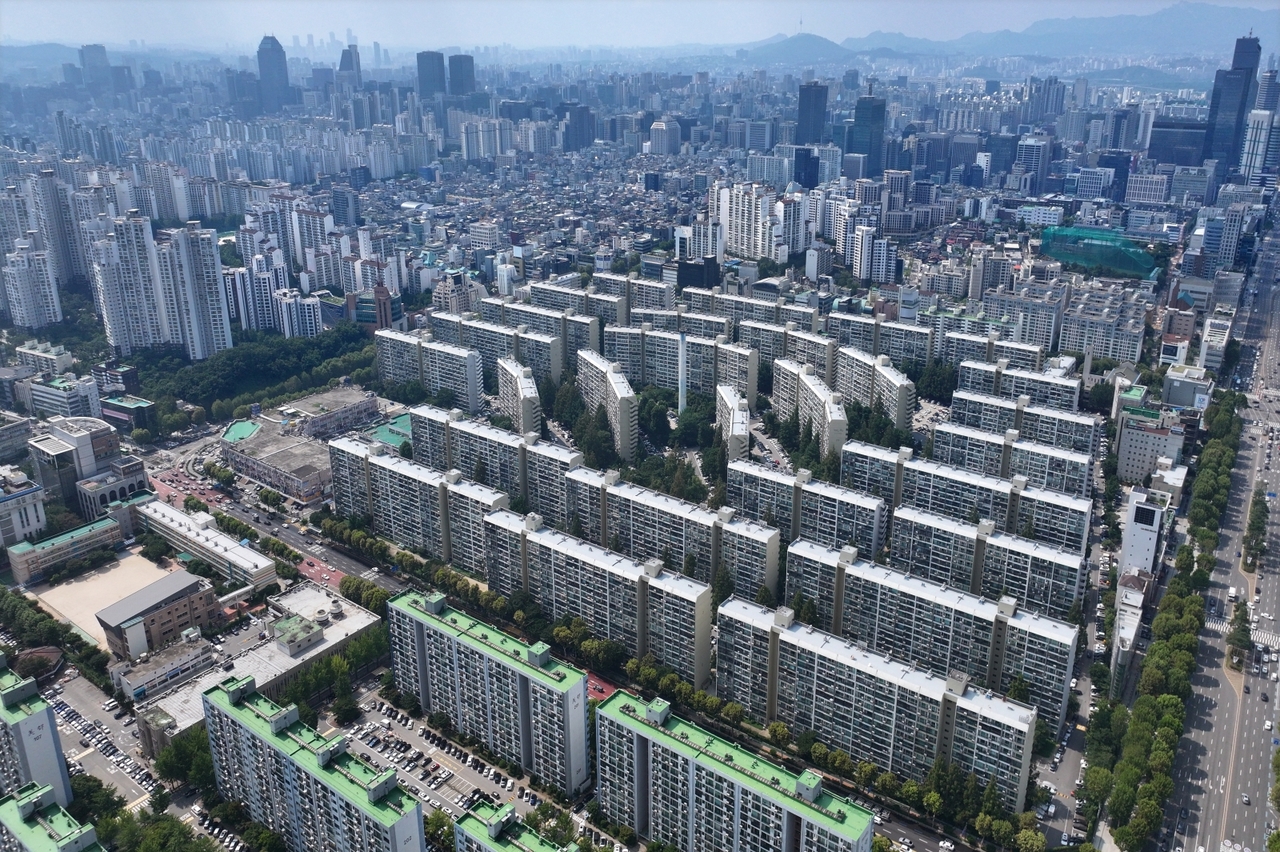
In high-end residential areas, older homeowners in particular are moving to sell as tax burdens rise following revisions to the property tax code, while buyer demand has failed to keep pace amid heavier loan costs from higher interest rates, leaving listings to pile up. According to the Seoul Metropolitan Government, apartment land-transaction permit approvals in the three Gangnam districts and Yongsan-gu reached 639 in October, up 20.6 percent from the previous month — but still less than 40 percent of the April peak of 1,615 approvals, the highest monthly figure this year.
Sale prices and jeonse rents are also moving in entirely different directions. The Korea Real Estate Board's weekly sale price index for the second week of November (as of Monday) showed continued declines in all three districts: Gangnam-gu moved from -0.39 percent to -0.25 percent, Seocho-gu from -0.37 percent to -0.26 percent, and Songpa-gu from -0.17 percent to -0.35 percent.
The jeonse price index, meanwhile, pointed the other way. Gangnam-gu's rate of increase widened to 0.27 percent from 0.07 percent the previous week. Seocho-gu turned positive at 0.04 percent — its first gain since the first week of August — as new-build move-in supply was largely absorbed. Songpa-gu also flipped from a decline of 0.05 percent the prior week to a gain of 0.03 percent.
Nam Hyeok-woo, a real estate researcher at Woori Bank, said the shift in the jeonse price index reflects a base effect as the downward pressure that had weighed on jeonse rents — driven by move-in supply from major new complexes in the Seocho area — has now largely dissipated. Nam added that jeonse prices have entered a range that many tenants find difficult to afford, particularly during the traditional off-season ahead of the college entrance exam, and that some complexes could see short-term pullbacks depending on conditions.
Industry watchers expect the jeonse market across the three Gangnam districts to face another bout of turbulence around the peak spring moving season in the first half of next year.
Kim Hak-ryeol, director of Smart Tube, said upward pressure on jeonse prices could intensify further once the current wave of move-ins is fully absorbed. Kim added that with DiH Banpo 124 set to open for move-ins at the end of next year and relocation demand from Eunma Apartment and Gaepo Jugong complexes 6 and 7 building in the first half, a notable shift toward monthly rent arrangements — including the conversion of partial-deposit jeonse contracts — is also likely to become more pronounced.
hope@heraldcorp.com