Semiconductors account for nearly 50% of exports; analysts urge caution as US data center regulations remain uncertain
Weak stock market could further squeeze private consumption; revised economic forecasts awaited
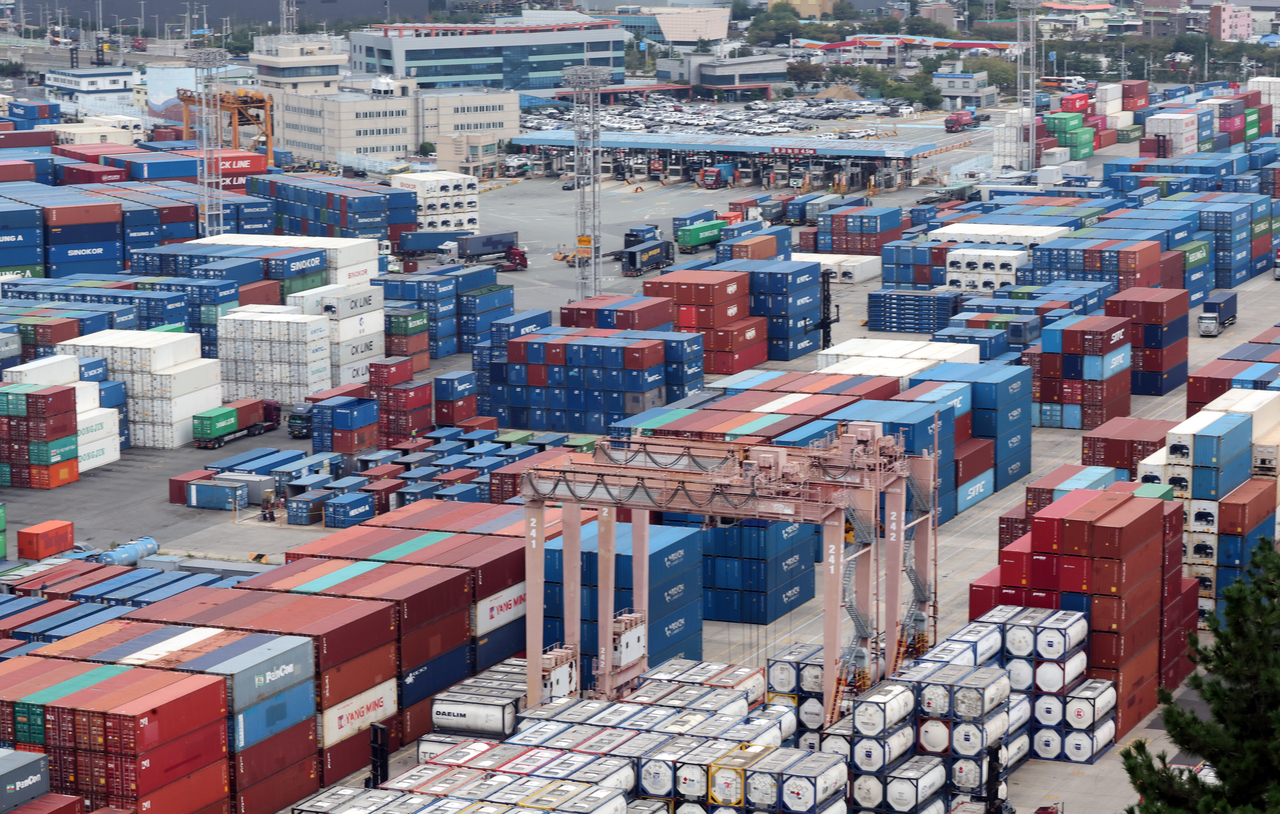
Concerns that the Democratic Party's sweeping victory in US midterm elections could tighten regulations on AI data center construction are raising fears of a blow to South Korea's semiconductor exports and prices — potentially the biggest variable shaping the country's growth trajectory next year.
According to the government, the Bank of Korea estimates that semiconductors accounted for roughly half of South Korea's economic growth this year, and the sector made up 49.0 percent of total exports in October.
Industrial activity data show that production excluding semiconductors — on an original-index basis — grew just 1.0 percent on average from January through September compared with the same period last year, far below the 2.7 percent growth rate recorded across all industries.
"If policy agendas aimed at halting data center construction begin to be decided in Congress, the pace of data center development will slow, and South Korea's semiconductor exports will contract," said Kim Gwang-seok, head of economic research at the Korea Economic and Industrial Research Institute. "That would reduce total demand for semiconductors and push prices down."
Kim added, however, that the immediate impact may be limited because Samsung Electronics and SK hynix have recently been signing long-term supply agreements.
Some analysts urge caution, noting that the regulations have yet to materialize. "If you look at what is actually driving the fear in the markets right now, there is no substance to it," said Yang Jun-seok, a professor of economics at Catholic University of Korea. "I don't think regulations severe enough to stifle the AI boom will be introduced. The Democratic Party entered Congress in large numbers to oppose President Donald Trump, so it needs to maintain a better growth rate than Trump."
Kim Mi-ru, head of the economic outlook division at the Korea Development Institute, said data centers already under construction and set to be completed next year would be difficult to touch. "The real problem is the year after next," Kim said.
Private consumption has already retreated. South Korea's economy expanded 1.0 percent in the third quarter from the previous quarter, driven by semiconductor exports and rising facility investment, but private consumption fell 0.2 percent as both goods and services spending declined.
If the current sharp drop in share prices continues, it could erode household asset values and further curb spending capacity.
The lagged effect of two benchmark interest rate hikes in July and August is also beginning to weigh on household disposable income through higher debt-servicing costs.
"Oil prices are still elevated, which is a burden on consumption. The interest rate hikes and stock market correction will also have an effect," Kim Mi-ru said. "That said, semiconductor performance bonuses, when paid out, should have some positive impact."
The issue has emerged as a new variable in forecasts for next year's growth rate. Major institutions' projections for South Korea's growth next year range from 2.2 percent to as high as 2.9 percent.
The Bank of Korea put next year's growth forecast at 2.9 percent in its August economic outlook, while KDI projected 2.2 percent in its own August forecast.
The Ministry of Economy and Finance projected 2.2 percent in its July economic growth strategy. The IMF forecast 2.8 percent in a relatively recent projection last month, and the OECD announced 2.6 percent in September.
The forecasts are expected to shift depending on how far the regulations actually materialize and translate into real economic shocks. Each institution is also expected to carefully examine the potential impact under various scenarios before releasing updated projections.
KDI is set to release its second-half economic outlook on Nov. 18, and the Bank of Korea will publish its revised economic forecast this month. The government plans to incorporate updated projections into its year-end economic growth strategy.
In Texas, the Democratic candidate who won the gubernatorial race announced plans to halt data center development until legislation protecting residents is in place.
"Judging from the Texas governor's remarks and other signals, the economic impact will depend on how far actual data center regulations are realized," Kim Mi-ru said. "How long the semiconductor cycle continues is also a key factor."
oskymoon@heraldcorp.com