KOTRA hosts export consultation event tied to World Hydrogen Expo
Over 20 buyers from Japan, Australia, India and China visit Korea
Talks cover fuel cells, electrolyzers and storage equipment
Global low-carbon hydrogen investment rose 70% last year to $6.6 billion
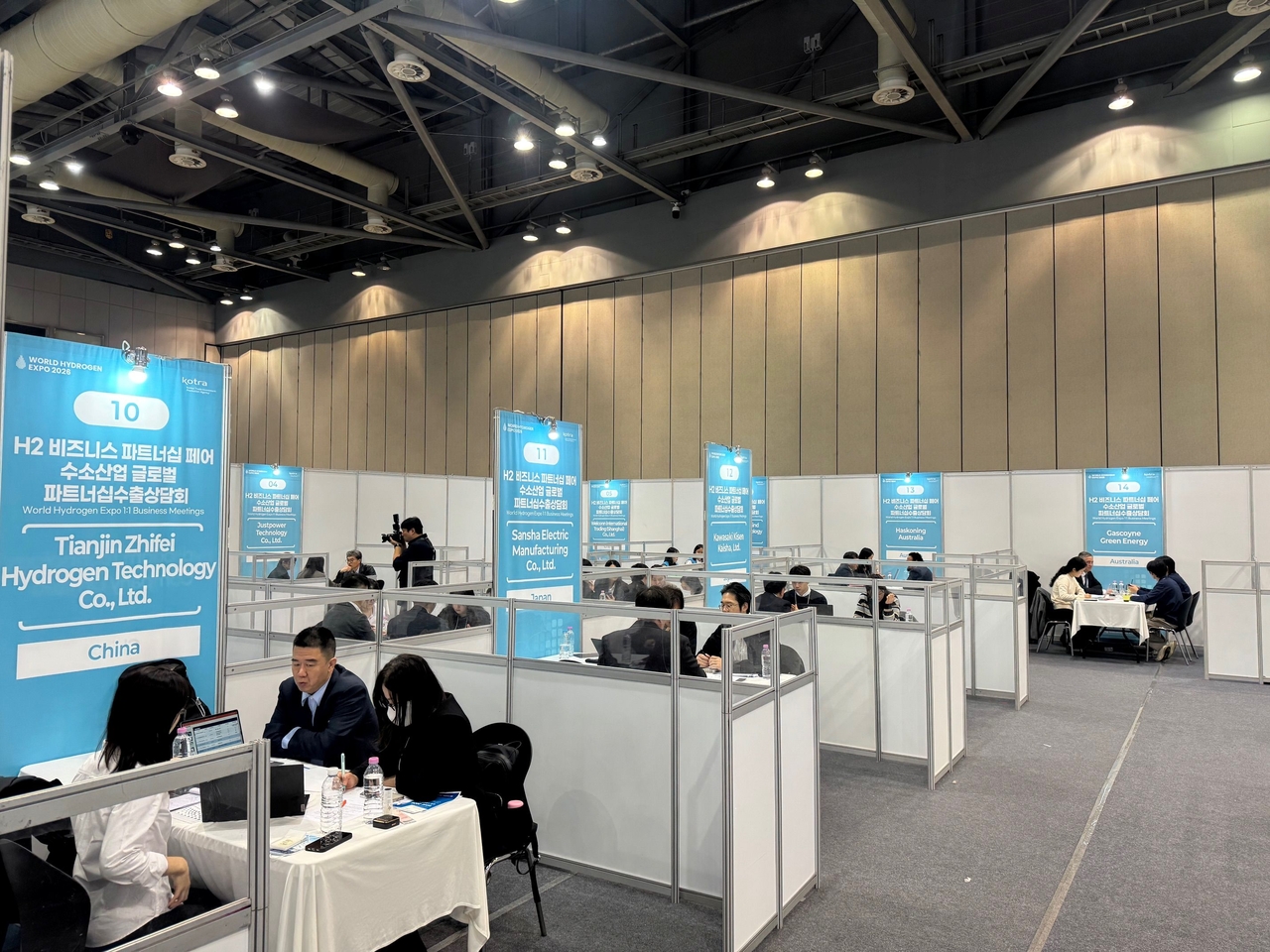
Talks are underway to apply South Korean hydrogen fuel cell technology to Japanese ships and Indian buses, and to supply Korean-made electrolyzer equipment to large-scale clean hydrogen production facilities in Australia. As the global hydrogen market expands, major overseas companies traveled to Korea to explore more than 100 potential partnerships with some 50 domestic hydrogen specialists.
The Korea Trade-Investment Promotion Agency (KOTRA) announced Friday that it co-hosted the H2 Business Partnership Fair at KINTEX in Goyang, Gyeonggi Province, from Wednesday to Thursday, together with the Korea Automobile Manufacturers Association and the Korea Hydrogen Alliance.
The event was organized alongside the World Hydrogen Expo (WHE 2026), held Wednesday through Friday, to help South Korean hydrogen companies secure overseas markets and forge technology partnerships.
Procurement and project managers from more than 20 companies across four countries — Japan, Australia, India and China — traveled to Korea for the fair. They held about 100 one-on-one consultations with roughly 50 small and mid-sized domestic companies active in hydrogen production, storage, transportation and fuel cell mobility.
The overseas buyers showed interest across a broad range of areas, from hydrogen production equipment and transport and storage hardware to fuel cells for ships and commercial vehicles.
Japanese shipping company K held talks with Korean firms on the feasibility of introducing hydrogen fuel cell systems for vessels. Indian commercial vehicle maker J also reviewed hydrogen fuel cell systems for use in buses.
A hydrogen fuel cell generates electricity through a chemical reaction between hydrogen and oxygen. Unlike battery electric vehicles that require charging, fuel cell vehicles and ships run on electricity produced from a continuous supply of hydrogen.
Australian companies pursuing large-scale clean hydrogen production projects also expressed interest in Korean-made equipment.
Local engineering firm H and renewable energy developer G joined the consultations to find suppliers of electrolyzer systems and hydrogen storage vessels for their green hydrogen production facilities.
Electrolysis splits water into hydrogen and oxygen by passing an electric current through it. When powered by solar or wind energy, the process can produce hydrogen while significantly reducing reliance on fossil fuels.
A representative of Australian engineering firm H said the large hydrogen production plant the company is developing uses electricity generated from sunlight and wind to split water. "What particularly impressed us was the production equipment technology of Korean companies, which can stably produce hydrogen without interruption even when electricity supply fluctuates due to weather changes," the representative said.
The surge in global hydrogen investment provided the backdrop for the fair.
According to the International Energy Agency's "Global Hydrogen Review 2026," global investment in low-carbon hydrogen projects last year reached approximately $6.6 billion, up more than 70 percent from $3.8 billion the previous year.
Low-carbon hydrogen refers to hydrogen produced with significantly reduced greenhouse gas emissions — typically through electrolysis powered by renewable energy, or through fossil fuel-based production combined with carbon capture and storage.
The buildout of hydrogen production infrastructure is also accelerating. The cumulative installed capacity of electrolyzers worldwide surpassed 4 GW by the end of last year, roughly double the figure from the year before, with China leading the expansion of new capacity.
However, the rise in investment does not yet signal full-scale commercialization of the hydrogen market.
The IEA said global low-carbon hydrogen production grew to about 1 million tons last year, but still accounted for less than 1 percent of total hydrogen output.
High production costs relative to conventional fossil fuel-based hydrogen, a limited pool of industrial buyers willing to commit to purchases, and insufficient transport and storage infrastructure remain the main obstacles to broader market growth.
The IEA said that due to investment decision delays and project cancellations, the projected production capacity of low-carbon hydrogen projects targeting operation by 2030 has fallen below earlier forecasts.
This has raised the importance of international cooperation that connects not only equipment suppliers but also shipbuilders, commercial vehicle manufacturers, and logistics and energy companies that will actually use hydrogen.
South Korean companies are also broadening their business scope across the hydrogen value chain, from production to end use.
Hyundai Motor Group showcased its hydrogen business brand HTWO at WHE 2026, presenting megawatt-class electrolyzer technology and a waste-to-hydrogen production method. The group also unveiled a fuel cell system for hydrogen commercial vehicles and demonstrated an automatic hydrogen charging robot for fuel cell cars.
As development continues on technologies applicable not only to hydrogen production but also to actual transportation, opportunities to supply related components and equipment overseas are expected to grow.
Meanwhile, this year's World Hydrogen Expo drew 197 companies from 12 countries. The event featured exhibitions on hydrogen production, storage, transport and utilization technologies, alongside international conferences and business cooperation programs.
KOTRA said it plans to support follow-up discussions to help South Korean hydrogen companies participate in overseas projects stemming from the consultations. The agency noted, however, that the talks held at the fair were at the stage of exploring potential purchases and technology partnerships, with actual contract terms and supply volumes still to be determined.
Kim Myung-hee, KOTRA executive vice president and head of the Industrial Innovation and Growth Division, said hydrogen is a future energy source that, alongside electrification and renewable energy, will lead the green transition amid the energy supply chain crisis. "As this is a field that requires international cooperation from production to end use, we will actively support companies in the K-hydrogen ecosystem in expanding their opportunities to enter overseas markets," Kim said.
kwater@heraldcorp.com