Annual vehicle shipments to grow from 3.4 million to 5 million units
Proactive investment in 30 car carriers begins to pay off
10 ultra-large vessels to be deployed next year, expanding capacity
Fixed fleet to reach 82 ships by 2030, sharpening cost competitiveness
Next-generation multi-cargo carriers in development beyond autos
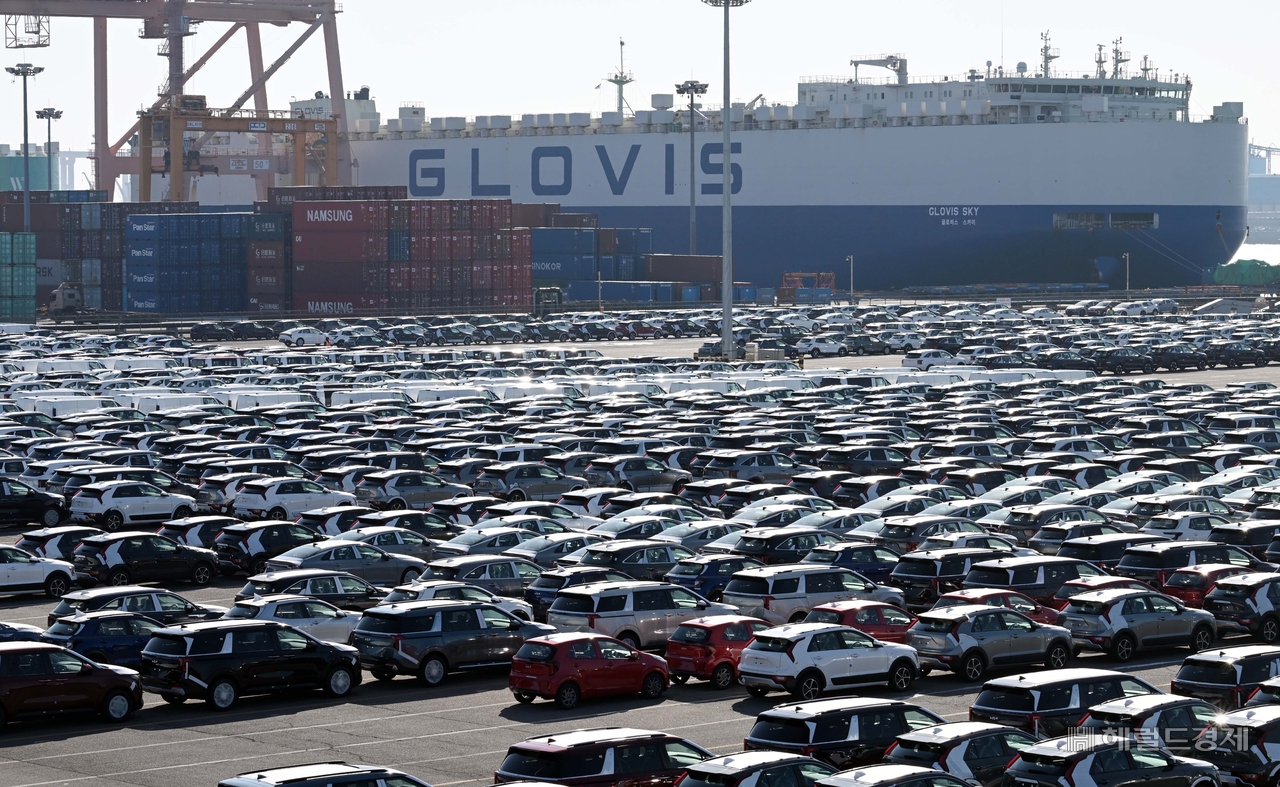
Hyundai Glovis is fleshing out an action plan to become a global shipping carrier responsible for 20 percent of all finished-vehicle maritime shipments worldwide by 2030. The company aims to grow its annual vehicle transport volume from about 3.4 million units to 5 million, deploying ultra-large pure car and truck carriers, known as PCTCs, to capture a dominant position in the global maritime auto-shipping market.
Kim Jeong-seok, executive vice president and head of Hyundai Glovis's maritime business division, told reporters at a press briefing held Wednesday at the Marriott Hotel Nansha in Guangzhou, China, that the company plans to expand its fleet to 128 vessels by 2030, with roughly two-thirds secured as fixed capacity through owned ships and long-term charters. "The pace of fleet expansion is also expected to be significantly faster than our previous medium- to long-term plan," Kim said.
Hyundai Glovis plans to grow its car-carrier operating capacity in stages — from 106 vessels in the third quarter of this year to 110 in 2027, 118 in 2028, 123 in 2029 and 128 by 2030. The figures are based on average annual capacity converted to the equivalent of 6,500-RT-class vessels.
On that foundation, the company aims to increase annual finished-vehicle maritime shipments by about 47 percent, from roughly 3.4 million units now to 5 million by 2030, while lifting its global market share from the low-to-mid teens to around 20 percent.
The strategy goes beyond simply adding more ships. The core of the plan is to restructure the fleet around ultra-large vessels capable of carrying more vehicles per voyage, raising loading efficiency to lower the per-unit transport cost and meet growing logistics demand from automakers worldwide.
Underpinning Hyundai Glovis's confidence in the global auto maritime shipping market is a proactive investment in 30 vessels it began pursuing in 2023.
Kim said the company's experience of missing out on a large number of chartered vessels during the COVID-19 pandemic underscored the need to secure stable capacity. "That led us to pursue a total investment of 30 vessels, centered on long-term charters and owned ships," he said.
Hyundai Glovis has already secured four car carriers with a capacity of 7,000 vehicles and six with a capacity of 8,600 vehicles, and is now taking sequential delivery of 20 of the world's largest class of vessels, each capable of carrying up to 10,800 compact cars.
Eight of the 10,800-unit vessels were secured this year, with 10 more set to be deployed next year and the remaining two in 2028. Once the full 30-vessel procurement plan is complete, the company's finished-vehicle maritime shipping capacity is expected to expand significantly.
The benefits of the early investment are becoming apparent as new vessel procurement has grown more difficult. Daily charter rates for car carriers roughly doubled from an average of about $49,000 last year to $100,000 as of October this year. Build slots at major shipyards are also largely booked through early 2030, making it difficult to increase supply in the near term.
"Shipowners and carriers in China and Japan are also hesitant to place new orders," Kim said. "Even if an order is placed now, delivery would not be possible until the second half of 2030 at the earliest, or 2031, so we expect a structural shortage of capacity to persist for now."
Hyundai Glovis expects to capitalize on this environment by deploying large vessels in succession at a time when competitors will struggle to secure new ships, allowing it to lock in transport volumes ahead of the competition.
Surge in Chinese auto exports fuels capacity race; Hyundai Glovis expands fixed fleet
The primary driver of growth in the maritime auto-shipping market is the rapid expansion of exports by Chinese automakers.
Chinese vehicle exports are projected to rise from about 7.99 million units last year to 11.25 million this year and approximately 14.67 million next year. The faster-than-expected growth in Chinese auto exports is deepening the shortage of car-carrier capacity, analysts say.
The volume of car-carrier shipments originating from China is expected to more than quadruple, from 1.49 million units in 2021 to about 6.08 million this year, and is forecast to reach approximately 7.39 million next year. Chinese automakers' push into export markets including Europe, Latin America and Australia is also supporting demand for maritime vehicle transport.
It remains uncertain, however, whether China's auto export growth can sustain the same pace over the long term. As trade barriers in the United States and Europe rise, a shift by Chinese manufacturers toward overseas local production could slow the growth in finished-vehicle maritime shipments.
To guard against such market volatility, Hyundai Glovis is pursuing a strategy that secures long-term transport capacity while flexibly managing short- to medium-term charters.
The company plans to expand its fixed fleet from 57 vessels in the third quarter of this year to 82 by 2030, while trimming short- to medium-term chartered vessels from 49 to 46 over the same period. As a result, the share of fixed capacity — owned ships and long-term charters — in the total fleet will rise from about 54 percent to 64 percent.
Autos, AI, batteries: Hyundai Glovis accelerates shift to multipurpose green fleet
The company is also pushing ahead with a transition to an eco-friendly fleet, planning to expand its low-carbon vessel count from 27 ships in the third quarter of this year to 62 by 2030 to comply with international maritime environmental regulations and improve operational efficiency.
After completing its planned vessel procurement by 2028, Hyundai Glovis intends to invest in next-generation car carriers as well.
The next-generation vessels the company envisions are multipurpose car carriers, or MCCs, capable of transporting not only vehicles but also batteries, AI-related equipment and hardware for the clean energy industry. The aim is to move beyond the traditional cargo mix of conventional car carriers, capture new transport demand, and optimize cargo combinations by route to improve vessel profitability.
"LNG dual-fuel propulsion is not a complete solution, so we are reviewing new zero-carbon propulsion systems," Kim said. "We also plan to identify new non-automotive cargo such as batteries and link that to the development of and investment in multipurpose car carriers that can transport them alongside vehicles."
kwater@heraldcorp.com