33,240 auctions held in Seoul from January to October, highest since 2006
Overall award rate falls to 75.4%; apartments hit 101.1% in October
High-end homes see failed bids as mid-range units draw owner-occupier demand
Experts: hard to call it a price-drop signal, but upward momentum may slow next year

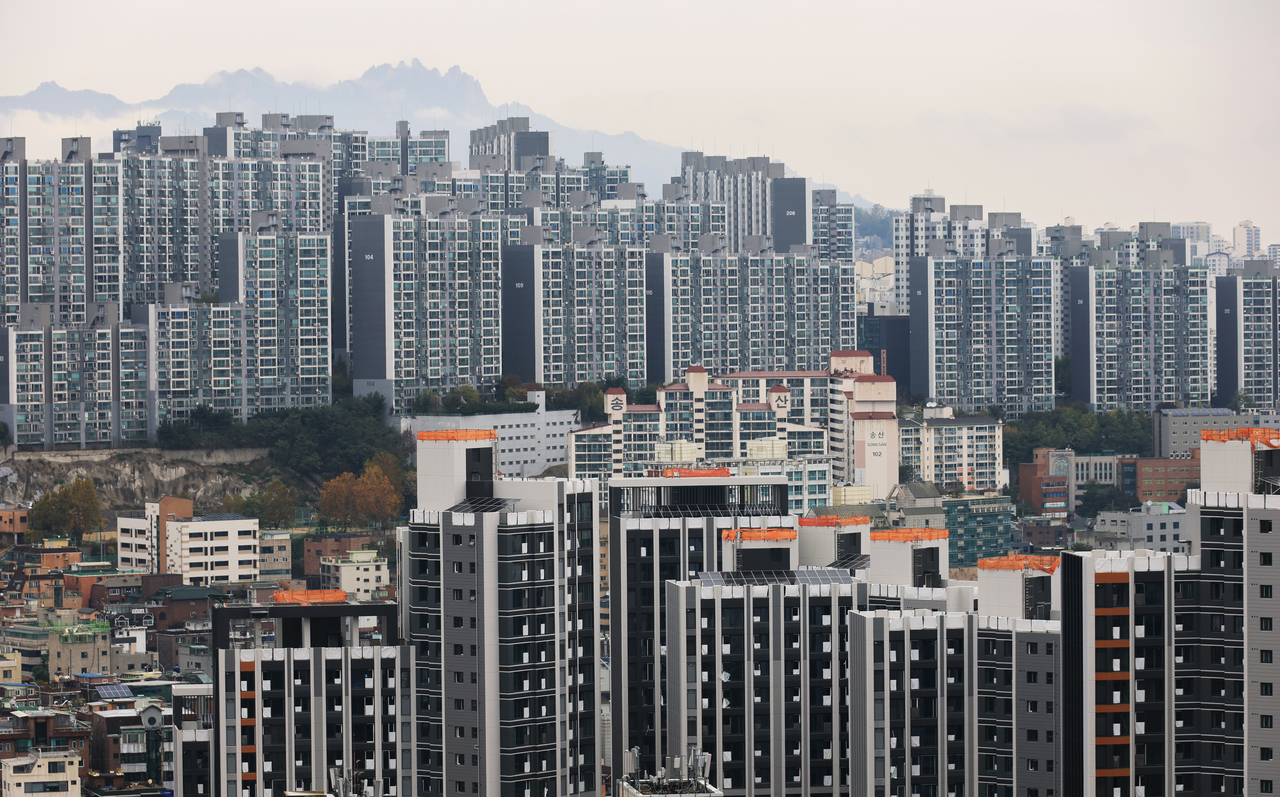
Seoul's real estate auction volume has surpassed 33,000 cases this year, reaching its highest level since 2006, while the average award rate has dropped to a 13-year low. As high interest rates push more properties into forced auction, high-end homes are increasingly failing to sell amid loan and tax burdens, while mid- and lower-priced apartments continue to attract owner-occupier buyers — pushing last month's apartment award rate above 100 percent. The divergence between a sluggish overall auction market and fierce competition for certain apartments has sharpened the contrast between property types and price tiers.
Seoul auction volume hits post-2006 high of 33,000 cases this year
Court auction sales statistics released Friday show that 33,240 properties went to auction in Seoul from January through October this year — the highest figure since 2006, when 33,824 cases were recorded. With November and December still to come, the full-year total is expected to surpass the 2006 level.
The figure far exceeds the volume seen during the real estate slump that followed the 2008 global financial crisis. Annual auction cases stood at 14,544 in 2008, then climbed to 18,357 in 2009, 17,709 in 2010, 20,100 in 2011, 22,426 in 2012 and 23,895 in 2013 before declining from 2014 onward. After falling as low as 6,357 cases in 2021, the count began rising again from 2022, when 8,658 cases were recorded.
The sharp increase is largely attributed to the steep interest rate hikes that began in 2022. The benchmark interest rate, which stood at 1.00 percent in November 2021, rose 2.25 percentage points to 3.25 percent by November 2022, then climbed further to 3.50 percent in January 2023. The prolonged high-rate environment left many property owners unable to service their debt, causing a rapid buildup of properties forced into auction.
Lee Ju-hyun, a senior researcher at GG Auction, said auction volumes are rising broadly across all property categories. "Apartments are piling up mainly in regional areas, while row houses and multi-family units are seeing a backlog driven by the fallout from jeonse fraud," Lee said, and went on to say that "retail spaces are being dragged into auction by vacancies caused by high interest rates and the economic slowdown, while land is being affected by tighter farmland inspections and weakened development demand under high rates."
The overall award rate — the ratio of the winning bid to the appraised value — for Seoul also hit its lowest point in 13 years. The average award rate for January through October came in at 75.4 percent, the lowest since 2013, when it was 72.3 percent. The rate had climbed as high as 100.3 percent in 2021, during the real estate boom, before declining from 92.4 percent in 2022.
Lending regulations have also weighed on the rate. Yoon Su-min, a specialist at NH NongHyup Bank, said that while auction winners could previously obtain post-award balance loans with relative ease, the June 27 lending regulations now subject such loans to the same restrictions as standard mortgage loans. "Winning a property at auction no longer offers much of an advantage," Yoon said. Post-award balance loans are financing secured against a successfully auctioned property to cover the remaining balance after the deposit.
Rising auction supply could dampen home-buying sentiment
Market watchers say that auction market trends — including award rates and case volumes — are widely regarded as leading indicators of the broader real estate market, and that a buildup of unsold auction inventory combined with falling award rates could dampen home-buying sentiment.
President Lee Jae Myung has repeatedly cited auction volume and award rate data on his X (formerly Twitter) account, urging close attention to real estate market trends. In August, Lee said one concern regarding the housing market was that mortgage delinquency rates and the number of properties going to auction were rising sharply. On Tuesday, he said people in the greater Seoul area feeling pressure to buy out of fear of missing out should closely monitor apartment transaction volumes, listing trends, actual transaction prices in key areas, mortgage delinquency rates and auction case trends. He added that the government was already preparing contingency measures, including the large-scale purchase of properties for public rental housing in the event of a sharp price decline.
Kang Eun-hyun, head of the auction research center at law firm Myeongdo, said Seoul apartment prices have been rising on the psychology of "if I don't buy now, I won't be able to at this price" — a fear-of-missing-out dynamic driven by supply shortages. "If auction inventory increases, buyers have more options to choose from," Kang said, and went on to say that "if the sense that there is no need to rush spreads, a wait-and-see mood could take hold."
Kang added that the effects of the interest rate hikes from July and August this year have yet to be fully reflected in the market, meaning the current trend is likely to continue for now.
October apartment award rate tops 100%; overheating may ease next year
Still, experts caution against reading the rise in auction volume and the fall in the overall award rate as a straightforward signal of a broader housing market downturn. Seoul's aggregate auction statistics cover not only apartments but also row houses, multi-family units, commercial properties and land. Case volumes are also influenced by both new listings and properties that repeatedly fail to sell. Assessing market direction requires a closer look at sales trends broken down by property type.
The high-end and mid-to-lower-end housing markets are also moving in opposite directions, partly because different regulations apply at different price points. Last month, 226 apartment units in Seoul — excluding mixed-use residential buildings — went to auction, up 42.1 percent from 159 the previous month, yet the award rate also rose, from 94.49 percent to 101.10 percent. Even as auction supply increased, buying competition persisted, with mid- and lower-priced complexes drawing bids above appraised value.
High-end apartments in Gangnam and Seocho-gu are seeing failed bids and lower award prices amid a 200 million won ($149,000) cap on mortgage loans for homes priced above 2.5 billion won ($1.86 million), along with heavier holding and capital gains tax burdens. Mid- and lower-priced complexes, which face comparatively lighter lending restrictions, are drawing survival buyers priced out of the jeonse market, pushing their award rates higher.
Experts are cautious about whether the upward trend in award rates for mid- and lower-priced apartments will last. With inventory backing up across the broader auction market and other indicators softening, they say it will be difficult for mid-range complexes to sustain their momentum.
Yoon said current Seoul auction market indicators are hard to interpret as a signal of falling home prices, but added that "the panic-buying that had overheated Seoul's real estate market is now partly shifting to a wait-and-see stance, so the market's upward momentum has eased somewhat." Yoon said that "outer Seoul areas such as Nowon, Dobong and Gangbuk are also showing signs of being constrained from rising further, so the mid-to-lower-price-led upswing could start to fade from next year."
Song Seung-hyun, chief executive of Dosi wa Gyeongje, said the auction market is mirroring the broader sales market, with demand-driven properties such as mid- and lower-priced apartments commanding higher award rates while officetels and villas are losing competitiveness. "Because mid-to-lower-tier award rates remain high as a leading indicator, the upward trend in mid- and lower-priced complexes will continue through the first half of next year," Song said. Song added that "from the second quarter or second half of next year, the tax issues that have weighed on high-end areas will be resolved, allowing premium districts to rebound, while mid- and lower-priced areas that surged sharply this year will face a correction."
hwshin@heraldcorp.com