
Forum focuses on financial innovation for housing market stability, residential welfare
Korea Finance Institute calls for demand control through loan pricing, supply linkage
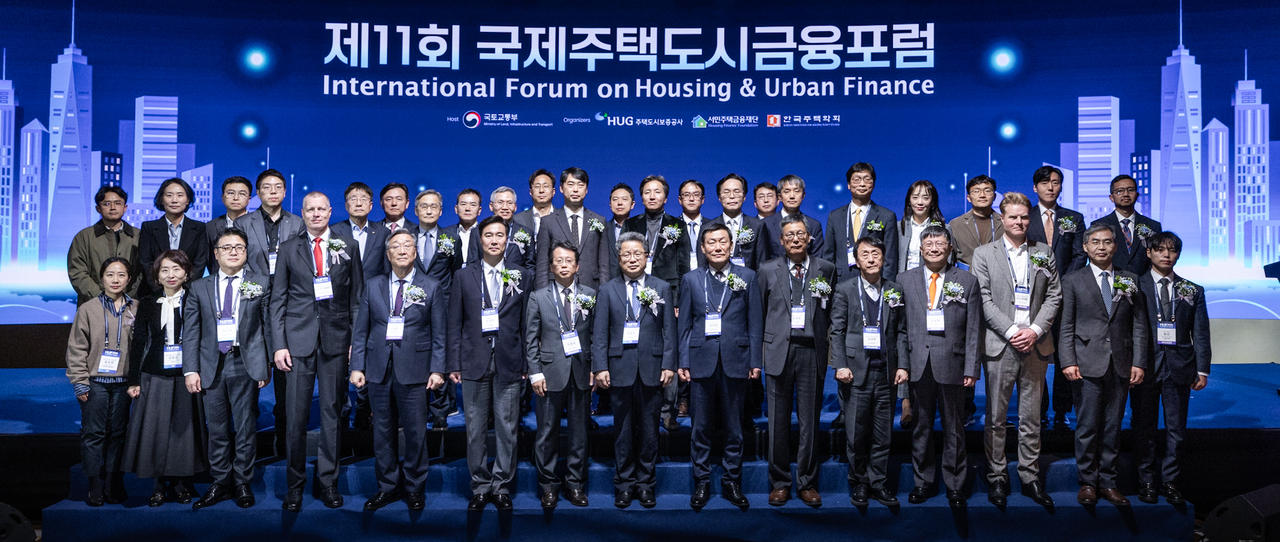
The Korea Housing and Urban Guarantee Corporation (HUG) held the 11th International Housing and Urban Finance Forum (HUF 2026) at the Westin Chosun Hotel in Seoul on Thursday.
Hosted by the Ministry of Land, Infrastructure and Transport and co-organized by HUG, the Korea Foundation for Housing and Urban Finance and the Korea Housing Studies Association, the forum brings together domestic and international experts in housing, urban development and finance to share policy challenges and discuss directions. This year's theme — "Innovation in Housing and Urban Finance for Market Stability and Residential Welfare" — centered on reforming the housing finance system, managing risk and exploring the potential of AI in advancing residential welfare.
The opening ceremony featured remarks by Kim Young-guk, director general of the Ministry of Land, Infrastructure and Transport's Housing and Land Bureau, congratulatory speeches by People Power Party lawmaker Yoo Eui-dong and Democratic Party of Korea lawmaker Bok Gi-wang, and a welcome address by Choi Jong-won, acting president of HUG.
The keynote address was delivered by Yongheng Deng, a professor at the University of Wisconsin-Madison, who spoke on the "trilemma of stability," diagnosing regional polarization in South Korea's housing market alongside household debt and housing affordability pressures. Deng drew on real estate and financial crisis cases from Japan, the United States and China, calling for an integrated housing finance policy that addresses both market stability and inclusive housing access.
Session 1 focused on innovation in the housing finance system and risk management for market stability. Andrey Pavlov, a professor at Simon Fraser University in Canada, analyzed the mortgage forbearance policies adopted in the United States during the COVID-19 pandemic and urged policymakers to strike a balance between short-term borrower protection and long-term financial market stability. Kim Young-do, a research fellow at the Korea Finance Institute, examined the effectiveness and limitations of current loan-cap and loan-volume-based housing finance regulations, and proposed reforms linking demand-control mechanisms through loan pricing with expanded housing supply.
The session discussion was moderated by Jo Man, an emeritus professor at the Korea Development Institute (KDI), with participation from Yoo Seung-dong of Sangmyung University, Lee Jeong-yeon of the Bank of Korea's Financial Stability Department, Park Cheon-gyu of the Korea Research Institute for Human Settlements, Jin Mi-yun of Myongji University and Alven H. Lam, senior vice president for international markets at Ginnie Mae (online).
Session 2 addressed innovation in residential welfare through AI. Thies Lindenthal, a professor at the University of Cambridge in the United Kingdom, analyzed risks of reduced market competition and discrimination arising from AI-driven pricing and housing recommendation systems, and said building AI governance frameworks is essential for fair and transparent markets. Choi Jin, an associate research fellow at the Korea Research Institute for Human Settlements, introduced practical applications of AI — including personalized residential welfare counseling, guarantee screening support, jeonse fraud detection, housing price assessment and early warning systems for guarantee defaults — and said a phased rollout premised on data infrastructure development and public trust is needed.
That discussion was moderated by Son Jae-young, an emeritus professor at Konkuk University, with participation from Lee Kwan-ok of the National University of Singapore, Jeon Jae-sik of Konkuk University, Kim Jin-yu of Kyonggi University, Kim Jeong-seop of UNIST and Cho Jae-beom, an economist at the OECD.
"Based on the domestic and international cases and policy proposals shared at the forum, we will seek ways to improve our operations and create changes that people can feel in their daily lives," Choi said.
Meanwhile, HUG began recruiting its first landlords for its jeonse trust service on Nov. 4. The pre-tax contractual yield for landlords was set at 4.35 percent.
hwshin@heraldcorp.com




