Foreign varieties hold 64.6% market share, costing farms about 700 million won a year
'Seoldan' grows faster; 'Aram' yields 23.8% more per bottle
Rural Development Administration targets 50% royalty reduction by 2030
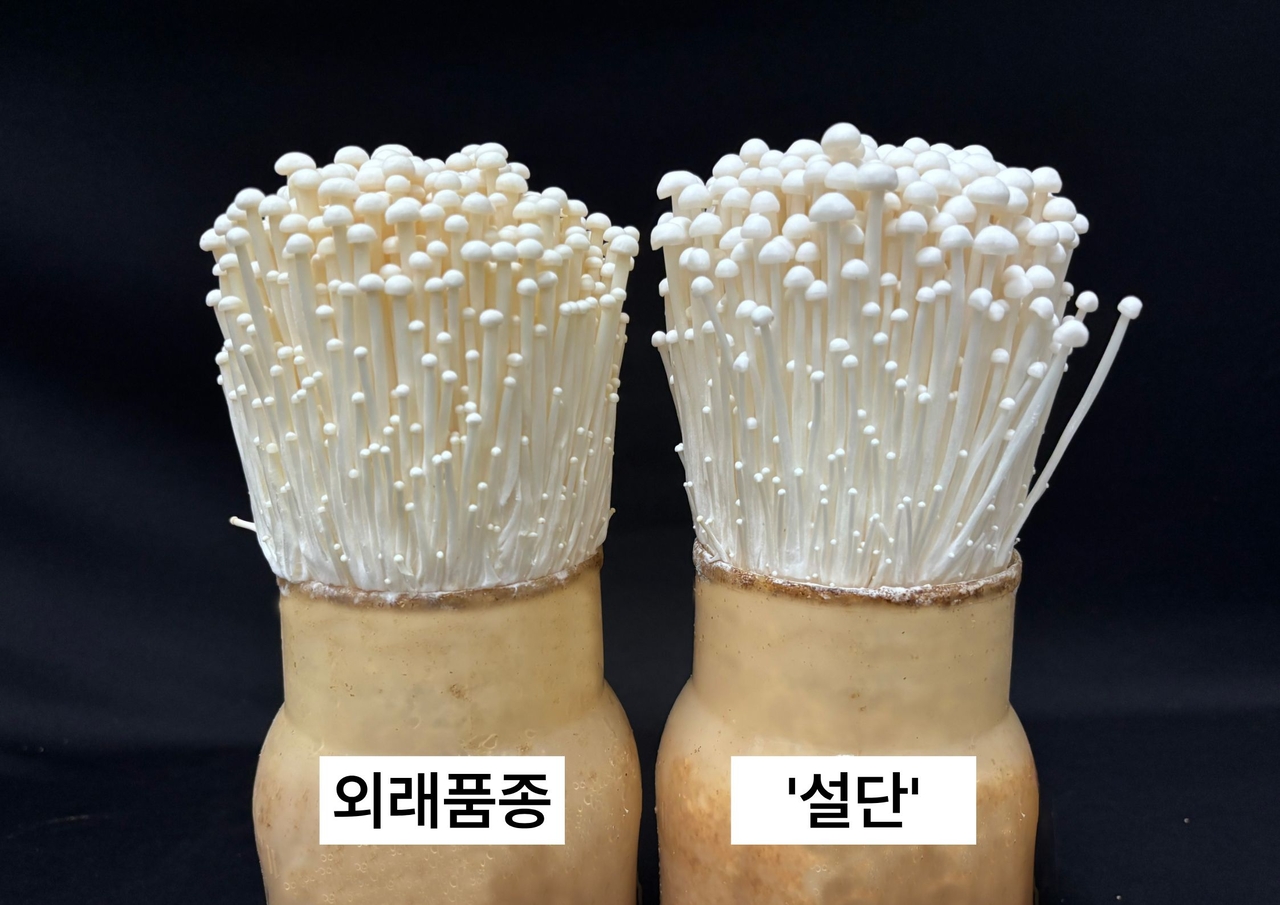
With foreign varieties accounting for more than 60 percent of South Korea's enoki mushroom market, two domestically developed breeds are set for wider commercial rollout. Seoldan, a whiter variety with a shorter cultivation cycle, and Aram, a golden-colored breed with higher yields and better shelf life, are at the center of the push. The government plans to expand distribution of both varieties to cut the roughly 700 million won ($522,000) in annual royalty fees paid by domestic farms to foreign breeders by half by 2030.
The Rural Development Administration announced Wednesday it would expand field trials and distribution of Seoldan and Aram, two enoki mushroom varieties it developed in-house, to reduce dependence on foreign breeds.
Foreign varieties held a 64.6 percent share of the domestic enoki mushroom market as of 2024, with farms estimated to pay around 700 million won in royalties each year. Intense price competition has also taken hold as production and consumption have concentrated on white enoki mushrooms.
Seoldan preserves the white color preferred by consumers while improving cultivation efficiency. Researchers developed it by drawing on beneficial traits from wild brown enoki mushrooms while engineering a white appearance, and filed for variety registration last year.
Digital breeding technology played a key role in its development. The research team applied genetic marker technology to identify white-trait individuals at the young mycelium stage, before the mushrooms begin to grow. The technique cut the time needed for crossbreeding and selection from 154 days to 48 days — a 69 percent reduction.
Field trial results also showed clear differences. Seoldan recorded a brightness value of 93.7, higher than the 91.1 of the foreign control variety — the closer to 100, the brighter the white. The time to first fruiting and the overall cultivation period were both one to two days shorter than those of the foreign variety, an advantage for farms running repeated growing cycles in the same facility.
Nutritional differences were also confirmed. Seoldan contained 93 percent more ergothioneine, an antioxidant compound, and 91 percent more tryptophan, an essential amino acid, than the control variety.
Aram, the golden-colored variety, addresses yield and quality-degradation issues seen during retail distribution. It completed variety registration in 2021 and reduces the blackening of the base that had been common in conventional brown enoki mushrooms.
Aram's yield per bottle rose from 283 grams to 350 grams, a 23.8 percent increase. The Rural Development Administration projected that farm revenue per bottle at market would also rise about 24 percent, from 1,132 won to 1,400 won.
The period over which freshness can be maintained after harvest extended from 30 days or less to a maximum of 40 days. On the strength of those characteristics, Aram became the first colored enoki mushroom variety to achieve commercial vacuum packaging. Previously, inconsistent yields and quality in brown enoki mushrooms had meant the product was sold mainly in 200-gram tray containers.
Compared with ordinary white enoki mushrooms, Aram contains three times more polyphenols, 2.5 times more GABA and 1.4 times more dietary fiber. Its firmer texture has also drawn favorable assessments for holding up well in heated dishes such as stews and hot pots.
The Rural Development Administration is conducting field trials at major growing farms in North Gyeongsang Province's Cheongdo and South Jeolla Province's Naju, among other locations. It plans to develop farm-specific cultivation guidelines and expand on-site technical support to broaden the adoption of domestic varieties.
Kim Dae-hyeon, director of the Rural Development Administration's National Institute of Horticultural and Herbal Science, said Seoldan and Aram "are varieties that can help secure seed sovereignty in an enoki mushroom market long dominated by foreign breeds, while contributing to stable farm income and greater variety diversity." Kim added that the administration would "continue developing and distributing varieties suited to field demand by leveraging advanced breeding technologies such as digital breeding."
adastra@heraldcorp.com