
Zero serious accidents, barrier-free access across all stations, and a 150 billion won green bond issuance highlight the agency's achievements — the only local public enterprise to receive the award this year. Starting this year, Seoul Metro is upgrading its framework to a safety-first 'S1st-ESG' model.
Seoul Metro, which transports an average of 6.7 million passengers a day, has been recognized for tangible achievements in sustainable management across its urban rail operations — spanning carbon neutrality, public safety, mobility rights for the transportation-disadvantaged, and community cooperation.
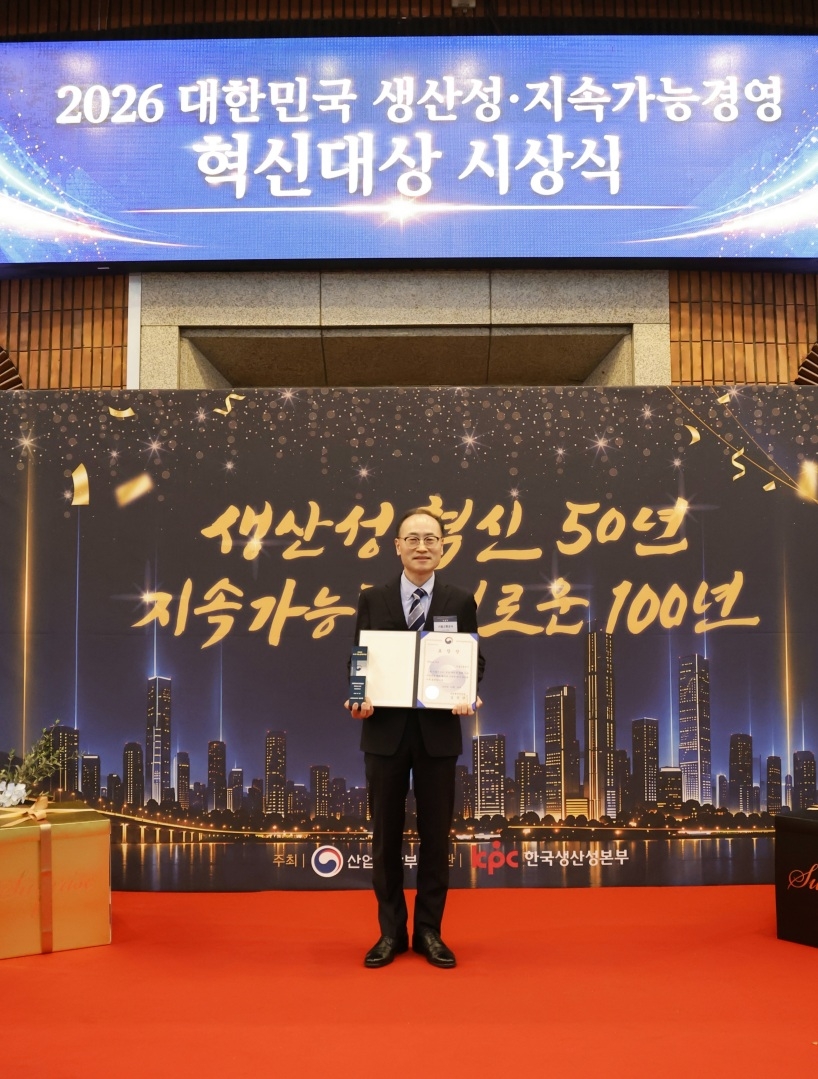
Seoul Metro said Thursday it received a commendation from the minister of trade, industry and energy at the "2026 Government Awards for Sustainable Management" ceremony, held at KBS Hall in Yeouido, Seoul. The agency is the only local public enterprise to receive the award this year.
The awards, hosted by the Ministry of Trade, Industry and Energy and administered by the Korea Productivity Center (KPC), are designed to encourage voluntary sustainable management activities and identify companies that have contributed to the spread of ESG management. Recipients are evaluated on their overall contribution to national and social development as well as their track record in sustainable management.
The best practices of selected organizations are used as benchmarking models for other institutions.
Seoul Metro is pursuing a comprehensive plan under its "2050 Carbon Neutrality Declaration" and the Framework Act on Carbon Neutrality, combining energy savings with renewable energy expansion. The agency exceeded its greenhouse gas reduction target by 102 percent last year, extending a streak of five consecutive years of above-target performance — a result driven by the introduction of new rolling stock, improved operational efficiency and facility upgrades. To secure stable financing for eco-friendly investments such as replacing aging trains, Seoul Metro also issued 150 billion won ($37.4 million) in Korean green bonds last year.
Green bonds are debt instruments whose proceeds are used for green economic activities that contribute to at least one of the six environmental objectives defined under Korea's green taxonomy — greenhouse gas reduction, climate change adaptation, sustainable water conservation, transition to a circular economy, pollution prevention and management, and biodiversity conservation — while meeting all four core components: use of proceeds, project evaluation and selection, management of proceeds, and reporting.
Seoul Metro also achieved an annual greenhouse gas reduction of approximately 123,000 metric tons by promoting use of the Climate Companion Card, a transit pass designed to encourage public transportation use.
The agency expanded renewable energy generation facilities to 28 sites by making active use of idle land at train depots and stations. Seoul Metro has also maintained its ISO 50001 Energy Management System certification for 10 consecutive years — the first railway operator in Korea to obtain it — demonstrating unrivaled energy management capabilities.
Seoul Metro's commitment to safety and inclusive mobility has also been notable. Through proactive risk management and expanded safety infrastructure, the agency achieved zero serious industrial accidents in 2025 while reducing the number of railway accidents by 25 percent compared with the previous year. In December last year, it completed a single barrier-free route at all 276 stations on subway lines 1 through 8, finishing an 18-year effort to establish fully accessible, elevator-connected paths from street level to every platform.
A single barrier-free route refers to a path that allows passengers with mobility difficulties to travel by elevator from street level to the platform without interruption.
Seoul Metro has also taken a leading role in governance reform and financial improvement. By combining a board-centered accountability framework with a specialist advisory system through its ESG Management Committee, the agency has strengthened the transparency and credibility of its decision-making. Efforts to improve its fundamentals — including strict integrity and ethics management, enhanced information security systems, and the operation of a financial risk management committee — helped bring its debt ratio down to 96.72 percent in 2025.
These achievements translated into strong results across external certifications and assessments. Seoul Metro was the only urban rail operator nationwide to receive an A rating (85.31 points) in the K-ESG level assessment for three consecutive years, and achieved an A+ (930 points) in the ISO 26000 implementation evaluation for two consecutive years. The agency also earned a first-grade rating in the human rights impact assessment for four consecutive years and an A+ in the community contribution recognition program.
Seoul Metro's sustainable management performance has also drawn international recognition. In February this year, the agency received a Platinum award — the highest honor in the sustainability report category — at the 2024/2025 Vision Awards organized by the League of American Communications Professionals, demonstrating its capabilities in ESG disclosure and stakeholder communication.
Starting this year, Seoul Metro is upgrading its existing ESG management framework to a safety-first "S1st-ESG" model. The agency plans to advance a sustainable urban rail operating model by reinforcing carbon neutrality, inclusive cooperation and transparent accountability, all grounded in safe mobility services.
"This award was made possible by the dedication of all our employees, who have embraced sustainable management as a core principle of urban rail operations," Seoul Metro President Kim Tae-kyun said. "Going forward, we will further strengthen safety management under the S1st-ESG framework, focus our efforts on improving the debt ratio, and drive the tangible changes and innovation that citizens can feel — connecting people, the environment and the future of our city."
seouldream01@heraldcorp.com




