1 in 3 random-motive crimes in past 4 years involved murder or attempted murder
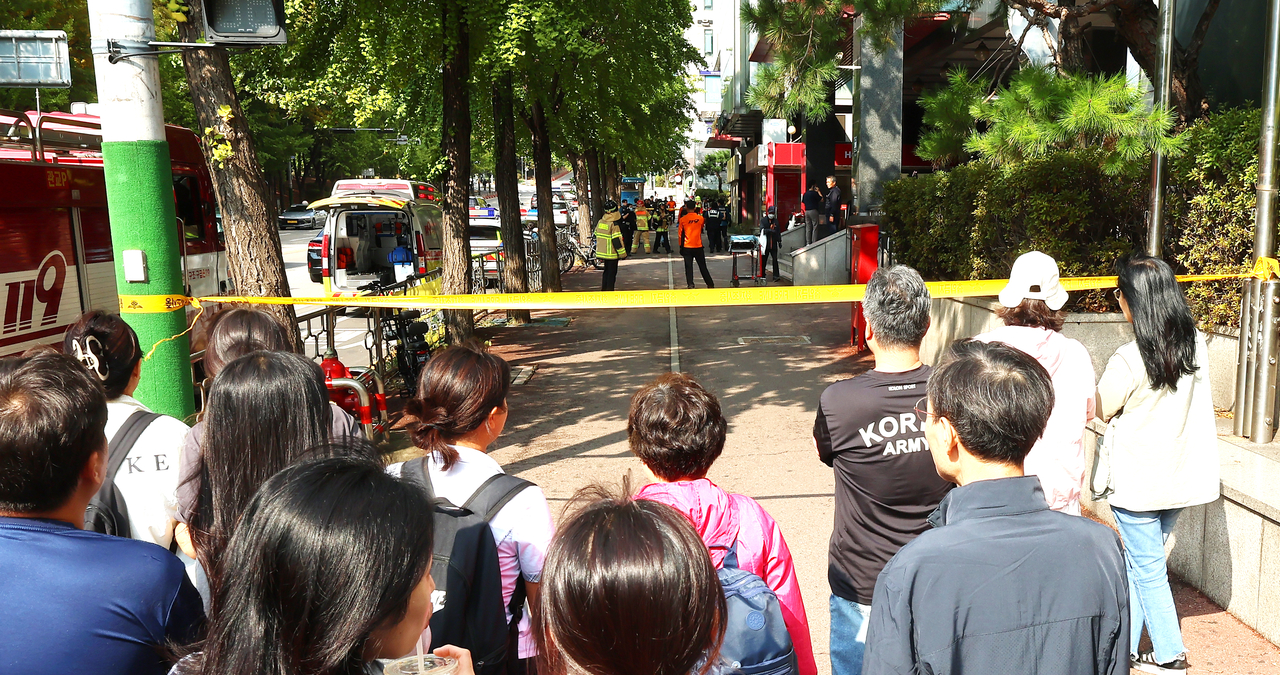
A knife rampage targeting random strangers in Incheon has put South Korea's response to so-called "random-motive crimes" under fresh scrutiny, with calls growing for stronger preventive measures against high-risk repeat offenders.
Choi Chung-rak, 59, is accused of attacking 10 people with a knife at a shopping complex in Namdong-gu, Incheon, on Tuesday afternoon. The Incheon Metropolitan Police Agency convened an identity disclosure review committee on Friday and voted unanimously to release his personal information, citing the brutality of the crime, the severity of the harm caused and the public interest.
Data the Korean National Police Agency submitted Monday to the office of People Power Party lawmaker Kim Ye-ji of the National Assembly's Interior and Safety Committee showed that 146 random-motive crimes have been recorded since the classification system was introduced in 2023. Of those, 15 were murders and 34 were attempted murders, together accounting for 33 percent of all cases. The remaining cases comprised 61 assaults causing injury and 36 cases of simple assault.
By time of day, the 2 p.m. to 5 p.m. window saw the most incidents at 42, or 28 percent of the total. That was followed by 11 p.m. to 2 a.m. with 23 cases (15 percent), 10 a.m. to 1 p.m. with 21 cases (14 percent) and 3 a.m. to 5 a.m. with 16 cases (11 percent). The 6 p.m. to 10 p.m. and 6 a.m. to 9 a.m. slots each recorded 13 cases (8 percent).
Weapons were used in 85 cases, or 58 percent of the total. Of those, 59 involved sharp-edged weapons such as knives, accounting for 69 percent of all weapon-involved incidents.
By age group, suspects in their 30s were the most common at 34 (23 percent), followed by those in their 50s at 32 (21 percent), those in their 40s at 28 (19 percent) and those in their 20s at 24 (16 percent). Suspects in their teens and those aged 60 or older each numbered 14 (9 percent).
'Police response alone has limits — recidivism risk must be taken seriously'
Some officers on the front lines argue that because the concept of random-motive crime was defined relatively recently, investigators and courts need to reflect that in their judgments. "When a lenient judicial decision puts an offender back on the street and a tragedy follows, it is the police who are left to deal with the aftermath," one police official said. "We need proactive and strict management of those at high risk of reoffending."
Another police official said enhanced patrols alone are not enough to prevent random-motive attacks. "There are limits to what police can do on their own," the official said. "A coordinated response across relevant government agencies is needed."
Questions have also been raised about whether the attack could have been prevented. Choi had been ordered to wear an electronic ankle monitor for 10 years following a previous knife offense, meaning authorities had a potential window to intervene before Tuesday's rampage.
About a month before the attack, police investigated Choi after he staged a protest outside a hospital while carrying a knife, on charges of possessing a bladed weapon in a public place. Officers confirmed his criminal record and the ankle monitor and notified the probation office, but the Ministry of Justice did not raise his supervision level. Police also returned the knife to him and did not move to detain him.
Courts had previously recognized Choi's risk of reoffending. According to a ruling by the Incheon District Court submitted to the office of Rebuilding Korea Party lawmaker Park Eun-jung, prosecutors in 2015 — when Choi stood trial on attempted murder charges — assessed that he posed a risk of committing murder again and sought an electronic monitoring order, which the court granted. Choi was sentenced to four years in prison for repeatedly attacking his former spouse with a knife in an attempt to kill her after she refused to reconcile with him.
Prosecutors had also noted that a psychiatrist treating Choi administered the Korean Offender Risk Assessment System-General (KORAS-G) and rated his recidivism risk as "high." A separate assessment using the Psychopathy Checklist-Revised (PCL-R) placed his recidivism risk at "medium."
Despite those findings, no application was made for a treatment custody order — a measure available when a mentally ill offender is found to pose a risk of reoffending and to require specialized treatment.
Baek Jong-woo, a psychiatry professor at Kyung Hee University Hospital, said policies to prevent reoffending by mentally ill offenders must combine supervision with treatment. "When you look at mental illness as a whole, the crime rate is between 0.7 and 0.8 percent — one-sixth to one-eighth that of people without mental illness, so it is actually lower," Baek said. "However, the recidivism rate among mentally ill offenders is 65 to 67 percent, which is high. Active management of certain high-risk individuals is necessary, and I think it is reasonable to include that in measures against random-motive crime."
He added that institutional and financial support must back those efforts. "It is not simply a matter of surveillance — the system must be able to provide treatment and conduct mental health assessments," he said.
However, it has not yet been confirmed whether Choi's history of mental illness is connected to the attack. Police have requested a criminal profiler analysis to determine the motive.
Police said they are stepping up efforts to guard against copycat or similar attacks. Seoul Metropolitan Police Agency Commissioner Go Beom-seok told reporters Monday at a press briefing at the Seoul police headquarters in Jongno-gu that violent crimes can inspire imitation. "We need to proactively assert a visible presence to deter that," Go said. "We will strengthen visible policing at crowded public facilities so that citizens can see officers and feel reassured."
Earlier, acting Korean National Police Agency Commissioner Kim Jong-cheol visited the scene on the day of the attack and pledged to concentrate all available personnel at crowded facilities and conduct visible patrols to prevent secondary harm to victims and copycat crimes. "We will not be negligent for even a moment in protecting the lives and safety of the public," he said.
arin@heraldcorp.com