Police put to the test on high-profile probe
Half of allegations dropped; no detention secured
Eyes now on whether prosecutors demand further investigation
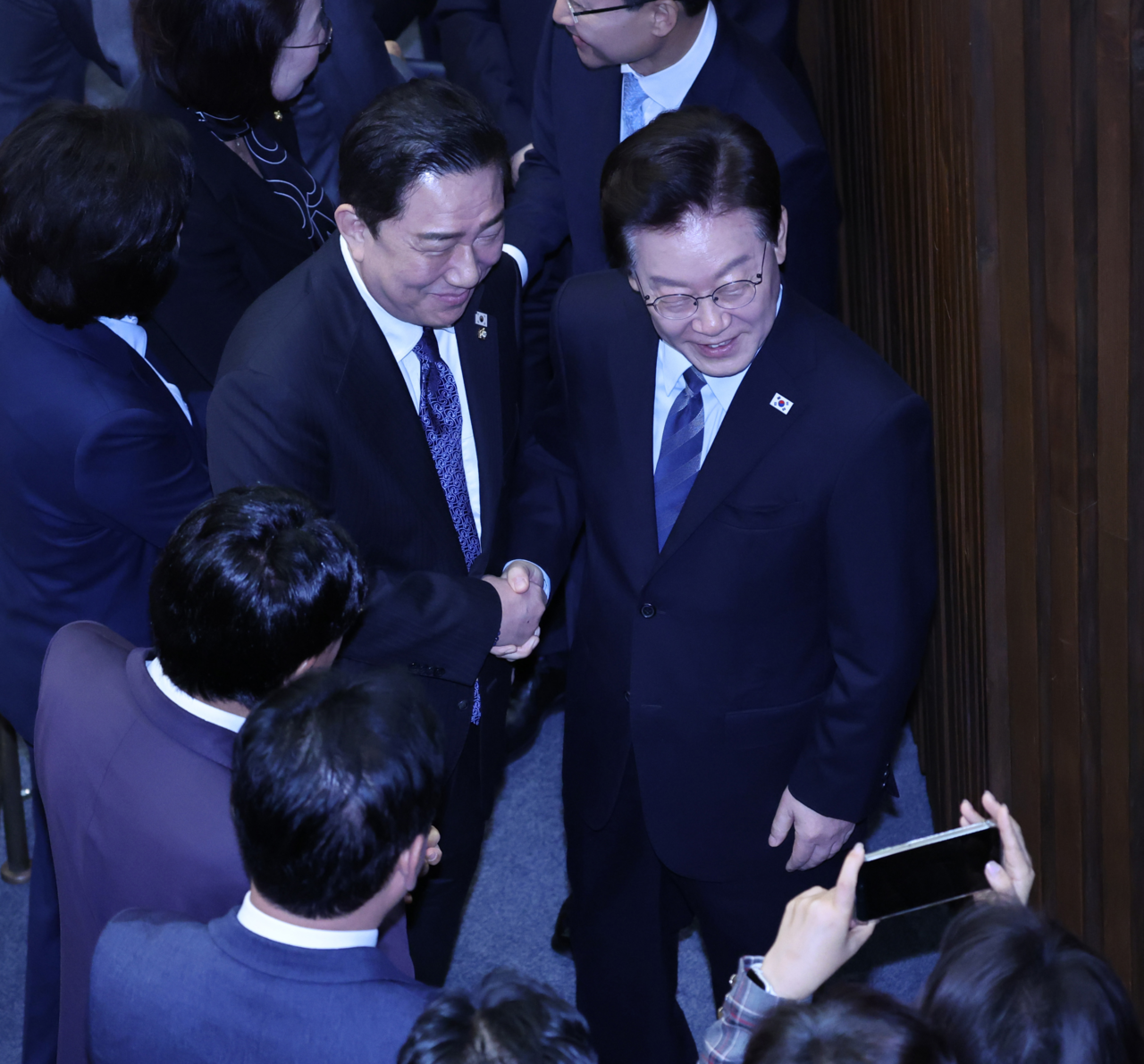
A police investigation into multiple misconduct allegations against Assembly member Kim Byung-kee has concluded after roughly 14 months, yielding what critics are calling a half-finished result. The probe had been closely watched as a test of police investigative capacity at a time when the prosecution's investigative powers have been stripped away. Kim, a prominent ally of President Lee Jae Myung who served as the ruling party's inaugural floor leader, faced more than 10 separate allegations — but police confirmed charges in only about half of them before referring the case to prosecutors.
The Seoul Metropolitan Police Agency Metropolitan Investigation Unit said Tuesday it had referred Kim to prosecutors without detention on charges including aggravated bribery under the Act on the Aggravated Punishment of Specific Crimes and violations of the Political Funds Act. Of the 13 cases and 33 individuals investigated, police referred 7 cases involving 18 people — a result widely described as only a partial success.
Police had initially received complaints and accusations against Kim as early as in September last year but took no action. They launched a full investigation only after Kim stepped down as floor leader and was expelled from the Democratic Party. Although Kim was summoned for questioning seven times through April, police sat on the case for five months before belatedly seeking an arrest warrant — which was rejected. Prosecutors dismissed the warrant application, citing insufficient substantiation of the charges, and demanded supplementary investigation. During this period, Kim and complainants alike submitted written requests urging police to wrap up the probe promptly. A police investigation review committee also recommended that a conclusion be reached by September, a deadline police failed to meet. After completing the supplementary investigation, police ultimately referred the case without securing Kim's detention.
Critics say police dragged their feet out of deference to those in power. Lee Woong-hyuk, a professor of police studies at Konkuk University, said the Kim Byung-kee investigation had been a benchmark for gauging police investigative capability under the new criminal justice system, but that it had once again left the impression that police remain ill-equipped to handle cases involving the politically powerful. "Now that police have a fundamentally different standing as an investigative agency than in the past, they need to look back on the past year of investigation and take stock," Lee said.
Another policing expert said the investigation had given the public ample reason to doubt whether police were genuinely committed to pursuing the case. "The investigative team surely knew that applying for an arrest warrant more than a year after opening an investigation would make it nearly impossible to argue there was a risk of flight or evidence destruction," the expert said. "You can't help but wonder whether the warrant application was just for show." The expert added that such conduct was why politicians no longer feared police, and why some were saying the goal of abolishing the prosecution had been achieved in name only.
A former senior police official said the missteps in the Kim case — the foot-dragging and the botched warrant timing — were deeply damaging at a moment when police were already under scrutiny over whether they could investigate cases as rigorously as prosecutors once did. "Police should have handled this properly so the public would recognize that they, too, can investigate those currently in power," the official said.
The handling of the Kim case also drew fire during the national audit. At the National Assembly's Public Administration and Security Committee audit of the Korean National Police Agency on Oct. 12, Democratic Party lawmaker Lee Sang-sik said he was raising the matter cautiously given that Kim was a fellow Assembly member, but asked why the case had taken so long. "The president himself has said police should be the organization with the greatest authority, responsibility and mission among all state institutions — are they still going to investigate while watching which way the wind blows?" Lee said.
Police had stressed thoroughness over speed
Demand for further investigation would deepen criticism of shoddy work
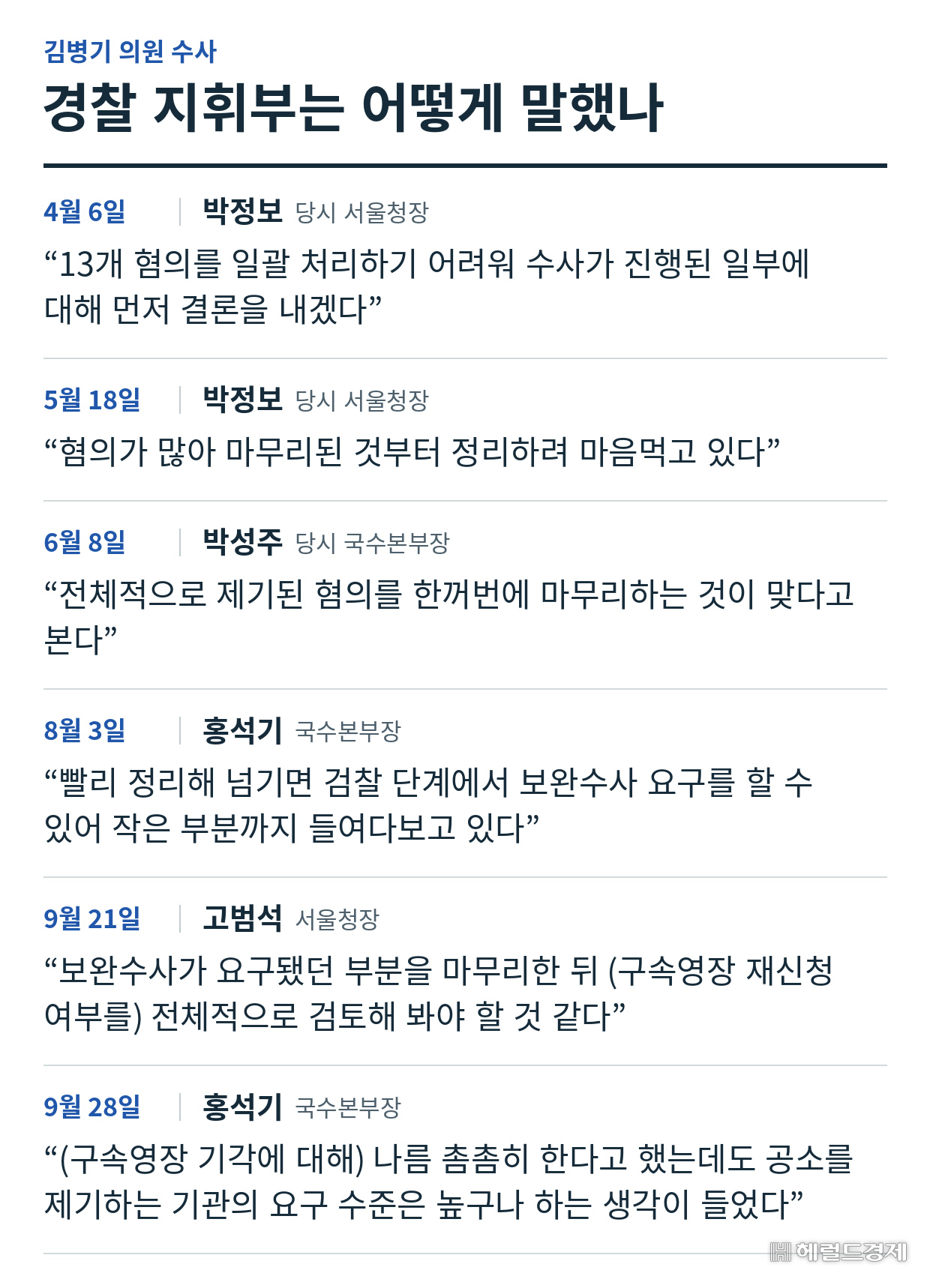
Whenever criticism arose over the slow pace of the Kim investigation, police leadership consistently maintained that they were reviewing the case carefully to avoid having prosecutors send it back for supplementary investigation. The message was that they were willing to take more time in order to build a more complete case.
National Investigation Headquarters chief Hong Seok-gi said at a regular press briefing on Sept. 3 that rushing the referral could prompt prosecutors to demand supplementary investigation, and that police were scrutinizing even minor details to prevent that from happening. After the arrest warrant was rejected and prosecutors did demand supplementary investigation, Hong said: "We thought we had been thorough enough, but it made me realize how high the bar is for the agency that actually brings charges."
Whether prosecutors will now demand yet another round of supplementary investigation is also drawing attention. Given that police spent more than a year on the case while emphasizing thoroughness, any additional demand for supplementary work would serve as a measure of just how deficient the investigation was.
In closing the case, police coordinated with prosecutors only on the five charges listed in the arrest warrant application — alleged ghost employment at Jinwoo Sanjeon, misuse of a corporate card by Kim's spouse, turning a blind eye to illicit political donations in connection with Kang Sun-woo's candidacy, preferential treatment from Korean Air and receipt of sponsorship funds from Silla Leisure. The remaining two charges — alleged job-placement lobbying at Bithumb and alleged personnel interference at Coupang Inc — were referred without separate coordination, according to sources.
Key charges fail to stick, but referred counts still seen as politically damaging
'Bribery charges are fatal for a sitting lawmaker'
Police were unable to establish Kim's direct involvement in one of the case's most closely watched allegations: the alleged receipt of 30 million won ($22,300) in illegal campaign funds in violation of the Political Funds Act. Police referred only two former Dongjak-gu council members and Kim's spouse on charges of exchanging money during the 2020 general election.
An allegation that Kim used his authority to quash a 2024 investigation by the Seoul Dongjak Police Station into his spouse's misuse of a corporate card — a charge of abuse of power — was dropped without referral. The allegation had also raised concerns about a conflict of interest, as it implicated a serving senior police official, prompting worries that police were effectively investigating themselves.
A charge that Kim unlawfully leaked Telegram conversation records belonging to a former aide — in violation of the Communications Secrets Protection Act and the Act on Promotion of Information and Communications Network Utilization — also ended without referral. The charge had been considered relatively straightforward to prove, given that Kim had personally posted the conversation records on his own Facebook page in December last year.
A separate controversy had also emerged after a recorded phone call between Kim's spouse and Lee Heon-su, then chief of staff at the National Intelligence Service, from July 2016 was made public, raising allegations that Kim's spouse had lobbied for their eldest child's hiring. Police did not investigate that matter.
Still, some observers say the political damage to Kim from the charges that were referred could be considerable, regardless of the final outcome. A ruling-party insider said violations of the Political Funds Act and aggravated bribery charges were "fatal allegations for a sitting lawmaker."
'Police must secure political independence'
With prosecutors stripped of their investigative powers, the burden of investigating politicians has fallen squarely on police. Having taken over residual cases from three special prosecutor investigations — into the insurrection, Kim Keon Hee and the death of a marine — police are now handling a large volume of cases involving senior officials from the previous administration, including former presidential chief of staff Jeong Jin-seok. More recently, ruling-party lawmakers have been pressing police to reopen an investigation into allegations surrounding the university admissions process for the children of independent Assembly member Han Dong-hoon.
Kim Do-woo, a professor of police administration at Kyungnam University, said the criticism that police defer to those in power was a problem that would keep recurring as long as police lacked political independence, given that personnel decisions and budgets remained tied to the executive branch. "Even if frontline investigators have the will and the ability to pursue a case, it is hard for them to hold their ground if the leadership fails to shield them from outside pressure," Kim said. "The public also needs to stand up for police so they are not pushed around by political power."
Meanwhile, Hong's predecessor, former National Investigation Headquarters chief Park Seong-ju, has been reported to prosecutors on allegations that he deliberately delayed and obstructed the investigation into Kim. The Seoul investigative team handling the Kim case had sought to move quickly — pushing for a split referral and pursuing an arrest warrant at an earlier stage — but Park allegedly blocked those efforts. The case, filed with the Seoul Central District Prosecutors' Office, is expected to be transferred to the Serious Crimes Investigation Agency.
arin@heraldcorp.com
kido@heraldcorp.com