Behind every public figure's polished appearance lies a personal care routine. This series examines the diets, workouts, procedures, and beauty and fashion habits of notable figures as practical lifestyle information.
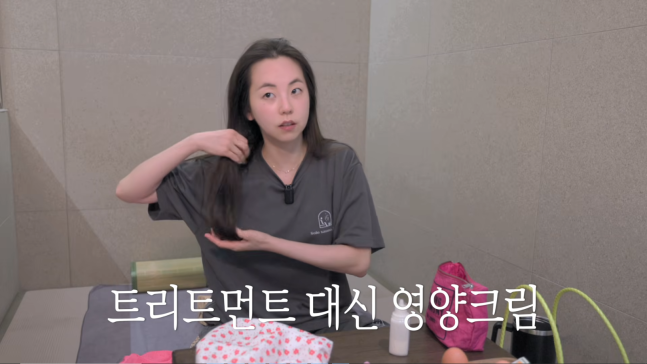
An So-hee, an actor and former member of the K-pop group Wonder Girls, has revealed that she conditions her hair with a rich facial moisturizer instead of a conventional hair treatment — a workaround she developed after finding that standard hair products irritate her skin.
An shared the routine in a video posted to her YouTube channel on Friday, filmed while she was enjoying a sauna session.
"I actually don't use a separate treatment," she said. "My skin has become very sensitive lately, and no matter what treatment I try, it breaks me out."
She applies a rich facial nourishing cream to her hair instead. "There's this really rich nourishing cream — it's made for the face, but I apply it generously to my hair," she said, adding that she leaves it on while in the sauna or while washing her face.
She added that she brushes her scalp and hair before shampooing and uses separate brushes before and after washing.
Hair treatments are designed to smooth the surface of damaged strands and reduce friction. However, certain ingredients in these products can trigger acne or contact dermatitis when they come into contact with skin, making product choice and application method important for those with sensitive skin.
An's facial nourishing cream of choice is formulated to reduce moisture loss and maintain hydration in the skin.
Standard nourishing creams typically contain a range of ingredients — humectants such as glycerin, plant-based oils, squalane and ceramides — though the specific composition and concentrations vary by product.
Among these, oil and emollient ingredients can form a thin film over the hair surface, temporarily imparting a softer feel. Coating dry strands may also help reduce the dull, rough appearance that comes with damage.
Hair strands are made up of an outer cuticle layer and an inner cortex, among other structures. The cuticle, which overlaps like scales, protects the interior of the strand.
When the cuticle is damaged by frequent dyeing, bleaching or repeated use of high-heat styling tools, the hair surface becomes rough and loses moisture easily. Tangling and loss of shine can follow.
Hair treatments address this by incorporating cationic conditioning agents, silicones and fatty alcohols to reduce the friction caused by such damage. These ingredients adhere to the hair surface, making it easier to comb through while reducing static and tangles.
Facial nourishing creams, however, are formulated for skin hydration and may differ from hair treatments in both ingredient composition and mechanism of action.
Applying a high-oil cream too liberally can leave hair feeling heavy and greasy. This effect may be more pronounced on fine hair or scalps that already produce excess sebum.
The results of any product applied to hair depend not only on its ingredients but also on the amount used, where it is applied and how thoroughly it is rinsed out.
Breakouts along the hairline and forehead — like those An described — are a recognized concern with hair product use.
According to the American Academy of Dermatology (AAD), oily ingredients in shampoos, conditioners and styling products can clog pores and cause acne when they come into contact with skin.
The forehead, hairline, temples and back of the neck are particularly prone to repeated exposure to hair products.
During washing, treatment can run down onto the face, neck and back, or residue left in the hair can transfer to the skin and cause problems.
Product-related acne of this kind can appear as small, closely clustered bumps or whiteheads.
Oil-based ingredients are not the only culprit. Fragrances and preservatives in hair products can also irritate the skin or trigger allergic contact dermatitis.
Contact dermatitis is a condition in which skin exposed to a particular substance becomes red, itchy or stinging. Symptoms vary depending on the triggering ingredient and the individual's skin condition.
Those with sensitive skin are advised to check the fragrance content and ingredient list when choosing hair products. Fragrance-free formulas or products designed with acne-prone skin in mind may be suitable options.
The AAD recommends that people who develop acne from hair products avoid formulas containing pore-clogging ingredients and thoroughly remove any residue left on the skin.
Even after discontinuing a product, acne may take four to six weeks to clear.
When using a treatment, applying it from the mid-lengths to the ends — rather than near the scalp or face — can help minimize skin contact. Rinsing thoroughly to ensure no product remains on the face, neck or back is also advisable.
Recurring itching or rashes can be evaluated at a dermatology clinic to identify potential allergic triggers.
An also highlighted pre-shampoo brushing as an important part of her hair care routine.
Gently combing hair before shampooing helps detangle knots in advance, reducing the friction that occurs during washing.
Hair becomes more vulnerable to external stress when wet. Forcefully pulling at tangles while shampooing increases the risk of breakage and cuticle damage.
The AAD recommends starting at the ends when detangling and working gradually upward.
Excessive brushing, on the other hand, can cause repeated friction. Aggressively scratching or pressing on the scalp can also cause irritation.
When shampooing, it is better to focus the cleansing action on the scalp rather than scrubbing the entire length of the hair.
The scalp continuously produces sebum, sweat and dead skin cells. Shampoo removes these impurities along with residue from hair products.
The ends of the hair are less affected by sebum but are more prone to dryness. Shampooing the scalp and allowing the lather to run down the strands can minimize unnecessary friction on the ends.
After washing, press hair gently with a towel to absorb moisture rather than rubbing it vigorously.
When detangling wet hair, use a wide-tooth comb and allow the hair to dry slightly before combing, depending on its condition. For curly or coarse hair, combing while conditioner is still in may help.
When using a hair dryer, avoid concentrating hot air on one spot for too long. Repeated exposure to high heat can increase moisture loss and surface damage.
Effective hair care requires taking into account the scalp's sebum production, hair thickness, degree of damage and skin sensitivity.
If breakouts repeatedly appear around the forehead or neck after using hair products, it is worth reviewing both the product's ingredients and washing habits. Managing dryness and tangles while minimizing residue that comes into direct contact with the skin is the foundation of healthy hair care.
rainbow@heraldcorp.com