Three AI films reimagine the lives of Yu Gwan-sun, Bang Jeong-hwan and Han Yong-un under the theme 'Walking Through Frozen Time'; free public screenings set for Thursday and Oct. 15
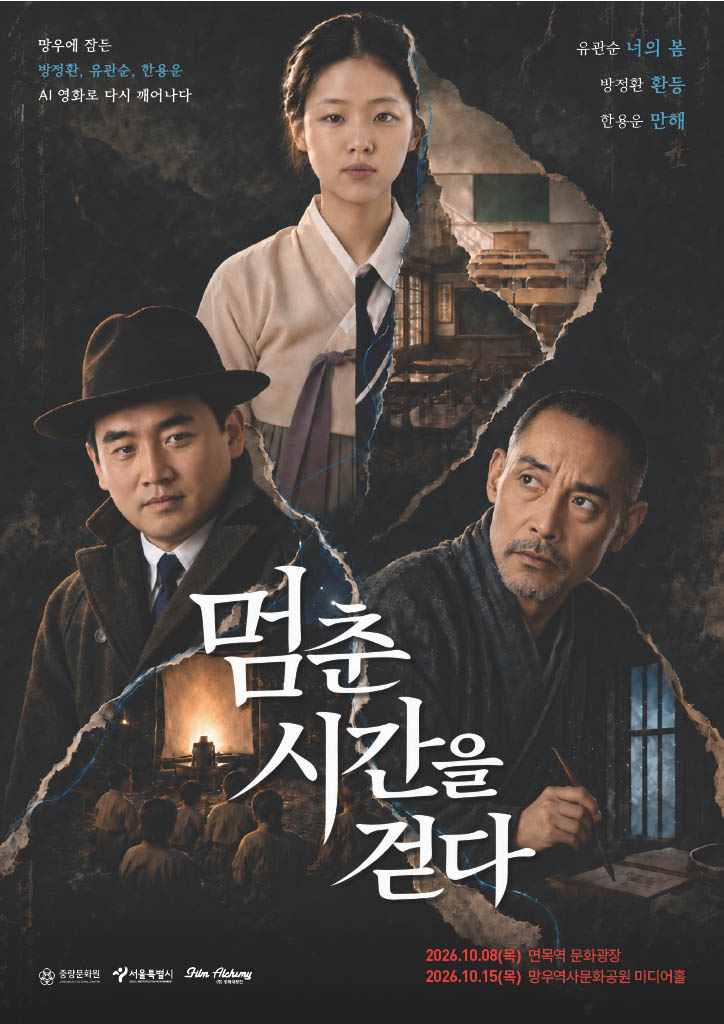
Historical figures buried at Mangwoo History and Culture Park in Seoul's Jungnang-gu are coming back to life on screen through artificial intelligence. Three films reconstructed using advanced imaging technology bring to life the stories of independence activist Yu Gwan-sun, children's rights pioneer Bang Jeong-hwan and poet-activist Han Yong-un.
Jungnang Cultural Center announced Thursday that it produced three AI films under the theme "Walking Through Frozen Time" and will hold free public screenings following a preview on Oct. 1.
The screenings will take place Thursday at Myeongmok Station Plaza and on Oct. 15 at Mangwoo History and Culture Park. The series was organized to deepen public appreciation of local cultural heritage by reinterpreting the lives and spirit of historical figures through a contemporary cinematic lens.
The three works are "Your Spring," about independence activist Yu Gwan-sun; "Magic Lantern," centered on Bang Jeong-hwan; and "Manhae," which illuminates the life of Han Yong-un.
The project goes beyond simple historical reenactment, drawing attention for its use of AI technology to bridge past and present and transform the district's historical and cultural assets into accessible video content for the public.
The film festival grew out of a question: how best to convey to today's citizens the lives of those who rest in Mangwoo History and Culture Park.
The park is a historical and cultural space where more than 60 figures who left their mark on modern Korean history — including Yu Gwan-sun, Bang Jeong-hwan and Han Yong-un — are interred. Jungnang-gu has been working to preserve the site's historical value and improve its facilities so that residents can engage with history and culture in their everyday lives.
Jungnang Cultural Center took note of these qualities. It concluded that bringing historical figures' lives to the screen through AI-powered filmmaking — rather than through conventional records or exhibitions — would broaden public empathy with history.
The project also reflects a recognition that enhancing the cultural value of Mangwoo History and Culture Park requires not only physical improvements but also an archiving function to accumulate and make use of historical records.
Jungnang Cultural Center secured a subsidy of 150 million won ($112,000) after being selected for a competitive grant program run by the Seoul Federation of Culture Centers, and used those funds to produce the films.
To ensure historical accuracy, the center formed an advisory committee that included officials from the Bang Jeong-hwan Support Center and local historians, conducting multiple rounds of review. The production company was selected through a Public Procurement Service tendering process, reflecting the center's commitment to transparency and professionalism.
Yu Gwan-sun of 1919 meets Yu Gwan-sun of 2026
Each of the three films interprets its subject's historical significance through a distinct cinematic approach and narrative structure.
"Your Spring," centered on Yu Gwan-sun, connects the activist of 1919 with a Yu Gwan-sun of 2026 to show that the spirit of the independence movement endures today. The film focuses on revisiting a historical figure through a contemporary gaze, conveying the meaning of freedom, sacrifice and courage that transcends time.
"Magic Lantern," about Bang Jeong-hwan, draws its inspiration from his boyhood encounter with a magic lantern projector that opened his eyes to a new world. Building on the influence that new visual media had on a child's imagination, the film traces Bang's lifelong dedication to children's rights and dreams.
"Manhae," which tells Han Yong-un's story, unfolds around his activities in Manchuria and his time at Oseam hermitage. The film follows Han's inner world as independence fighter, Buddhist monk and poet, culminating in the scene where he writes his landmark work "The Silence of My Love."
All three films are grounded in historical fact while using AI technology to reconstruct the spaces, figures and atmosphere of their respective eras on screen, bringing historical records to life and drawing viewers into each subject's world.
The project brought together directors who have earned recognition at domestic and international AI film festivals.
"Your Spring" was directed by Kim Ju-shin, winner of the grand prize at the Daejeon International AI Film Festival. "Magic Lantern" was produced by directors Song Yeong-yun and Kang Seung-pyo, who have worked at the intersection of generative AI and filmmaking, while "Manhae" was directed by Lee Jin-ho and Park Jin-yeong, recipients of the best AI film award at the All-Russia Short Film Day.
The team also includes directors who worked on a video depicting Kim Gu pinning a Taegukgi on a young Son Gi-jeong, as well as a promotional film for the National Museum of Korea, adding expertise in rendering historical subjects through AI imagery.
Overall production and screening operations are handled by Yeonghwa Daejanggan, the Korean partner of Weta Workshop, the New Zealand-based global visual effects studio.
Jungnang Cultural Center plans to submit all three films to domestic and international film festivals in 2027, aiming to introduce key figures from modern Korean history and the district's cultural heritage to overseas audiences through the international festival circuit.
The center intends to build on the film project beyond a one-time cultural event, expanding it into a broader initiative encompassing history education and local cultural revitalization.
It plans to provide the films as educational materials to institutions connected to Mangwoo History and Culture Park, the Bang Jeong-hwan Support Center, memorial foundations for the three figures, and local education offices.
The goal is to help students understand the lives and historical context of these figures through film, while giving local residents a fresh appreciation of the history embedded in the spaces where they live.
Cultural observers have noted that the project expands the role of local cultural centers from preserving and passing down traditional culture to creating and distributing content through advanced technology.
AI-driven historical content, they say, has demonstrated new possibilities for improving public access to culture and connecting local historical and cultural assets to tourism, education and the cultural industries.
Advisory committee members who participated in the production described it as a meaningful attempt to make the Yu Gwan-sun of the past feel as though she is alive again as a Yu Gwan-sun of the present.
The AI film festival represents an effort to transform the resting place of historical figures from a site of simple commemoration into a living cultural space where past and present speak to each other.
As advanced technology meets local history to produce new cultural content, attention is turning to whether Mangwoo History and Culture Park can evolve from a place that conveys historical memory into a hub for cultural education that engages future generations.
7toy7@heraldcorp.com