Borrowers with three or more loans at financial institutions
Increase resumes from May as banks tighten lending
Those with five or more loans — the 'ultra-high-risk' group — up by 60,000
'Loan nomads' proliferate as debt-fueled investing meets tighter caps
People Power Party lawmaker calls for urgent measures to protect genuine borrowers

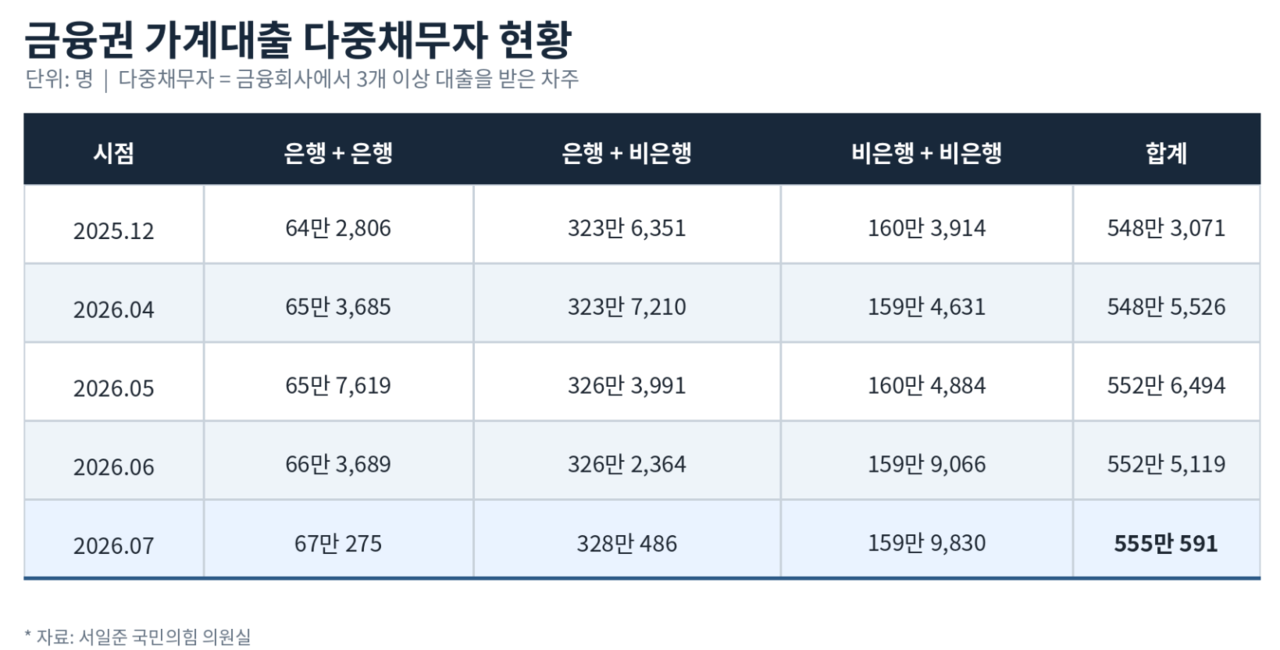
The number of multiple debtors — borrowers classified as high-risk by the financial sector — grew by roughly 70,000 in just seven months this year, data obtained by a lawmaker showed Wednesday. Analysts say the surge reflects a rise in so-called "loan nomads": borrowers who hop between financial institutions after hitting lending caps, amid a crackdown on household debt and a wave of debt-fueled investment in stocks and real estate. Warnings are growing that household loan quality is deteriorating as interest rates climb.
According to data that People Power Party lawmaker Seo Il-jun, a member of the National Assembly's Political Affairs Committee, obtained from NICE Credit Information, the number of household borrowers with three or more loans across banks and non-bank lenders — including mutual savings banks, credit card companies, savings banks and insurers — stood at 5.55 million as of the end of July.
That is up 67,520 from 5.48 million at the end of last year, and an increase of 70,070 from the same period a year earlier.
The total had climbed from the end of last year to 5.51 million by February before dipping below 5.5 million in April. It has been rising again since May.
Breaking down the figures by category, borrowers who held three or more loans exclusively at banks rose from 642,806 at the end of last year to 670,275 in July — an increase of 27,469 — marking seven consecutive months of growth.
Borrowers with loans at both banks and non-bank lenders numbered 3.28 million as of the end of July, the largest of any category and up 44,135 from the end of last year. This group includes those who took out a bank loan and then turned to credit card loans, savings banks or insurance policy loans.
Among those with loans at both banks and non-bank lenders, borrowers carrying exactly three loans fell from 1.19 million at the end of last year to 1.18 million in July, while those with four loans edged down from 794,651 to 792,205.
The "ultra-high-risk" segment — those with five or more loans — swelled from 1.25 million to 1.31 million, an increase of roughly 60,000.
Analysts point to two main drivers behind the rise: financial authorities' tighter household lending caps and growing demand for investment in stocks and real estate. Regulators this year lowered the target growth rate for household loans by 0.2 percentage points from last year as part of efforts to rein in household debt. The tighter caps collided with strong first-half demand for investment borrowing, leaving more borrowers unable to secure the funds they needed from a single lender.
Banks began restricting mortgage loan limits in May, including by capping access to mortgage credit insurance. In June, they capped unsecured credit loans at 100 million won ($74,400) per borrower regardless of income. Some banks went further, cutting mortgage loan limits from 600 million won to 300 million won. The pickup in multiple-debtor numbers has tracked closely with those May restrictions.
Financial industry experts say the caps have triggered a "nomad" phenomenon, with borrowers crossing between sectors to piece together the funds they need. Existing bank customers sought additional loans from other banks or non-bank lenders such as credit card companies, while existing non-bank borrowers moved on to yet other financial sectors, collectively swelling the multiple-debtor count.
A former senior financial regulator said the trend appeared to reflect individual lenders managing per-borrower limits amid rising loan demand, pushing people to seek funds from institutions beyond their primary lender. "As the economy weakens, more self-employed people are likely taking out loans to cover funding shortfalls," the official added.
Calls are also growing for lenders to prepare for potential defaults among multiple debtors as interest rates rise. Particularly concerning is the elderly segment: borrowers aged 60 and older numbered 971,228 as of the end of July, up 35,555. Of those, 455,991 had loans only at non-bank lenders.
"The government's blanket lending caps are pushing even genuine borrowers out of the banking system and forcing them to wander between financial institutions," Seo said. "Financial authorities must urgently put in place measures to protect real borrowers."

hyuk@heraldcorp.com
rim@heraldcorp.com