Hosted by the Korea Transportation Safety Authority's automotive safety research institute
Participation in the '2026 Firefighter Vehicle Safety Rescue Seminar'
Training conducted for about 100 firefighters from across the country
All-electric flagship Volvo EX90 provided on-site
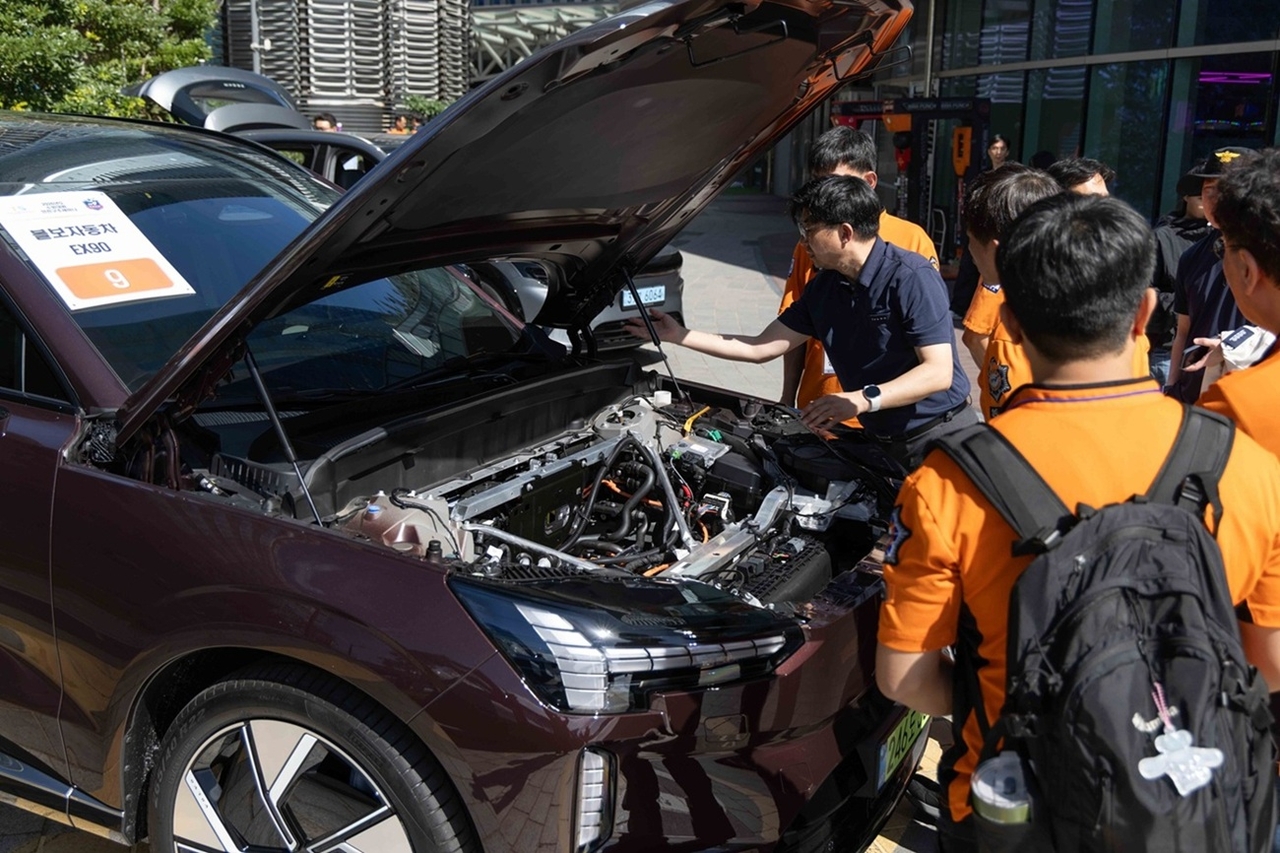
Volvo Car Korea announced Friday that it participated in the 2026 Firefighter Vehicle Safety Rescue Seminar held in Haeundae, Busan, providing its all-electric flagship SUV, the EX90, and conducting safety rescue training for firefighters from across the country.
The seminar was organized to help first responders who carry out rescues at accident scenes better understand the structure and characteristics of electric vehicles — including high-voltage batteries — so they can secure the critical window of time needed to save lives.
With about 100 firefighters from around the country in attendance, Volvo Car Korea brought the all-electric flagship EX90 to the venue to support training on next-generation EV rescue procedures. The curriculum covered the location and identification of key high-voltage system components, the risks associated with each component and how to cut power in an accident, and the correct body-cutting positions for passenger rescue — structured as a step-by-step, scenario-based program.
The event also featured sharing of real-world rescue cases and practical know-how. Volvo Cars, which marks its 99th anniversary this year, places safety at the core of its brand values and has pursued a range of innovations in that spirit. In 1959, the company shared its patent for the three-point seatbelt, a decision credited with helping save more than 1 million lives to date.
Volvo continues to advance its research and public-private collaboration toward a vision of a collision-free future and saving more lives. To that end, its safety center in Gothenburg, Sweden, conducts rigorous testing that goes well beyond standardized crash protocols, studying the complex and varied collision scenarios that occur in real traffic accidents.
Since 1970, the company has also operated its own traffic accident research team, which visits real crash scenes to collect data on road and traffic conditions, the time of the incident, collision causes and damage. Drawing on that work, Volvo has analyzed more than 50,000 accidents involving more than 80,000 occupants, contributing to advances in cervical spine protection, side-impact airbags and advanced driver assistance systems.
Since 2019, the company has also been sharing its accumulated safety research data through the E.V.A. Initiative.
Meanwhile, Volvo Car Korea continues to carry out corporate social responsibility activities across a range of fields.
Most recently, "Naranhi Boneun Misulgwan" — a cultural accessibility program run jointly by the Purme Foundation, which the company sponsors, and the Seoul Museum of Art — became the first museum program in South Korea to receive the Outstanding Museum Practice Award from the International Council of Museums, winning the 2026 honor.
likehyo85@heraldcorp.com