![Bulky waste items left on a neighborhood street. [Image generated with ChatGPT]](https://wimg.heraldcorp.com/news/cms/2026/09/28/news-p.v1.20260928.51bbc7f923d44aa69043cb8fc653c1cc_P1.png)
"Looks like I could take that home right now."
With the autumn moving season now in full swing, a familiar sight has returned to residential alleyways and apartment recycling areas across the country.
Piles of discarded furniture — desks, chairs, dressers, sofas and more — line the streets, yet few pieces show any serious damage.
Most could be used again with minor repairs. But when it comes down to it, few people choose to fix what they already own.
![Bulky waste items left on a street. [Captured from the Seoul Metropolitan Government website]](https://wimg.heraldcorp.com/news/cms/2026/09/28/news-p.v1.20260928.7b2e83b6e2f947eb97341c5ce50b5110_P1.png)
In fact, South Koreans show a lower willingness to repair items than consumers in other countries — though the problem cannot simply be chalked up to a preference for new things.
Many people do not know where to get things fixed, and repair shops are in short supply. The situation is particularly serious for everyday items such as furniture and electronics.
A 2023 sustainability survey by global market research firm Euromonitor International, which polled about 40,000 people, found that roughly 40 percent of respondents worldwide said they would choose to repair a broken item rather than replace it with something new.
![Bulky waste items left on a street. [Captured from the Seoul Metropolitan Government website]](https://wimg.heraldcorp.com/news/cms/2026/09/28/news-p.v1.20260928.d50b7d4d5c6546b4a69bd1c68fce9a8f_P1.jpg)
Among South Korean respondents in a separate report drawing on the same data, however, only 21 percent said they preferred repairing items over buying new ones — roughly half the global figure.
That gap does not simply reflect a love of new things. Even when consumers want to repair an item, barriers around cost, spare parts and know-how stand in the way. Experts note that the hurdles are especially high for everyday household goods beyond the major home appliances that large manufacturers service directly.
The Korea Consumer Agency's "2025 Korean Consumer Lifestyle Index," based on a survey of 10,000 people, found that among factors hindering sustainable consumption, "high repair costs" scored 56.7 points, "difficulty of repair methods" scored 52.5 points, and "unavailability of spare parts" scored 51.4 points.
![Bulky waste items discarded in an alleyway. [Image generated with ChatGPT]](https://wimg.heraldcorp.com/news/cms/2026/09/28/news-p.v1.20260928.22b0da14675242a99fe92e556dfd00ae_P1.png)
The data also show that actual repair experience is concentrated in a narrow range of products: smartphones (20.7 percent), refrigerators and kimchi refrigerators (13.6 percent), and air conditioners (11.0 percent). Repairs tend to happen mainly for products from large manufacturers that already have well-established service networks.
The right to repair is a central pillar of sustainable waste policy. South Korea's current Act on Promotion of Transition to a Circular Economy Society explicitly addresses this, requiring that waste generation be minimized by producing more durable goods and extending product lifespans through repair.
The current government has also included "institutionalizing a product repairability assessment system," alongside the introduction of a Korean-style eco-design framework, as part of its 123 national policy tasks under the goal of building a circular economy ecosystem.
Guaranteeing the right to repair requires more than making products easier to fix — it also demands an environment in which consumers can realistically choose repair. For low-cost products beyond the reach of manufacturer service networks, or in areas without nearby repair shops, the private market alone cannot ensure access.
Local governments have stepped in with public repair service programs, and Seoul alone has 126 such initiatives on record. The number looks substantial — but a closer look at whether residents across the city can easily repair a wide range of items tells a different story.
![Discarded home appliances. [123RF]](https://wimg.heraldcorp.com/news/cms/2026/09/28/news-p.v1.20260928.320868758f4c45388a974fe29aa0d186_P1.jpg)
Seoul Environment Federation and the Resource Circulation Society Economy Research Institute recently released findings from an assessment of repair and mending infrastructure across Seoul's 25 autonomous districts, conducted with a 33-member citizen research team and supported by the Seoul Public Interest Activities Support Center.
"The repair environment across Seoul's 25 districts — where residents can easily and consistently fix a wide variety of items in their daily lives — has not yet been sufficiently established," Seoul Environment Federation said in its report.
Bicycle repairs were available in all 25 districts. Repair services for medical assistive devices for people with disabilities were accessible in 23 districts, and umbrella repair in 19.
![Boxes filled with toys. [Provided by Seoul Environment Federation]](https://wimg.heraldcorp.com/news/cms/2026/09/28/news-p.v1.20260928.43ef7cc1336c4070b32c55c78f387e00_P1.jpg)
For more common everyday items, however, the options dropped sharply. Public toy repair services were available in only seven districts, while electronics and clothing and footwear repair were each confirmed in just four districts.
Furniture was the starkest gap of all: among the 25 districts, only Seongdong-gu offered any public furniture repair service.
In addition, 27 of the 126 programs operated as mobile services, rotating among neighborhood community centers, apartment complexes and local hubs. Those programs came with practical constraints, as residents had to check schedules and locations in advance before using them.
![Bicycles left abandoned on a sidewalk in Yangcheon-gu, Seoul. [Provided by a reader]](https://wimg.heraldcorp.com/news/cms/2026/09/28/news-p.v1.20260928.7c33b353c4a843408dd414fd9640246d_P1.jpg)
Finding information about repair services proved difficult as well. Even where services exist, locating them is no easy task.
Of the 25 districts, only Yangcheon-gu was rated as having repair information that residents could easily find online and use to make reservations or applications. In 19 districts, basic program information was available but residents still had to follow up by phone to confirm availability or make a booking.
Scores varied considerably across districts. Seoul Environment Federation evaluated nine categories — including repair-related ordinances, information accessibility and service fees — and assigned each district a score out of 100. Mapo-gu ranked highest with 73 points, while Gangseo-gu came in last at 46.4 points, a gap of 26.6 points between first and last.
![A fan being repaired at a "Repair Cafe" electronics repair space in 2018. [Provided by Enlighten]](https://wimg.heraldcorp.com/news/cms/2026/09/28/news-p.v1.20260928.87d5039d7e5948449ae99f53c3d57966_P1.jpg)
A deeper problem is that it is nearly impossible to tell how much waste these repair programs are actually preventing. Not one of Seoul's 25 districts manages its various repair and mending initiatives under a unified framework tied to the shared goal of resource circulation and waste reduction.
Each program tracks its own figures — user numbers, repair counts, operating sessions — in isolation. No common performance indicator exists to measure how much waste has actually been diverted as a result of repairs.
Citizens who took part in the survey also raised concerns, Seoul Environment Federation said, with comments such as "even good repair programs go unused because they are not publicized enough" and "they need to run continuously, not just as one-off events."
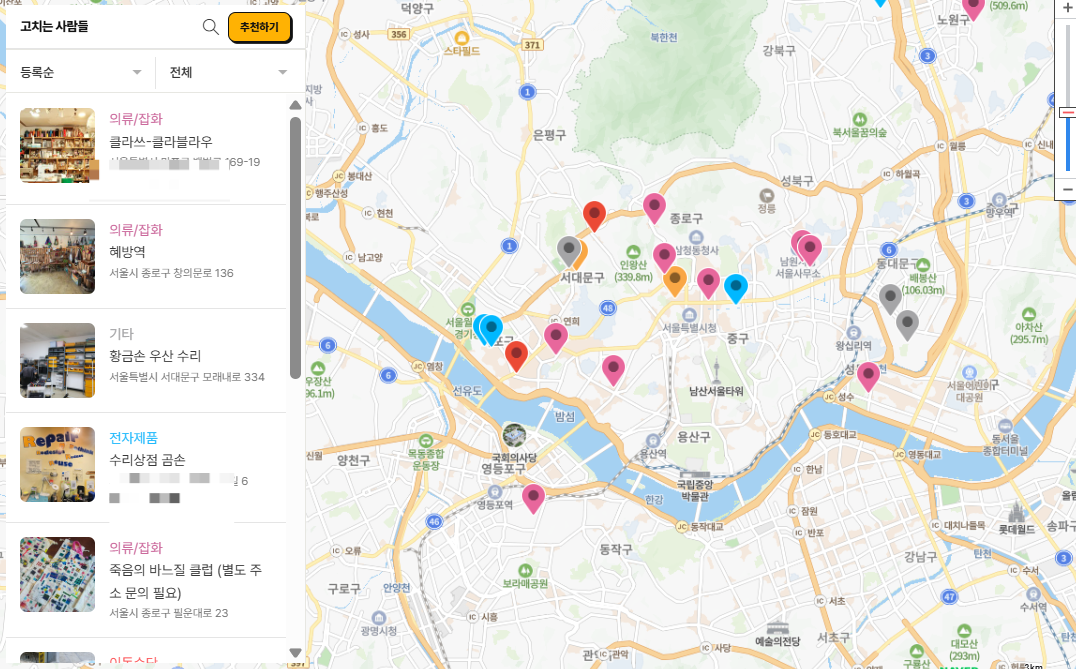
In response, Seoul Environment Federation and the Resource Circulation Society Economy Research Institute launched "Gochimep Seoul," an online map consolidating scattered repair and mending information from across the city. The platform lets users search for nearby repair locations and relevant details by item category, including bicycles, umbrellas, clothing and footwear, toys and electronics.
"We plan to keep adding residents' repair shop experiences and related information, and will call on the Seoul Metropolitan Government and individual districts to expand permanent and regular repair spaces, diversify the types of items covered, strengthen cooperation with local repair businesses and social enterprises, and establish an integrated information system," a Seoul Environment Federation official said.

woo@heraldcorp.com