
Sales hit 1.66 trillion won, operating profit reaches 138.2 billion won
AI, cloud revenue tops 961.5 billion won, accounting for 58% of total sales
Financial sector grows 21.3%; AI investment expands
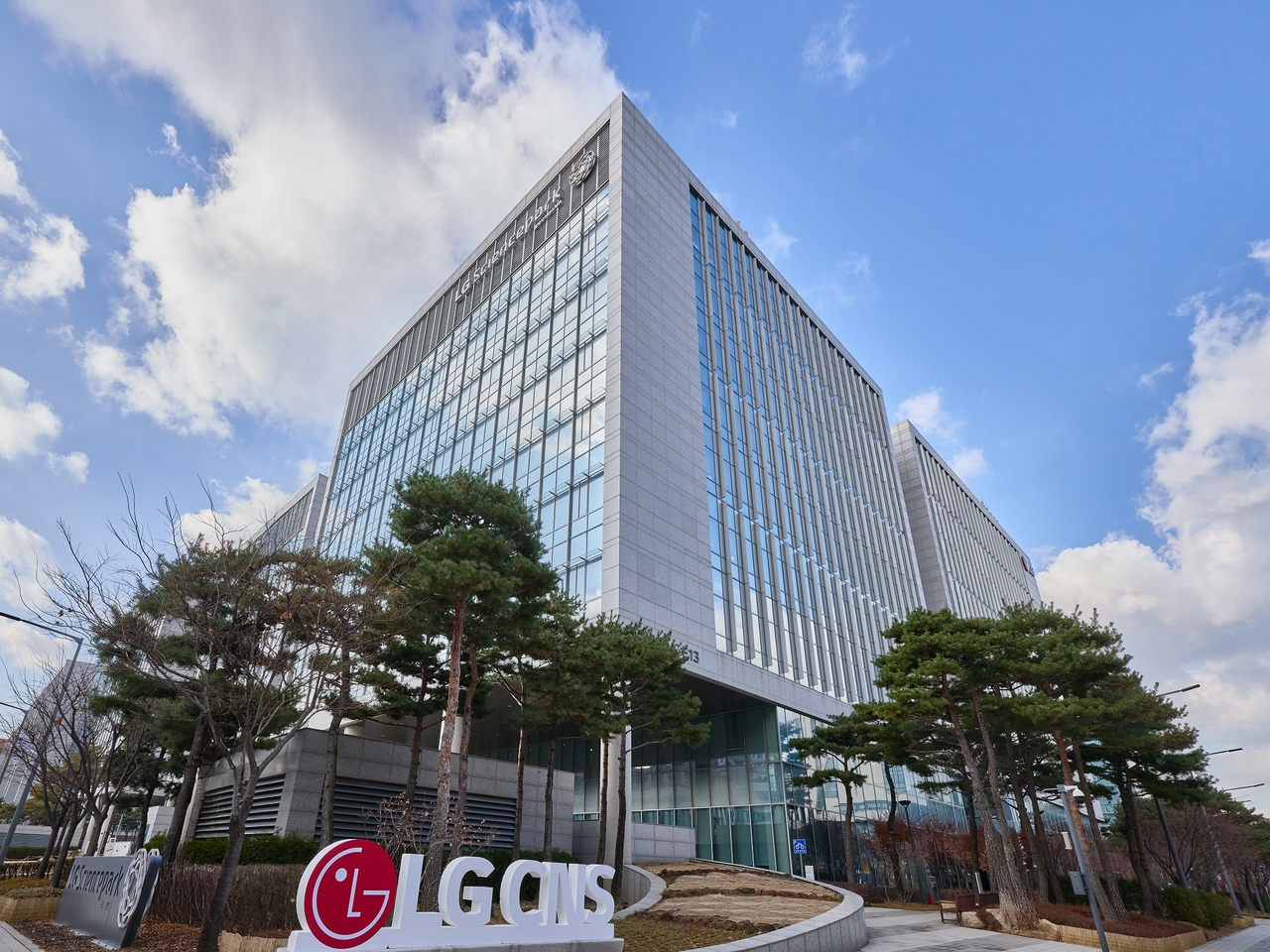
LG CNS posted a 15% year-on-year rise in operating profit for the third quarter, driven by growth in its AI and cloud business and expanding revenue from next-generation financial system projects.
The company announced Friday that its consolidated third-quarter sales reached 1.66 trillion won ($1.25 billion) and operating profit came in at 138.2 billion won, both preliminary figures. Sales rose 9.3% from the same period last year, while operating profit climbed 15%.
Revenue from AI and cloud — the company's core business — grew 9.3% year-on-year to 961.5 billion won, accounting for roughly 58% of total sales.
Within AI infrastructure, data center revenue continued to grow. LG CNS said the gains reflected higher colocation revenue at AI data centers it operates under contract, including the Samseong AI Data Center it built and manages.
The company also expanded its AI transformation, or AX, business targeting external customers, carrying out projects that included developing an airport AX master plan, building an AI drug development platform and deploying a health screening AI agent.
Enterprise AI projects using global generative AI tools such as ChatGPT Enterprise and Claude also grew. Broader AI adoption across industries — including finance, gaming, aviation and manufacturing — helped lift cloud revenue as well.
Revenue from digital business services rose 21.3% year-on-year to 408.2 billion won, as next-generation financial system projects moved into full-scale development.
Revenue recognition accelerated on previously won contracts to build next-generation systems for NH NongHyup Bank, Mirae Asset Life Insurance and KB Kookmin Bank. New orders continued as well, including a project to modernize the core banking system of the saemaul credit union network. In the public sector, LG CNS is carrying out systems integration and management work for the Korea Securities Depository and the Ministry of Justice.
Smart engineering revenue, however, edged down year-on-year to 294.5 billion won, weighed down by a slowdown in the manufacturing sector.
Within smart factory operations, the company secured new customer references across defense, pharmaceuticals, electronics and battery industries. Its smart logistics business is also expanding automation projects targeting Korean companies operating overseas.
Going forward, LG CNS plans to build its AI business around two pillars: agentic AI and AI infrastructure. The strategy is to simultaneously scale up services in which AI autonomously handles a broad range of tasks and the infrastructure that supports them.
To that end, the company recently acquired tangible assets worth around 380 billion won to secure GPUs needed to build and operate AI factories. LG CNS has also joined global investment firm General Atlantic in a co-investment initiative targeting enterprise software and AI.
At a recent global data center event in Singapore, the company showcased its prefabricated modular data center "AI HAUS" and a GPU-as-a-service offering based on Nvidia's Vera Rubin platform, signaling its push to expand AI infrastructure business.
LG CNS is also accelerating its robot transformation, or RX, business. The company is conducting proof-of-concept projects at logistics and manufacturing sites using its robot learning and operations platform "PhysicalWorks," then converting those pilots into commercial contracts.
"We plan to expand into service sectors such as security patrol, customer reception and safety," a company official said, adding that LG CNS intends to deepen cooperation with global technology companies including Nvidia, Microsoft and Amazon Web Services, as well as robot manufacturers.
woo@heraldcorp.com




