Vows to push third-generation new towns at 'unprecedented pace' by 2030
Pursues 'eight-party talks' on semiconductor workforce relocation
Calls for constitutional reform up to 'what the people want'
Plans discovery system after third round of Commercial Act revision
Suggests ruling, opposition parties sit mixed at plenary sessions
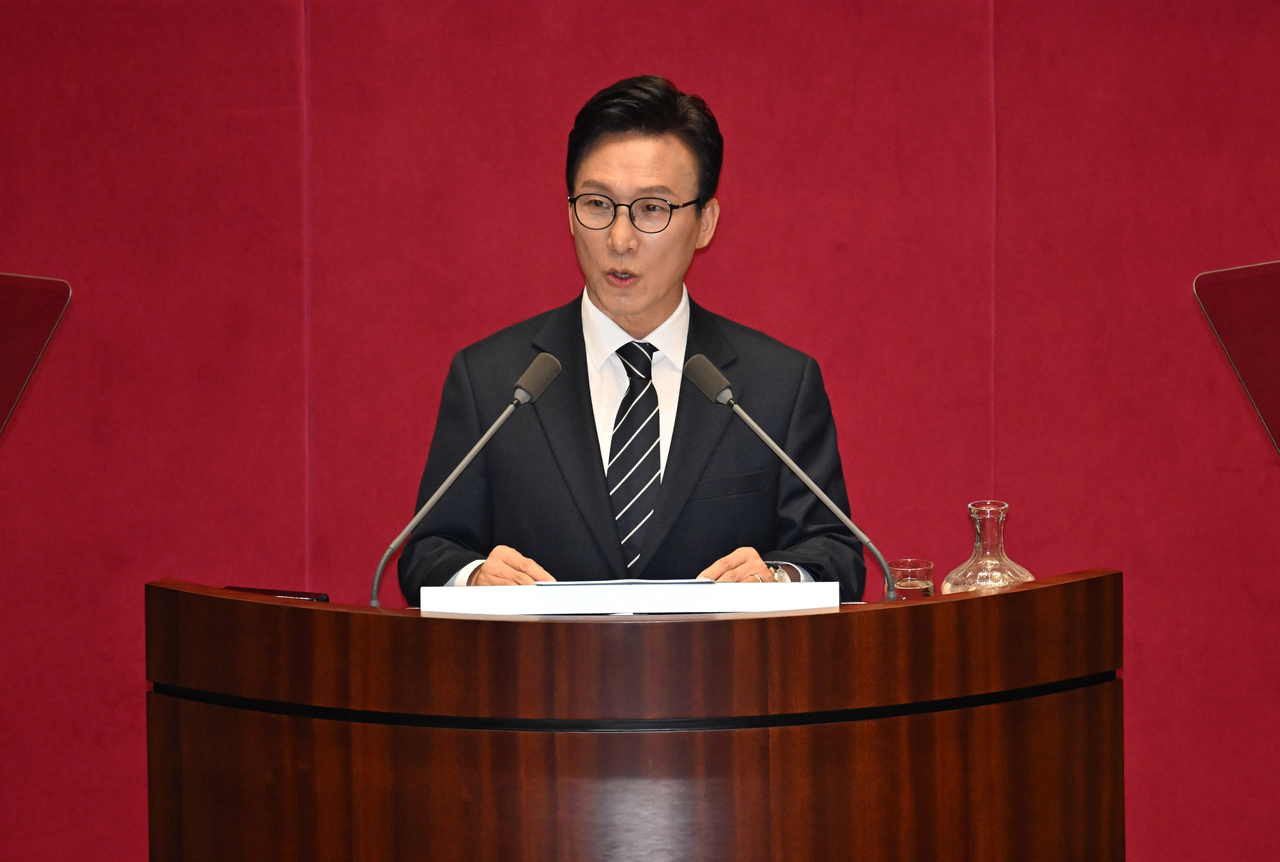
Democratic Party of Korea leader Kim Min-seok proposed Monday that the country open a public debate on a "Housing New Deal" — a plan to dramatically expand the housing budget — in his first floor leader speech since taking office. He also said he would work to establish a housing policy governance body bringing together central and local governments, stakeholders and experts.
"There needs to be a public debate on the gradual pursuit of a Housing New Deal that dramatically expands a housing budget that has long depended on funds and revenues from development and asset sales," Kim said at the National Assembly plenary session.
"The foundation of housing policy goes beyond price stability — it must address the housing problem itself," Kim said. "It must encompass price stability and supply in the Greater Seoul area, as well as improved living conditions and housing welfare in non-metropolitan regions and rural communities."
Kim also pledged to accelerate housing supply, saying there was a need to discuss high-density and mixed-use development in transit-oriented areas and semi-industrial zones, as well as the mixed-use redevelopment of water reclamation centers proposed by the Seoul Metropolitan Government. He described height restrictions near the National Assembly and the Supreme Court as "relics of an authoritarian era."
He added that the government would push the third-generation new towns forward "at an unprecedented pace so that people can feel the results by 2030," including fast-tracking ground-breaking on already-announced sites. Kim also proposed forming a ruling-opposition consultative body on housing supply and policy. "We will actively consult with the opposition party and the Seoul Metropolitan Government," he said. "We will form a ruling-opposition housing policy consultative body, and if necessary, address it continuously and as a priority through a joint livelihood-economy consultative body."
Kim said he would also pursue "eight-party talks" to discuss the voluntary and stable relocation of semiconductor workers to regional areas and efficient workforce management as part of realizing three major mega-projects. "We will discuss ways to achieve the voluntary and stable relocation of semiconductor-related workers to the regions, and efficient workforce management to compete against rivals such as China," he said, adding that the talks would involve the central government, local governments, the National Assembly, local councils, universities, civil society, businesses and labor.
On the economy, Kim signaled further market reform following the third revision of the Commercial Act. "After the third Commercial Act revision, we will continue to innovate market systems, including strengthening disclosure requirements and introducing a discovery system," he said.
Kim also vowed to pursue constitutional reform alongside political reform. "We will pursue a realistic constitutional amendment that reflects the changes of the times and the demands of the people, while upholding the procedural spirit of the current Constitution and laws," he said. He proposed enshrining the May 18 pro-democracy movement and the Buma Democratic Uprising in the constitutional preamble as "the starting point of constitutional reform," and said restructuring the power structure should "go as far as the people want." He added that he would push forward discussions on easing the threshold for recognized parliamentary negotiating groups.
Kim also put forward a modest proposal to ease partisan tensions. "Forget grand political reform — let's start small and sit mixed at plenary sessions," he said, suggesting members be seated in alphabetical order rather than by party.
"If you give the leadership some leeway, I would be happy to sit in the back with floor leader Jang Dong-hyeok, or in the front if we go alphabetical," he added, asking the floor leaders of both parties to consider changing the seating arrangement at plenary sessions.
thanks@heraldcorp.com