Retail and foreign investors may misread Democratic Party's commitment to capital market reform, lawmaker warns
Calls for revision of a mandatory tender offer bill have emerged within the Democratic Party of Korea, even as the ruling and opposition parties move forward with a jointly agreed plan to require any acquirer gaining a stake of 25 percent or more — and thus becoming the largest shareholder — to purchase shares totaling at least 50 percent plus one share.
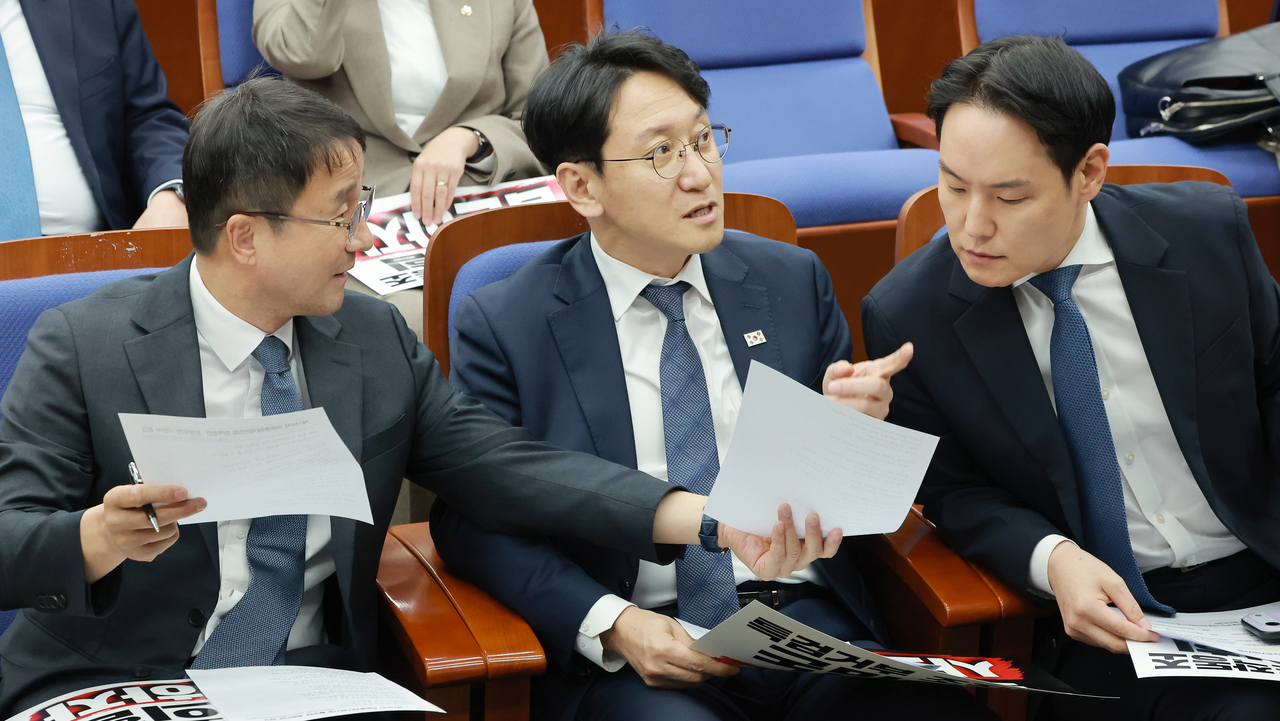
Rep. Park Hong-bae of the National Assembly's Political Affairs Committee raised the alarm at a Democratic Party policy caucus on Tuesday, warning that if the bill passed as written, "there is a very high chance that not only ordinary retail shareholders but also foreign investors will misjudge the Democratic Party as lacking the will to properly reform the capital markets." Park argued that with the Kospi hovering around the 5,000 level, the 50-percent-plus-one-share mandatory tender offer requirement could become an additional drag on the index.
A mandatory tender offer regime requires an acquirer taking control of a listed company to purchase shares from ordinary shareholders at the same price paid to the controlling shareholder — not just from the largest shareholder alone. The system is designed to prevent situations like the Namyang Dairy Products case, in which ordinary shareholders suffered heavy losses after the controlling shareholder sold out and the share price collapsed.
Ordinary shareholders have pushed back strongly against the 50-percent-plus-one-share threshold agreed to by the ruling and opposition parties, arguing that all general shareholders should be guaranteed the right to sell their stakes on the same terms as the controlling shareholder. Their concern is that the threshold would offer little practical protection because the largest shareholders of small and medium-sized enterprises targeted for mergers and acquisitions often hold more than half of the shares themselves. The average combined stake held by the largest shareholders and their related parties at domestically listed companies stood at 42.39 percent as of last year.
At the caucus, Rep. Yoo Dong-su, who chairs the National Assembly's Political Affairs Committee, pushed back against reopening the debate. "The mandatory tender offer bill was agreed upon by the ruling and opposition parties and has already cleared the Legislation and Judiciary Committee," Yoo said. "What would happen if we took this back to the Political Affairs Committee for further discussion or introduced an amendment?" Yoo added that the bill should be passed first and amended later if necessary.
Another Democratic Party lawmaker on the Political Affairs Committee said the threshold had been agreed upon by the ruling and opposition parties' policy committees after weighing concerns about a potential chilling effect on mergers and acquisitions. "Even if it is not 100 percent satisfactory, the idea is to restart the mandatory tender offer regime for the first time in 28 years," the lawmaker said.
The remark reflected the view that requiring acquirers to buy out all ordinary shareholders in full could dampen merger and acquisition activity. During the bill's review, FSC Vice Chairman Kwon Dae-young said, "From a pure shareholder-value standpoint, the 100 percent approach has full logical merit, but an appropriate balance is needed given that corporate restructuring needs to happen on a fairly broad scale."
The Democratic Party said it plans to continue discussions on the mandatory tender offer bill. Floor spokesperson Kim Seong-hoe said the party is "well aware of the concerns raised by market participants regarding the mandatory tender offer," adding that "since the matter cannot be resolved in a single discussion, we plan to gather opinions and hold further deliberations at the next general assembly meeting."
addressh@heraldcorp.com
thanks@heraldcorp.com