![[Herald Business DB]](https://wimg.heraldcorp.com/news/cms/2026/08/21/news-p.v1.20260609.0f7987c31c5445149d869d79ca1f8e48_P1.png)
More than 40 people die by suicide every day in South Korea, yet the country's prevention policies remain heavily focused on individual psychological and mental health issues, a new legislative report has found. Researchers are calling on the government to strengthen the legal framework so the state takes responsibility for addressing structural social factors — poverty, unemployment and social isolation — that drive up suicide risk.
South Korea recorded 14,872 suicides in 2024, up 894, or 6.4 percent, from the previous year, according to a report released Saturday by the National Assembly Research Service titled "What Is the Suicide Prevention Act Missing in Addressing Suicide Risk?" The suicide rate reached 29.1 per 100,000 people — the highest since 2011 — equivalent to an average of 40.7 deaths per day.
South Korea's suicide rate is among the highest in the OECD. In 2023, the country's rate stood at 24.8 per 100,000, more than double the OECD average of 10.9. The research service noted that international bodies including the WHO identify social determinants — poverty, unemployment, education levels, housing conditions and social isolation — as key factors elevating suicide risk.
The recent rise in suicide rates has been particularly pronounced among people in their 30s, 40s and 50s, who form the core of the country's working-age population.
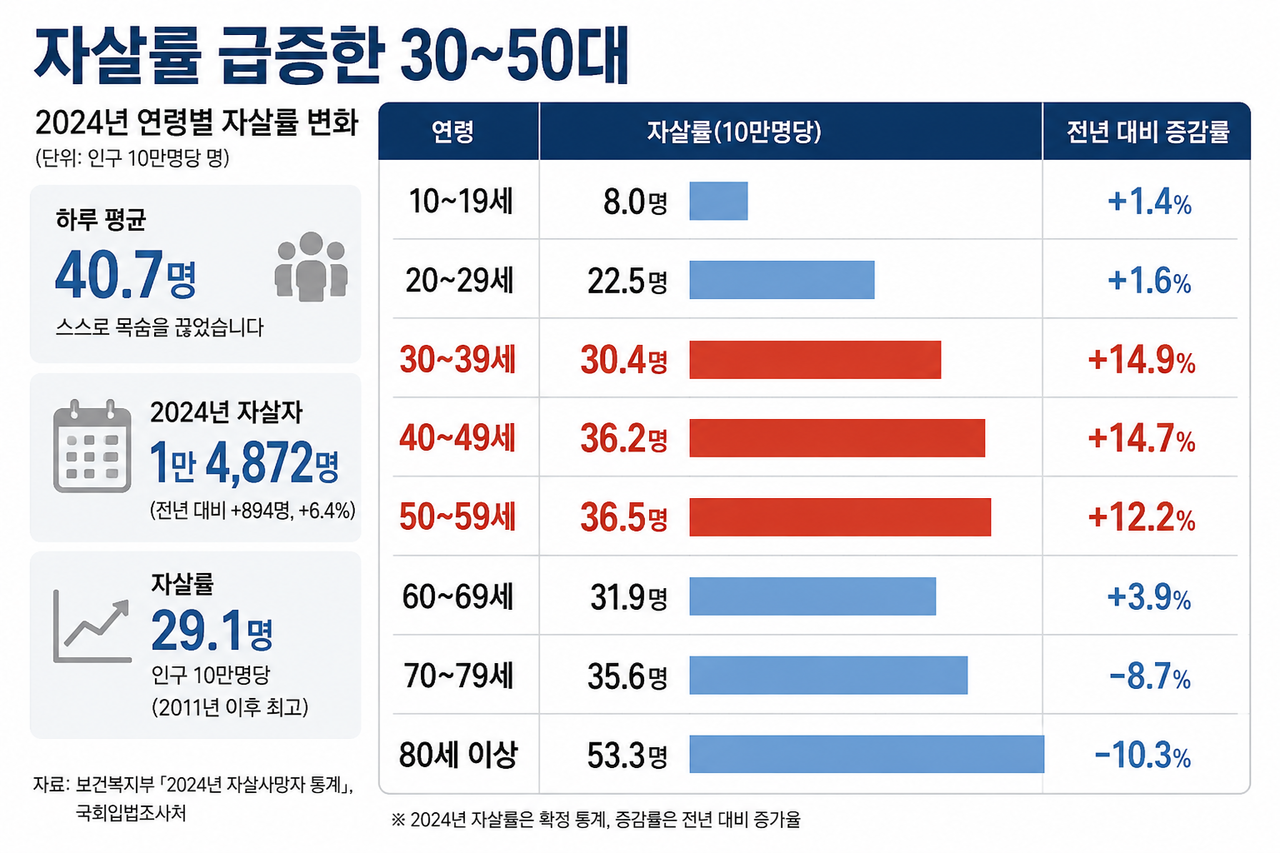
The suicide rate among people in their 30s rose 14.9 percent in 2024 from the previous year, while rates for those in their 40s and 50s climbed 14.7 percent and 12.2 percent, respectively. By contrast, rates fell 8.7 percent among people in their 70s and 10.3 percent among those aged 80 and older.
Socioeconomic factors figure prominently among the causes. Korean National Police Agency data on unnatural deaths in 2024 show that mental and psychiatric problems were cited as the leading motive at 35.4 percent, but economic difficulties accounted for 29.6 percent of cases. Physical illness followed at 15.2 percent, family problems at 4.7 percent, and workplace or occupational issues at 3.3 percent.
Among men, economic problems were the leading motive at 35.7 percent, outpacing mental and psychiatric issues at 27.7 percent — a finding that points to a close link between financial insecurity, employment problems and suicide risk.
Yet the current Act on the Prevention of Suicide and the Creation of a Culture of Respect for Life does not adequately address these structural social risk factors, the research service said.
The existing law designates suicide prevention as "a national responsibility" and calls for pan-government preventive measures. In practice, however, the policy framework centers on changing sociocultural attitudes — spreading awareness of the value of life and fostering a culture of respect for life — rather than tackling underlying social conditions.
As a result, the legal system in practice focuses on individual and psychological approaches: identifying at-risk individuals, restricting access to means of suicide, blocking online content that encourages self-harm, and conducting prevention education.
Han Jin-ok, a legislative researcher at the National Assembly Research Service, said suicide should be viewed not merely as an individual psychological problem but as a "social disaster" shaped by a complex interplay of social, economic and environmental factors. The current Suicide Prevention Act, she said, lacks a sufficient legal basis for clearly designating the state's responsibility to address structural risk factors and for specifying the roles of related ministries and their coordination mechanisms.
Japan has already enacted legislation treating suicide as a problem requiring a whole-of-society response. When Japan passed its Basic Act on Suicide Countermeasures in 2006, it embedded in the law's founding principles the recognition that suicide can stem not only from personal circumstances but also from a range of social factors. The law also requires that suicide prevention be pursued comprehensively, linking health and medical policy with welfare, education and labor policy.
The management of locations where suicide attempts recur — rooftops, high-rise buildings and bridges — was also identified as a blind spot in the current law.
Falls accounted for 19.0 percent of all suicide deaths in 2023, and among young people aged 9 to 24, falls made up 46.8 percent of all suicide methods. Yet unlike the legal frameworks governing suicide-inducing materials and online content, the Suicide Prevention Act provides a relatively weak legal basis for managing the physical environments of rooftops, high-rise buildings and bridges.
South Korea requires automatic emergency-door opening devices on rooftop access doors in residential complexes, but the requirement does not apply to existing buildings. The Ministry of Health and Welfare supports a "means restriction project" that includes fall-prevention measures at bridges and high-rise buildings, but only four local governments — Seoul, Daegu, Sejong and South Jeolla Province — are currently running fall-prevention programs. Safety infrastructure levels vary depending on local interest and fiscal capacity.
The research service recommended amending the Suicide Prevention Act to clarify the state's responsibility for addressing structural social risk factors.
One proposal would add "identifying and improving structural social factors related to suicide prevention" to the statutory definition of suicide prevention activities, making responses to poverty, unemployment and social disconnection explicit legal obligations. A bill to amend the Suicide Prevention Act has already been introduced in the National Assembly this month; it would reframe suicide as a structural social problem and establish a legal basis for pan-government coordination and means restriction.
The report also recommended adding a new provision on "building a means-restriction system" that would allow the central and local governments to conduct surveys, monitoring and fiscal support for locations and facilities where suicide attempts repeatedly occur. It further proposed amending the Building Act and the Road Act to create a legal basis for installing safety facilities on rooftops and bridges, with costs covered by central and local governments.
Han said people at high risk of suicide often face not only mental health problems but also economic, employment, housing and legal difficulties, and called for a comprehensive overhaul of implementation systems — including clearer accountability for central and local governments and stronger coordination among relevant agencies and social welfare services.
If you are thinking about self-harm or suicide, contact the Ministry of Health and Welfare's helpline 1393, available 24/7. Please request a translator for English-language services.
fact0514@heraldcorp.com