
Share of middle-income earners with falling income hit 38.9% in 2024, highest since COVID-19 year of 2020
Share with rising income dropped to 57.3%, lowest since 2021, down 5.7 percentage points
Semiconductor boom benefits concentrated among top earners, limiting broader recovery
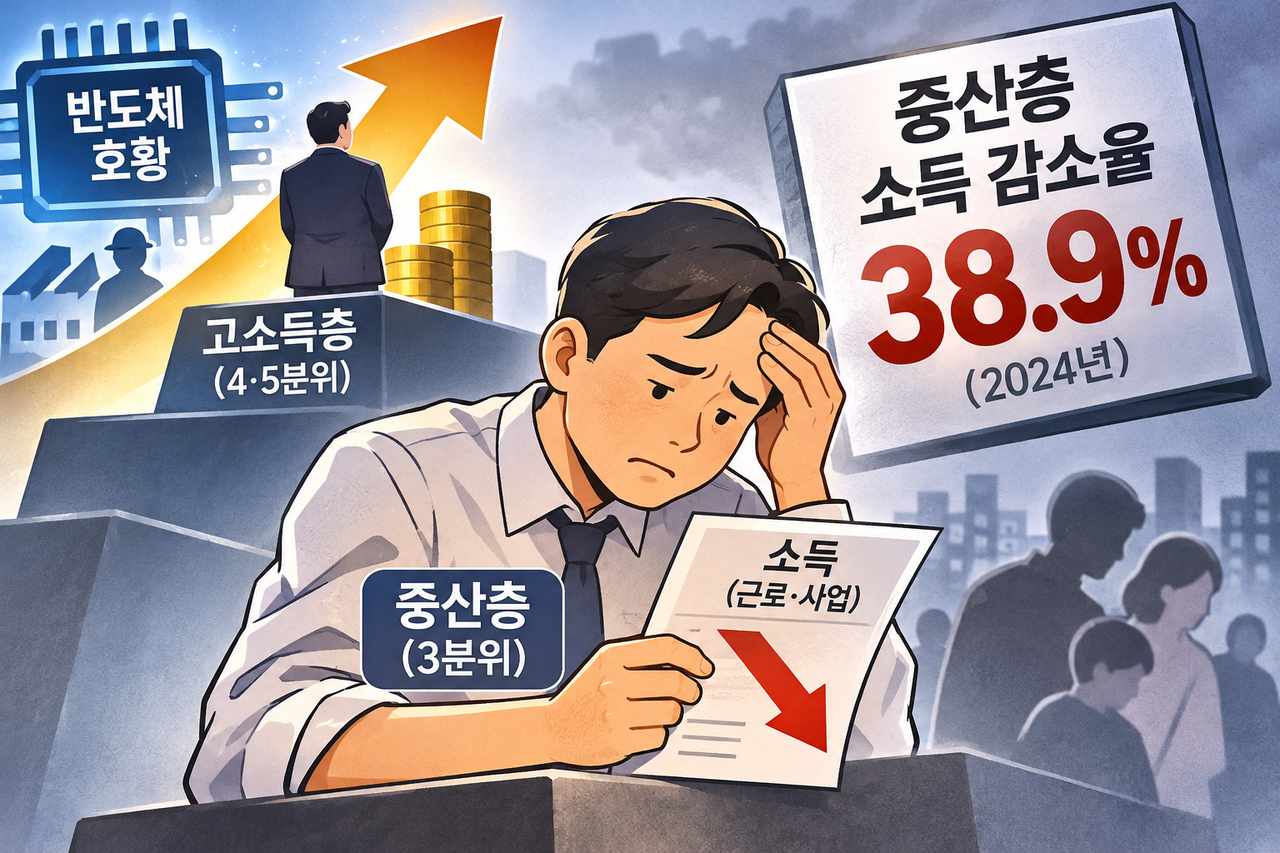
Nearly four in 10 middle-income earners saw income fall in 2024 compared with the previous year — the highest share since 2020, when the COVID-19 pandemic dealt its heaviest blow to household finances. At the same time, the proportion of people whose income grew dropped to its lowest level in three years, raising concerns that the benefits of economic recovery are not reaching all income groups equally and that income polarization may be deepening.
According to the Ministry of Statistics' 2024 Income Mobility Statistics released Sunday, 38.9 percent of individuals in the third income quintile — a standard proxy for the middle class — recorded lower earned and business income in 2024 than in 2023. That was up 3.7 percentage points from 35.2 percent the previous year.
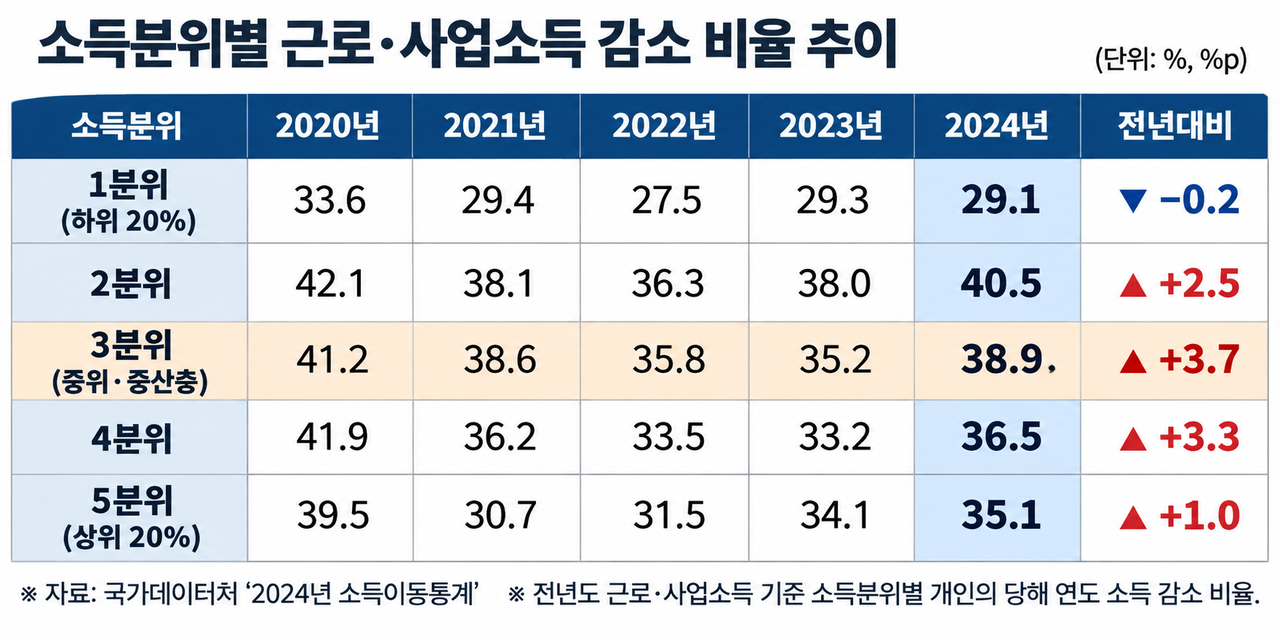
The share of middle-income earners experiencing an income decline had fallen for three consecutive years after peaking at 41.2 percent in 2020, easing to 38.6 percent in 2021, 35.8 percent in 2022 and 35.2 percent in 2023. The reversal in 2024 pushed the figure back to its highest point since the pandemic year.
The depth of the income losses was also notable. Among those whose income fell, 32.9 percent saw it drop to less than half of the prior year's level — meaning one in three people who experienced an income decline suffered a drop of 50 percent or more. Across all individuals in the quintile, 12.8 percent saw their income cut by at least half, up 0.5 percentage points from the year before.
On the other side of the ledger, the share of individuals whose income rose fell to 57.3 percent in 2024, down 5.7 percentage points from 63.0 percent the previous year — the lowest level since 2021.
Particularly striking was the share of individuals whose income grew by 50 percent or more, which fell to 9.7 percent — down 2.3 percentage points from the prior year and the lowest since the statistics were first compiled in 2018.
Middle class hit hardest as income declines spread across all quintiles
The trend of falling incomes was not confined to the middle class — it was visible across low- and high-income groups as well. However, the increase in the share of income decliners was steepest among middle-income earners.
In the second quintile, the share of individuals with lower income rose from 38.0 percent in 2023 to 40.5 percent in 2024, a gain of 2.5 percentage points. The fourth quintile saw a 3.3-percentage-point increase, from 33.2 percent to 36.5 percent over the same period. Even the top quintile edged up 1.0 percentage point, from 34.1 percent to 35.1 percent.
The bottom quintile — the lowest 20 percent of earners — was the exception, with its share of income decliners nudging down slightly, from 29.3 percent to 29.1 percent.
The fact that the third and fourth quintiles recorded the sharpest increases — 3.7 and 3.3 percentage points, respectively — suggests that middle-income households faced a relatively pronounced deterioration in their income conditions.
The data indicate that while falling incomes are not limited to any single group, the momentum of income growth is weakening most visibly among middle-class earners.
Semiconductor boom leaves middle class cold as growth gains stay concentrated at top
The central concern is that the ongoing economic recovery may not translate into meaningful income gains for middle-class households.
South Korea's economy is forecast to grow at around 3 percent this year, driven largely by an improvement in the semiconductor sector. Yet stronger earnings in semiconductors and other export-oriented manufacturing industries have limited capacity to lift household incomes across the board.
Wage increases and capital gains flowing from the semiconductor boom tend to accrue disproportionately to higher-income earners.
"Bonuses and benefits from semiconductors and certain other manufacturing sectors tend to be concentrated in the fourth and fifth quintiles, which are dominated by workers in their 30s and 40s," a Ministry of Statistics official said. "For middle-income earners in the third quintile, the warmth from strong export performance may have limited reach."
The Bank of Korea reached a similar conclusion in a report published in July, finding that wage gains and capital gains stemming from the recent semiconductor upswing are flowing primarily to high-income, high-asset households — groups with relatively low marginal propensities to consume and weaker asset-effect dynamics.
That suggests the spillover from export-led growth to domestic demand and broader household income may be more limited than in past cycles.
As a result, concerns are growing that if middle-class incomes fail to keep pace with a rebound in headline growth figures, the gap between macroeconomic indicators and the economic conditions that ordinary households actually feel could widen further.
fact0514@heraldcorp.com




