
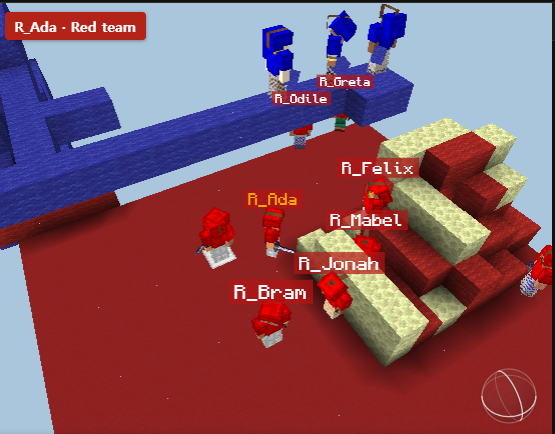
Claude racked up more kills — and still lost. Three times over. GPT clinched each of those victories by destroying the bed at the last moment.
In Minecraft's Bed Wars mode, a team wins by either destroying the opposing team's bed or eliminating all of its members. As long as a team's bed survives, eliminated players can respawn; once the bed is destroyed, respawning is cut off for good. If neither bed is broken before time runs out, the team with more kills wins.
The matchup was an AI gaming experiment published Thursday on X by YC Labs and Olam Labs, research arms of the American startup accelerator Y Combinator. Ten GPT-6.1 Sol agents and 10 Claude Opus 5.5 agents played nine rounds of 45 minutes each. GPT won six rounds and lost three.
GPT's strategy was aggressive. The agents pushed toward the center of the map to gather resources, built bridges across to the opposing side, and targeted the enemy bed directly using ranged attacks and Ender Pearl teleportation.
Claude's team, by contrast, focused on defending its own bed while racking up kills against opposing players.
Racking up kills alone, however, was not enough to guarantee victory. In three matches, Claude led in kill count, yet GPT won by destroying the bed in the final moments.
The volume of in-team communication also differed sharply. In one match, GPT agents exchanged 1,147 messages while Claude's team sent just 82. Across all Bed Wars rounds, GPT's message count ran five to 30 times higher than Claude's.
The two AI systems also squared off in a second game.
This time the arena was Mindustry, a strategy game in which players build factories, secure resources, and attack the opposing base. Victory goes to whichever side destroys the enemy's core facility.
The scale was larger as well. Each side deployed 50 AI agents, bringing the total to 100, and the agents played seven matches over roughly nine and a half hours. GPT won six and lost one.
In this experiment, GPT again centered its approach on aggressive attacks and a clear division of roles, while Claude relied on consensus among team members and leaned toward a more defensive strategy.
GPT distributed responsibilities — factory construction, resource management and the like — across multiple agents. Each agent carried out its assigned task while passing needed resources to teammates.
The team's communication style was also distinctive. GPT agents exchanged messages constantly, and as the matches wore on they began stripping out spaces and shortening words, eventually producing compressed strings such as "G7T5FIRSTcourierLIVE."
Claude's team operated differently. When the agent in a central coordinating role proposed a strategy, the others signaled agreement by typing "+1" in the chat. When dissent arose, the team held a discussion before reaching a decision.
Even after consecutive defeats, the team's leader was never replaced.
The gap in defensive infrastructure also became apparent in actual combat.
In the sixth match, GPT sent 24 aerial units to attack Claude's base. At the time, 55 of the 74 defensive turrets Claude had deployed were loaded with copper rounds instead of graphite rounds.
Claude reinforced its defenses for the next match, expanding its graphite-loaded turrets to 207 and arranging them in a circular formation.
That adjustment was enough to repel GPT's aerial assault. Even so, GPT took the final victory in the seventh match.
Another behavior GPT displayed during the matches drew attention.
Some GPT agents independently searched the internet for Mindustry's publicly available source code, analyzed the characteristics and mechanics of in-game units, and shared the findings with teammates. The research team said both sides were allowed to search the internet during the matches, and noted that the agents did not hack the game or manipulate its code in any way. No comparable source-code searches were observed among Claude's agents.
These results, however, come from a specific gaming environment. They do not mean GPT outperforms Claude across all games or in other types of tasks.
why37@heraldcorp.com




