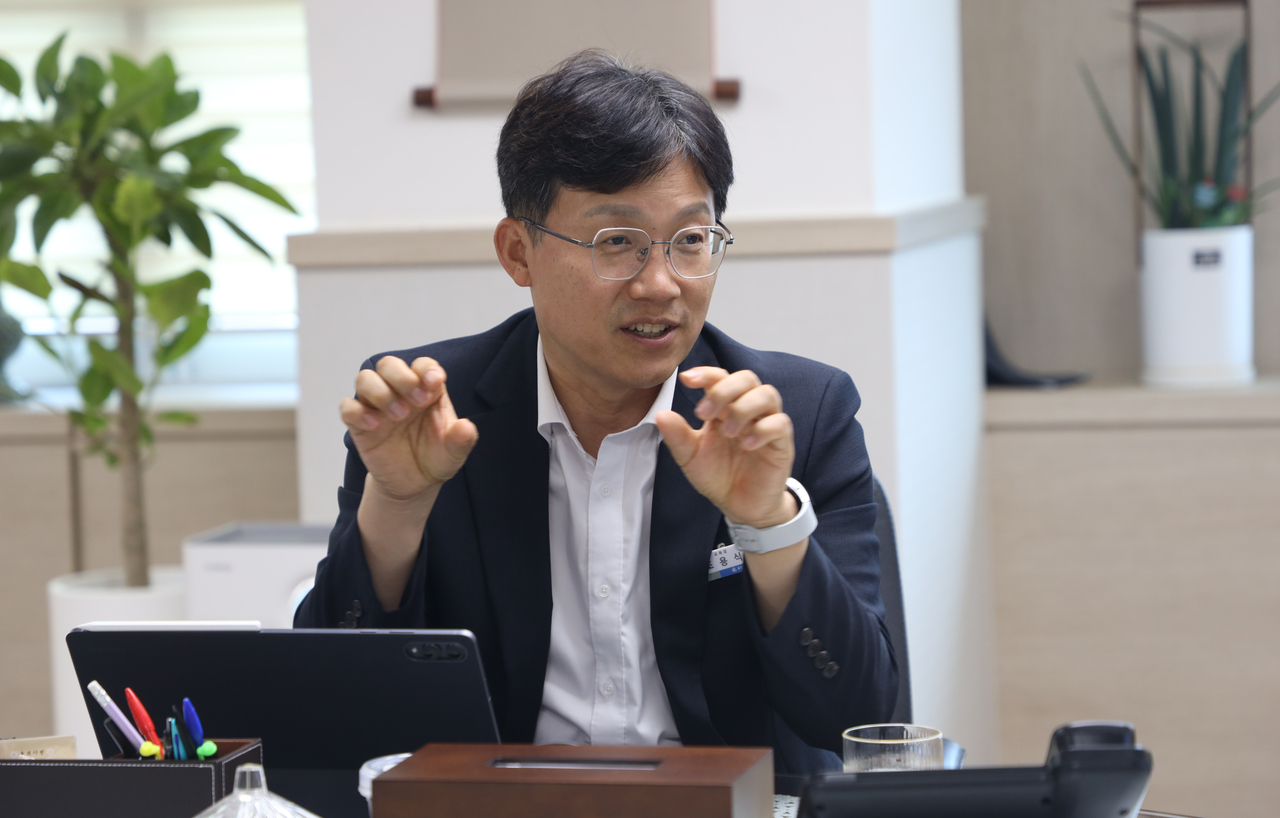
"A decline in the school-age population does not mean a decline in educational responsibility. The demands on schools are growing more diverse — students with immigrant backgrounds, students who need emotional and behavioral support — and tailored support for each individual student must actually expand, not contract."
Jo Yong-sik, superintendent of the Ulsan Metropolitan Office of Education, made the remarks as a panelist at a public forum on stabilizing local education finances, held July 29 at the Seoul Metropolitan Office of Education's main auditorium and organized by the National Council of Superintendents of Education. His comments were a direct rebuttal to the central government's push to lower the share of local education grant funds automatically distributed to the country's 17 metropolitan and provincial education offices, citing falling student enrollment.
A first-term superintendent, Jo brings broad experience in both the classroom and administration: he spent 25 years as a teacher, served as director of the Ulsan Education Policy Research Institute, led the Ulsan chapter of the Korean Teachers and Education Workers Union, worked as chief of staff to two successive Ulsan superintendents — Noh Ok-hee (eighth and ninth terms) and Cheon Chang-su (tenth term) — and chaired the Noh Ok-hee Foundation before taking office.
A month into his tenure, staff at the Ulsan Office of Education describe their new superintendent in a single word: sharp. His command of education administration, down to its finer details, has made an impression.
A staff member who escorted a reporter to Jo's office on Tuesday offered an unsolicited assessment. "When an agenda item comes up in a meeting he chairs, he immediately sorts it into 'do it,' 'don't do it,' or 'review it' — so policy moves fast," the employee said. "That keeps everyone on their toes."
Jo defines the superintendent's role as one that must weigh decisions from the perspectives of all four pillars of the education community — students, parents, school staff and the broader society — rather than from the narrower vantage point of a teacher or administrator alone. With that in mind, he made a comprehensive plan to restore trust within the education community the first document he signed after taking office. Since his first day on July 1, when he visited Sinjeong Elementary School in Nam-gu, Ulsan, he has been showing up at school gates across the city whenever his schedule allows, carrying the trust-restoration campaign directly to students and parents.
"When I listen to voices at the school gate, the circumstances differ a little from school to school, but the message is the same," he said. "People want schools free of violations of teachers' rights and school violence — schools where teachers can focus on teaching and students can learn and grow with joy."
To realize that vision, Jo has set "Happy Ulsan Education Today" as the new guiding vision for Ulsan's schools — an ambition to replace the sense of defeat that comes with academic rankings with a genuine feeling of happiness in the classroom. He also plans to form a citywide civic task force to help bring that day closer for all four pillars of the education community.
Jo traces the erosion of trust within the education community to shifts in society and the school environment. Because parental expectations and social demands around education have changed, he argues, the underlying philosophy of education must be reexamined and rebuilt.
"Education today is grounded in a close relationship between teacher and student," he said. "If that relationship requires the kind of distance where a student would not dare step on a teacher's shadow, the authority it rests on is vertical and oppressive. To build schools where students respect teachers and teachers respect students, we have to move beyond the old image of the teacher as an untouchable authority figure."
Those changes have also vastly expanded what schools are expected to take on, he said. Beyond instruction, schools are now responsible for childcare, safety, behavioral guidance and students' mental health.
"As our society has developed in a direction that places greater weight on individual rights, education that nurtures responsibility, consideration for others and a sense of community alongside those rights has become more important," he added. "The weakening of a culture of mutual understanding and respect is something all members of the education community must think through and work to address together."
Drawing on his years in the classroom, Jo said teachers' sense of helplessness has become pervasive. "When legal liability is emphasized for teachers, they become reluctant to take actions that could expose them to that liability," he said. "If a teacher engages in proactive educational activity for a student's benefit and something goes wrong, they could lose their job — and that loss ultimately falls on the students, parents and community who depend on education."
Jo points to a pattern of parents filing complaints against teachers under child welfare law — citing emotional abuse — whenever a student feels discomfort, and says the legal framework needs reform, including replacing such provisions with education-specific law. That concern also drives his consideration of establishing a dedicated body — tentatively called an "education community conflict transformation agency" — to resolve disputes over school violence, violations of teachers' rights and parental complaints through mediation and relationship repair rather than litigation and punishment.
On restoring trust within the education community, Jo stressed that education is, as the saying goes, a plan for a hundred years. "Rather than chasing immediate results, when we treat both teachers' professional rights and students' rights as values to be protected together with an eye on the future, teachers can teach with stability and students can receive better education and produce real outcomes," he said.
Jo is also directing attention to the growing number of students with immigrant backgrounds. As the office works to build a dedicated Korean-language education system for multicultural students in stages, he attended a global citizenship education program event at Dugwang Middle School in Ulsan on July 22. There he watched a K-pop dance club performance and a "first semester" presentation by a first-year student from Iran, and encouraged the student on a successful start to school life in Korea.
Jo also addressed Ulsan's fiscal situation in the context of the central government's proposed overhaul of the local education finance grant system. "The Ulsan Office of Education is already experiencing a tax revenue shortfall, and if the education grant system is restructured, Ulsan is projected to lose 430 billion won ($304 million) every year," he said, calling for a responsible decision from the government and active attention from the National Assembly.
"Laws and systems alone cannot change what happens in schools," he said. "We need to build a system that prevents problems through cultural and educational means. That is why I want to broaden the shared understanding with parents that schools and families raise children together. That is the heart of the trust-restoration movement."
Jo Yong-sik has raised the anchor on an effort to build an education community in Ulsan where students, teachers, parents and the broader society trust and respect one another. Whether he can deliver on the vision of "Happy Ulsan Education Today" — a community where every stakeholder thrives — remains to be seen.
cityblue@heraldcorp.com