On a Friday afternoon June 24, five elementary school students sat hunched over their work at the Woori Neighborhood Care Center No. 9 inside the Sageun-dong Community Service Center in Seongdong-gu, Seoul. Using a brown clay-like material, each child shaped a name plaque — circles, squares, triangles, hearts and clouds — then pressed their name in large letters into the surface. Three college students in aprons moved quietly among them, offering gentle guidance.
The session was run by Seramico, an entrepreneurship club from Hanyang Women's University's ceramics design department, as part of a hands-on name-plaque workshop for children in the neighborhood. It was the second of four planned sessions.
Through this month, Seramico has been running a two-month eco-friendly craft education program for children at the Sageun-dong center's kids' activity space. The program uses reclaimed clay made from ground waste ceramics to create pottery for exhibition and hands-on experiences, conveying the value of resource recycling.
One elementary school student surnamed Park said he returned this week after enjoying the previous week's session, where participants made chopstick and spoon rests. "I'm going to hang the name plaque I made today on our front door," he said.
Cho Woo-young, 23, a Seramico member, said the experience opened up new possibilities. "Since we're an entrepreneurship club, most of us mostly think about starting a business after graduation," she said. "But through a program like this, it was great to be able to consider careers related to education as well."
Seramico's activities are part of the Seoul Metropolitan Government's "2026 Seoul Club ON" project, which supports university clubs' social-contribution activities. The city launched the program last year to encourage club participation and help students grow as members of society by expanding young people's opportunities for civic engagement and rebuilding social networks.
This year, 155 clubs were selected for support, with 6,000 active student participants. The program is divided into two tracks: a self-directed "planning" track, in which clubs design their own activities (114 clubs), and a "participation" track, in which clubs join programs organized by the city (41 clubs).
While last year's program offered only a basic subsidy, this year the city brought in outside specialist organizations to provide preliminary training and consulting, allowing clubs to showcase their talents in a more structured way.
Participant satisfaction has been high. Of the 123 clubs that took part last year, 91.9 percent reported being satisfied with the program, and 92.6 percent of participating members said their personal capabilities had improved.
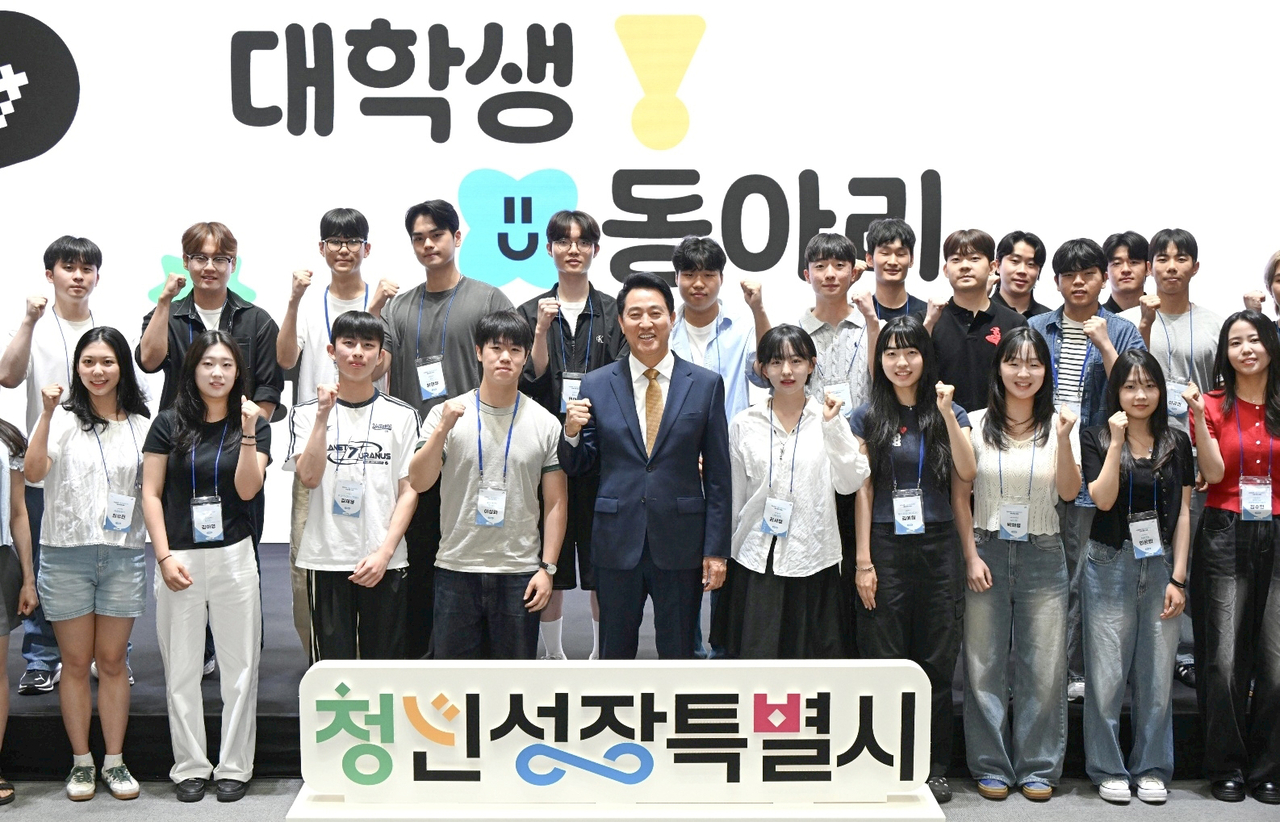
Through the program, the Seoul Metropolitan Government provides university clubs engaged in social-contribution activities aligned with the city's "companionship and charm" governance values with up to 2 million won ($1,360) per year.
Last year, 123 clubs carried out 1,661 activities across Seoul over roughly six months, covering a broad range of areas including welfare, culture, the environment and health. Through talent donations and mentoring that drew on each club's major and strengths, a cumulative total of 94,596 residents benefited.
The city plans to hold a year-end performance showcase and conduct ongoing monitoring to ensure the program delivers tangible results and helps participants strengthen their individual capabilities.
Kim Cheol-hee, the Seoul Metropolitan Government's director of future youth planning, said the Seoul Club ON program is "an opportunity to contribute to society using each person's major and strengths, while also growing as an individual." He added that he looks forward to seeing a wide range of activities that bring energy and fresh ideas from university students to local communities and to Seoul as a whole.
ikson@heraldcorp.com