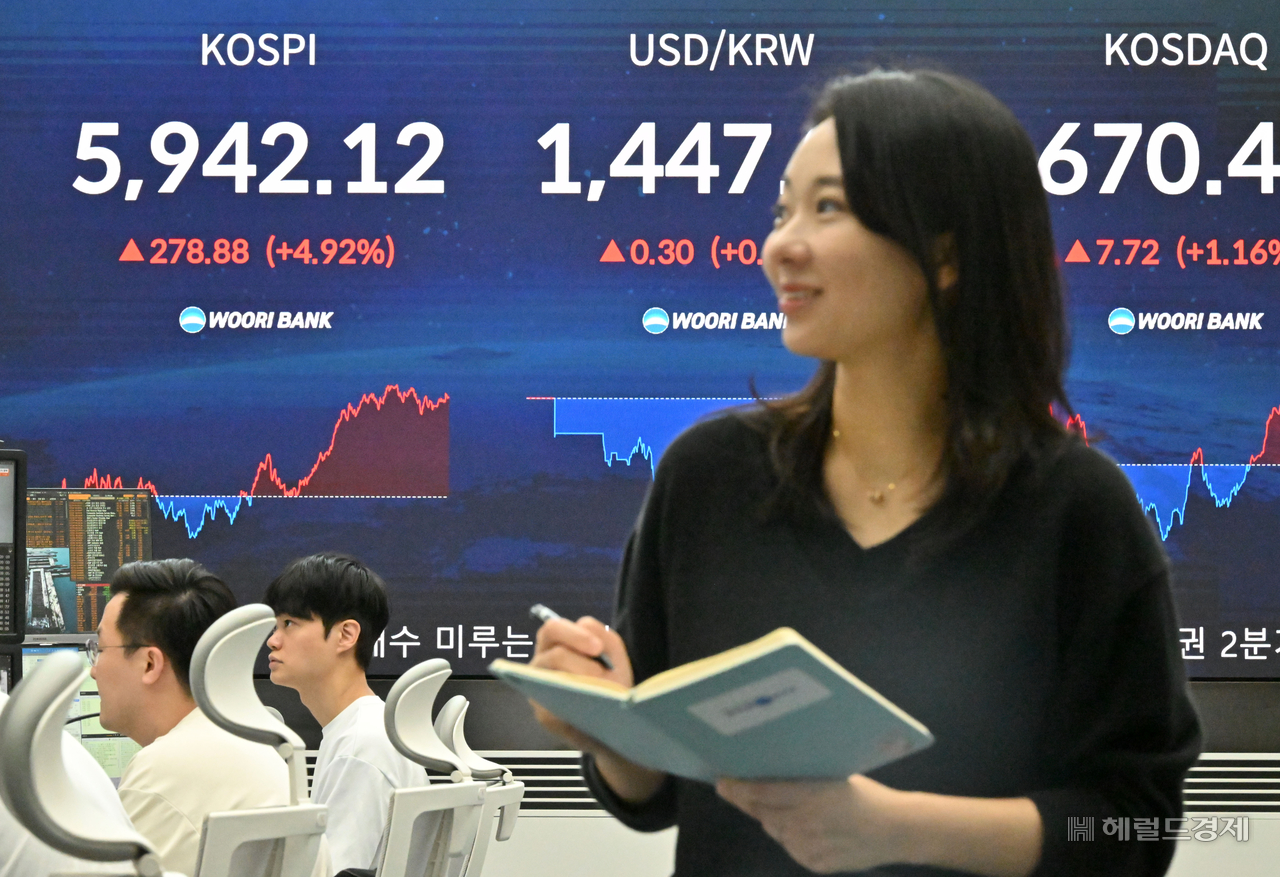
The biggest casualty of this year's domestic market rout was not the Kosdaq but the Kospi. Circuit breakers and sidecar halts were triggered more than twice as often on the Kospi as on the Kosdaq, reflecting price swings of unusual severity. Market analysts attributed the outsized volatility to the heavy concentration of Samsung Electronics and SK Hynix — which together account for roughly half of Kospi market capitalization — combined with large-scale net selling by foreign investors.
According to Korea Exchange, circuit breakers were triggered nine times on the Kospi this year, compared with just four times on the Kosdaq over the same period. A circuit breaker — activated when an index falls more than 8 percent intraday — is itself a rare event. Historically, the mechanism had been triggered only 15 times on the Kospi and 14 times on the Kosdaq in total; this year alone accounted for nine and four of those instances, respectively. Sidecar halts, which temporarily suspend program trading, were activated 43 times on the Kospi and 27 times on the Kosdaq. While the Kosdaq typically exhibits greater volatility than the Kospi, this year the pattern reversed sharply. The Kospi's swings far exceeded those of the smaller-cap market as the index lurched between steep gains and steep losses.
The semiconductor-heavy composition of the Kospi lies at the heart of its extreme swings. As of Wednesday, Samsung Electronics and SK Hynix had a combined market capitalization of 2,242.37 trillion won ($1.55 trillion), representing 48.03 percent of the Kospi's total market capitalization of 4,669.1 trillion won. Even on June 22, when the Kospi hit a record high, the two stocks accounted for 55.67 percent of the index. With roughly half the Kospi's market value concentrated in just two names, a simultaneous sharp drop in both semiconductor giants is enough to send the entire index into a tailspin.
Volatility data confirm that the Kospi was hit harder than other major markets. According to Mirae Asset Securities, the Kospi's volatility index — which rises during sharp market swings — averaged 86.2 on a daily basis since May 27, roughly 2.5 times the Nikkei average's reading of 33.9 and five times the S&P 500's reading of 17.3.
Foreign selling was also concentrated in the same two stocks. According to Korea Exchange, from June 22 through Wednesday, foreign investors net sold 27.69 trillion won worth of SK Hynix and 18.76 trillion won worth of Samsung Electronics — a combined 46.45 trillion won in net selling from just those two names. Total foreign net selling on the Kospi over the same period reached 51.92 trillion won, meaning 89.46 percent of all foreign outflows were concentrated in Samsung Electronics and SK Hynix.
Analysts say the selling pressure reflected a confluence of factors rather than any single negative catalyst. Concerns about a surge in memory chip supply grew as China advanced development of immersion deep-ultraviolet lithography equipment, CXMT expanded production capacity, and Yangtze Memory Technologies raised the prospect of an initial public offering. Profit-taking also spread following SK Hynix's earnings release. Global semiconductor stocks fell broadly — Nvidia and Micron in the United States, Tokyo Electron and Kioxia in Japan, and TSMC in Taiwan — but the outsized weight of Samsung Electronics and SK Hynix in the Kospi meant South Korea's benchmark absorbed a disproportionately large shock.
Single-stock leveraged exchange-traded funds, whose trading volumes have surged recently, are also cited as a factor amplifying volatility. On Wednesday, when underlying stocks fell sharply, trading in 16 leveraged and inverse ETF products reached 15 trillion won — nearly double the 8.2 trillion won recorded Tuesday. That figure represented 36.1 percent of total ETF trading volume of 41.54 trillion won on Wednesday, up from 34.2 percent on Tuesday. Analysts said retail investors' bargain-hunting money flowed into leveraged ETFs rather than individual stocks, driving a surge in ETF trading that in turn amplified volatility in the underlying cash market.
The brunt of the market's decline fell on investors holding leveraged products. On Wednesday, Citigroup estimated that investors had lost approximately $38.7 billion through leveraged product positions during the recent market correction, with single-stock leveraged products accounting for a significant share of those losses. Citigroup Global Markets said the market capitalization of leveraged products tied to Korean assets peaked at around $52.5 billion on June 22 before falling to approximately $19 billion recently.
The problem is compounded by the fact that retail investors hold the vast majority of single-stock leveraged products. Financial Supervisory Service Commissioner Lee Chan-jin said at a press briefing last month that retail investors hold "about 92 percent" of single-stock leveraged products.
"The sharp market decline was significantly amplified by leveraged ETF and derivatives trading, as well as basket selling by foreign investors," said Lee Jae-won, a researcher at Yuanta Securities Korea. "As large-index stocks like Samsung Electronics and SK Hynix moved sharply and simultaneously, Kospi volatility expanded well beyond that of other major Asian markets."
hajun825@heraldcorp.com