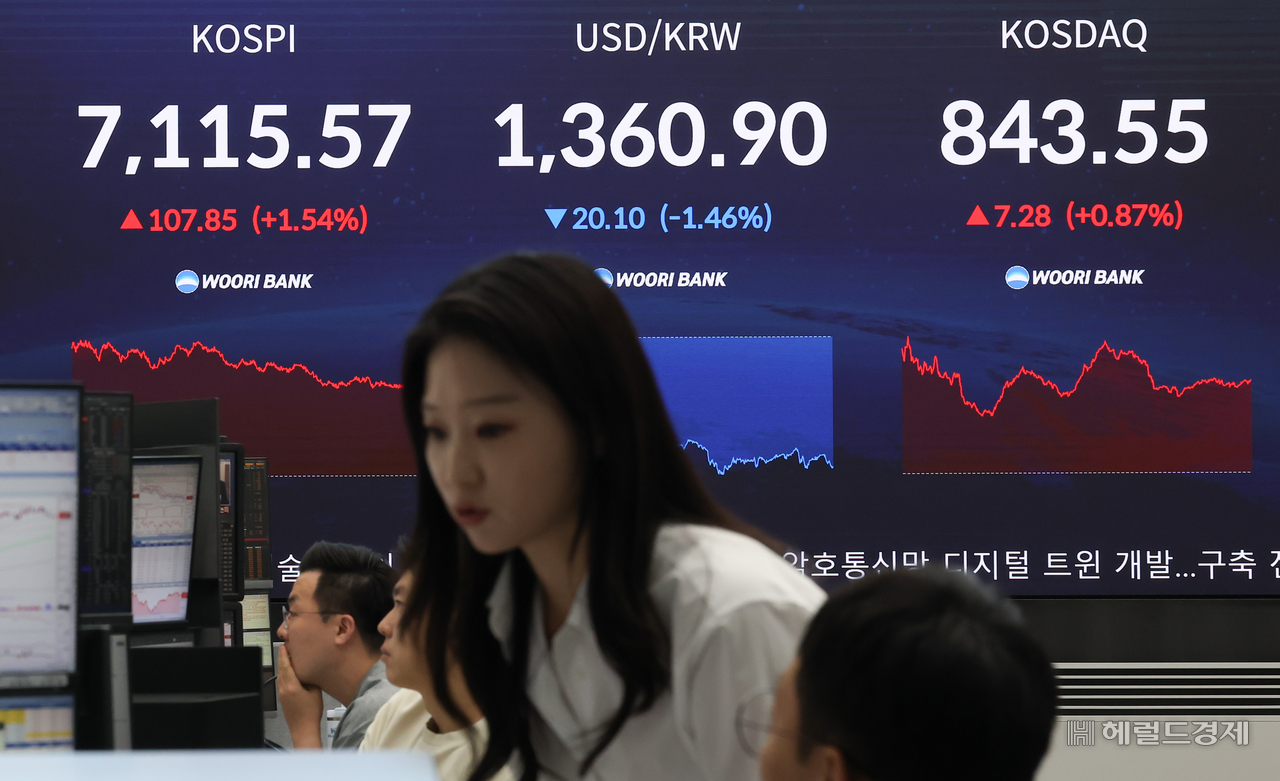
As the Kospi reclaimed the 7,000 mark, the number of listed stocks whose brokerage target prices exceed their actual share prices by more than 100 percent has grown from zero on May 6 to 14. Although the index is trading near the level it was at when it first broke through 7,000, all 14 of those stocks have fallen since then.
According to FnGuide, a financial data provider, 14 companies listed on the Kospi or Kosdaq had a target price gap ratio of 100 percent or more as of Tuesday. The gap ratio measures the difference between a stock's current price and the average brokerage target price, divided by the current price. A reading above 100 percent means the target price is more than double the current share price.
Hankuk Carbon had the widest gap at 136.01 percent. Its closing price on Tuesday was 20,550 won, less than half the average brokerage target of 48,500 won. Daehan Shipbuilding (132.92 percent), OCI Holdings (128.72 percent), Hyundai Rotem (127.01 percent) and HD Hyundai Marine Engine (121.96 percent) followed.
The share price declines have also been steep. According to Korea Exchange, Hankuk Carbon fell 56.96 percent from 47,750 won on May 6 to 20,550 won on Tuesday. Over the same period, Hyundai Rotem dropped 55.31 percent, from 262,000 won to 117,100 won. HD Hyundai Marine Engine (-49.95 percent), Hanwha Vision (-46.77 percent), Daehan Shipbuilding (-46.71 percent) and OCI Holdings (-44.30 percent) also posted sharp declines.
Market analysts attributed the widening gap to a lag between falling share prices and downward revisions to target prices. After second-quarter earnings releases dashed hopes of a sector recovery for some companies, their shares tumbled — but brokerages were slow to cut their targets by a comparable margin.
According to CompanyGuide, the average brokerage target price for Hankuk Carbon — the stock with the widest gap — was trimmed 14.16 percent, from 56,500 won to 48,500 won. Shinhan Securities cut its target from 56,000 won to 42,000 won, a reduction of 25 percent, while SK Securities and DS Investment Securities each lowered theirs by more than 15 percent.
"Companies left behind by the recovery narrative saw their shares tumble on disappointed selling after the second-quarter earnings season," a researcher at a brokerage research center said. "As brokerages did not immediately lower their target prices in line with the pace of the share price declines, the number of stocks with a gap ratio exceeding 100 percent increased."
Some analysts argue that target prices do not need to track every share price move. "Analysts tend to have a positive view of share prices — that is a phenomenon seen not only in Korea but overseas as well," said Kim Hak-kyun, head of the research center at Shinyoung Securities. "There is no obligation to cut a target price simply because the share price has fallen."
Analysts also pointed to recent sector rotation as a factor behind the widening gap. Buying interest has shifted from semiconductors to other industries, but some stocks have failed to rebound in the process.
"The recent rotation is not a rally driven by fresh capital flowing in and lifting all stocks evenly — it is a flow where investors sell existing holdings to buy into other sectors within a limited pool of funds," another research center official said. "Stocks left out of the rotation have seen share price declines accumulate over several months, pushing target prices to more than double their current levels."

hajun825@heraldcorp.com