![Logos of Samsung Electronics and SK hynix. [The Herald Business DB]](https://wimg.heraldcorp.com/news/cms/2026/09/21/news-p.v1.20260814.07a15e690ce74afcb5211963c9edc23a_P1.png)
Samsung Electronics and SK hynix have clawed back the losses they suffered when calls to slow the pace of AI development rattled domestic chip stocks, recovering to their pre-shock share prices. As the debate over AI deceleration spills into an antitrust lawsuit in the United States, voices within the semiconductor industry continue to warn of a looming supply shortage. Analysts say the recent share price declines do not reflect any deterioration in fundamentals, given that AI investment and chip demand remain intact.
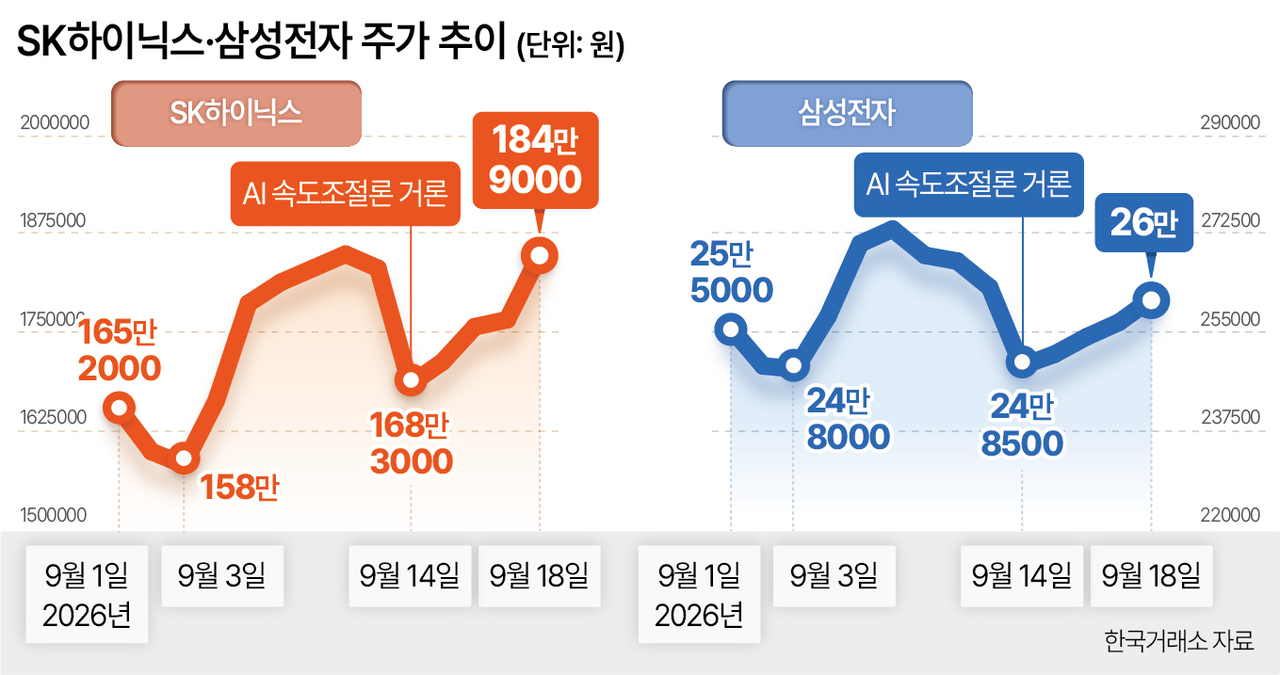
Samsung Electronics opened Monday up 1.35 percent from the previous session at 263,500 won ($190) per share, according to Korea Exchange. The stock had been pushed down to 248,500 won on Sept. 14, when concerns over AI deceleration first surfaced, before rebounding to 260,000 won by Friday. SK hynix also opened Monday up 0.49 percent at 1.858 million won. It had fallen to 1.683 million won on Sept. 14 before recovering to 1.849 million won by Friday.
The AI deceleration debate that shook domestic chip stocks last week ran into antitrust scrutiny in the United States over the weekend. Anthropic, OpenAI, Google, SpaceX AI and other AI companies were sued in a US federal court on allegations that they coordinated to slow the pace of AI development. The plaintiffs took issue with Anthropic CEO Dario Amodei's calls for "industry-wide coordination" to moderate the speed of cutting-edge AI development, and cited statements by executives at other AI firms expressing agreement with that position. The plaintiffs argued that a joint agreement among leading AI companies to slow development could constitute a prohibited restraint of competition under US antitrust law.
In contrast to the debate over AI deceleration, the semiconductor industry has seen a string of forecasts warning of supply shortages. Lee Kyung-min, an analyst at Daishin Securities, noted that Intel's CEO had flagged tightening supply conditions next year given limited memory production capacity, and that AMD had said demand for its CPUs and GPUs was outpacing supply, prompting plans to expand production. "On top of that, Nvidia CEO Jensen Huang said chip sales next year would roughly double this year's levels, lending support to sentiment around AI semiconductor investment," Lee said.
Chip stocks also advanced on US markets. The Philadelphia Semiconductor Index rose 2.78 percent on Friday (local time). Micron gained 3.92 percent, AMD rose 2.70 percent and Nvidia climbed 1.34 percent — all posting gains even as the yield on the 10-year US Treasury note climbed back above 5 percent.
Han Ji-young, an analyst at Kiwoom Securities, said the rebound illustrated the resilience of chip stocks in the face of external shocks. "It indirectly shows that the fundamental drivers of the market — the AI capital expenditure cycle and corporate earnings momentum — have not been impaired," Han said.
Foreign investors also eased their selling of Samsung Electronics and SK hynix on Friday. On Sept. 14, when AI deceleration concerns first emerged, foreigners net sold 867.8 billion won worth of Samsung Electronics and 2.08 trillion won worth of SK hynix. Net selling of SK hynix continued through the week — 998.5 billion won on Tuesday, 452.7 billion won on Wednesday and 1.23 trillion won on Thursday — before flipping to net purchases of 1.33 trillion won on Friday. Samsung Electronics also saw net selling of 434.9 billion won on Friday, roughly half the volume recorded on Tuesday.
Lee Jae-won, an analyst at Yuanta Securities Korea, said the most encouraging development was not simply the index recovery but the return of semiconductor leadership and an improvement in foreign investor flows. "If oil prices and market interest rates stabilize further and foreign net buying continues, the recent correction should be seen as a buying opportunity," Lee said.
Risks remain, however. Recent shifts in the IPO timelines of OpenAI and Anthropic have added uncertainty around the pace of growth and fundraising at AI companies. If those firms slow their investment, companies that have already committed capital to data centers and GPUs in anticipation of AI demand could feel the impact.
Madison Rezaei, an analyst at Bernstein, said the AI deceleration argument was not a call to cut capital expenditure or halt model training. "However, investors have started to question how data center demand might change if model training slows," Rezaei said.

hajun825@heraldcorp.com
kacew@heraldcorp.com