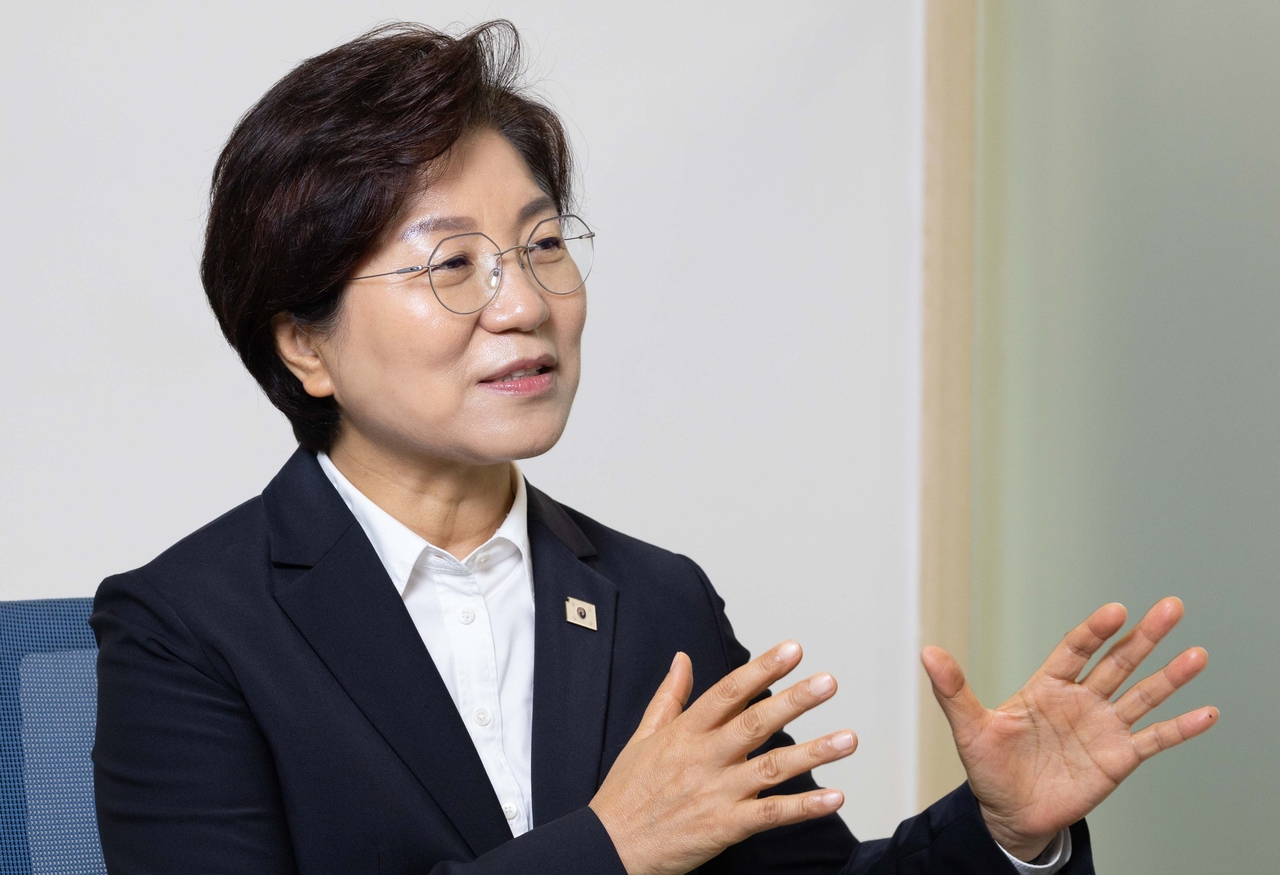
Kim Mi-gyeong, who became Seoul's first female three-term district mayor following consecutive wins in the seventh and eighth elected terms, said she intends to spend the next four years redrawing Eunpyeong-gu's future map. She said the title carries the weight of "responsibility" far more than "glory." Having spent eight years working tirelessly to make Eunpyeong a warm and livable community, Kim pledged that in her remaining four years she would reach into every alley and corner she had yet to visit, listen to residents' voices and translate them directly into policy. The Korea Herald sat down with Kim at the Eunpyeong-gu office conference room on June 20 to hear her ambitions and plans for the ninth elected term. The following is an edited transcript of the interview.
— You have become Seoul's first female three-term district mayor.
The warm encouragement and support residents sent me at every alley and every site during the campaign gave me real strength. I see this result not as a personal achievement but as the fruit of the trust and partnership built together with Eunpyeong residents over the past eight years. The weight of a third term comes to me not as glory but as an even heavier responsibility. I will continue, without change, an administration that breathes together with residents and finds its answers in the field.
— What changes will Eunpyeong residents feel during the ninth elected term?
Through the seventh and eighth elected terms we focused heavily on everyday quality-of-life projects. The core of this ninth term is designing Eunpyeong's future through what I call points, lines and planes. The "points" are the everyday lifestyle policies that touch residents' lives most closely. Among them, "Aimam Taxi" has become a signature Eunpyeong policy that other autonomous districts benchmark. It started as a way to ease the travel burden on pregnant women and families with infants and toddlers, but it has grown into an Eunpyeong-style care policy that supports the full arc of childbirth and child-rearing. In the ninth elected term, I plan to expand it as "Aimam Taxi Plus (+)" — adding extra voucher trips for vulnerable families and others who need additional support. Another new policy I will introduce is the "filial-piety bench." The thing I heard most often when I walked through alleys meeting senior residents during the campaign was, "We need somewhere to sit and rest for a moment." That is something we had overlooked. Younger people can pop into a café when they need a break, but that is not easy for seniors. I plan to map the routes seniors frequently travel and place filial-piety benches at spots that do not obstruct pedestrian flow. We are currently conducting a demand survey and will move quickly to install them.
— Many residents commute to work or school inside and outside Seoul. What is your strategy for tackling transportation issues during your term?
More than 70 percent of residents live on the outskirts and often spend only their evenings at home. The transportation policy of the ninth elected term will not simply be about adding one more road or rail line — it will be a "regionalization" strategy that expands Eunpyeong's living sphere. This is the "line" strategy within the points-lines-planes framework: building out the transport network that connects life in Eunpyeong. I will push ahead without delay on expanding the northwestern rail network, including the addition of Sinsa-gogae Station on the Goyang-Eunpyeong Line, as well as the Goyang-Sinsa Line, the Western Line and GTX-E. Sinsa-gogae Station in particular has secured economic viability through a supplementary feasibility study, so I will work actively with relevant agencies — including the Metropolitan Area Transport Commission and the Seoul Metropolitan Government — to ensure it is reflected in the detailed design. The goal of transportation in the ninth elected term is not a network for Eunpyeong alone, but a wide-area transport system in which the entire northwestern Seoul region grows together. Going forward, I will build the foundation for Eunpyeong to grow into the central city of the northwestern metropolitan area by jointly addressing transportation issues across the northwest and weaving the regional transport network more tightly together. When transportation improves, commute times fall, businesses and people gather, and the local economy revives — a virtuous cycle I believe will follow.
— During the campaign you put forward "Eunpyeong-style rapid development" as a campaign pledge. What are your plans for redevelopment and reconstruction projects?
In the ninth elected term, urban renewal projects must be ones that residents experience not as "plans" but as "completion." To that end, I will create a dedicated "Integrated Urban Renewal Complaints Officer" directly under the district mayor's office. This office will handle all complaints related to reconstruction and redevelopment in one place and ensure that necessary inter-departmental consultations move swiftly. It will explain the difficult and complex administrative and legal procedures and terminology in plain language, and make sure anyone who needs advice can get it. The district will also play an active role in mediating and resolving the various difficulties that arise during urban renewal — conflicts within associations, disputes with project operators and the like. I will also strengthen on-site communication forums where I go directly to the scene. It is more important to explain things fully and listen to opinions from the very start of a project than to try to resolve conflicts after they have grown large. I will visit project sites in person, listen to residents, and follow through to the end on every complaint and suggestion that emerges from the field together with the relevant departments. About 90 development projects, including urban renewal projects, are currently under way in Eunpyeong-gu. In the ninth elected term, I will start by making sure the projects already in progress are brought to a definite conclusion.
— You said you would discuss various projects with neighboring districts such as Mapo-gu and Seodaemun-gu. Which project will you pursue first?
Cooperation with neighboring districts such as Mapo-gu and Seodaemun-gu is not an entirely new story. Our three districts have already worked through difficult shared challenges together — the construction of a joint wide-area resource recycling center, for example. Because residents' living spheres extend beyond administrative boundaries, the administration must move in step with that reality. The first project to pursue is the development of a shared park golf course. Park golf is a healthy leisure activity that all generations can enjoy together, and demand is growing — particularly among senior residents. Eunpyeong, Mapo and Seodaemun will jointly develop a shared park golf course to produce a tangible result of cooperation that residents can feel directly. It will be the first step toward expanding public services in line with residents' actual living spheres, going beyond the simple creation of a sports facility.
ikson@heraldcorp.com