Only one in two government-managed public housing units qualifies as a genuinely affordable long-term rental, a civic group said Wednesday.
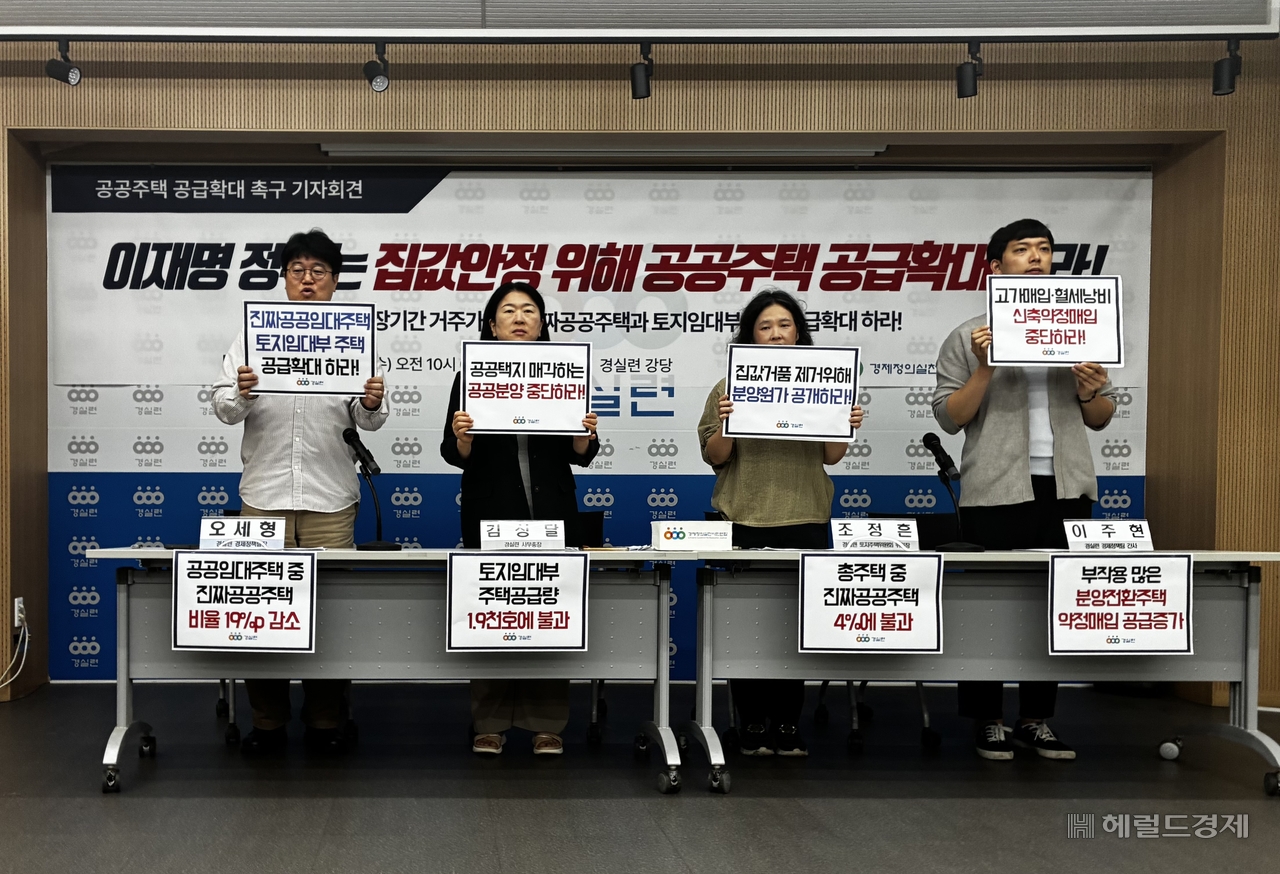
The Citizens' Coalition for Economic Justice, known as CCEJ, held a press conference Wednesday at its auditorium in Jongno-gu, Seoul, urging the government to expand the direct supply of long-term public rental housing to stabilize home prices.
"Jeonse and monthly rent prices keep rising and tenants' anxiety is growing," CCEJ Secretary-General Kim Seong-dal said. "Tax and financial policy matter, but what is most needed is an affordable and sustainable supply of public housing."
He then urged the government to present a concrete road map for supplying public housing that residents can afford, rather than selling off public land — including sites earmarked for third-phase new towns — to private developers.
CCEJ classified only five of the 11 types of government-managed public housing as genuinely affordable long-term rentals: permanent rental, 50-year rental, national rental, long-term jeonse and integrated public rental housing — all allowing residents to stay for 20 years or more at low rents.
The share of such units has been declining sharply. According to CCEJ's analysis, in 2015 roughly 885,000 of the approximately 1.257 million total public housing units — about 70.4 percent — met that standard. By 2024, total public housing had grown to about 1.972 million units, but genuinely affordable long-term rentals accounted for roughly half, at about 1.016 million units.
CCEJ criticized jeonse rental support and purchased rental programs for inflating public housing statistics. "Jeonse rental support is in effect a deposit support system," said Lee Ju-hyeon, a policy team coordinator at CCEJ. She added that the share of long-term public rental housing should be expanded to around 20 percent of total housing stock.
CCEJ also proposed expanding land-lease housing as an alternative. Under this model, the public sector retains ownership of the land while only the building is offered for pre-sale, allowing units to be supplied at relatively lower prices.
"What matters is not supply itself, but what kind of supply," said Cho Jeong-heun, chair of CCEJ's land and housing committee. "Policy must shift away from redevelopment and reconstruction toward expanding long-term public rental housing."
jookapooka@heraldcorp.com
snsd@heraldcorp.com