
Male-dominated crowds at free lunch lines in Jongno-gu
Elderly women in Korea face deeper poverty than men
Yet grandfathers, not grandmothers, fill the free-meal queues
Women aged 60-plus make up 2.4 times more part-time workers than men
Experts say work, meal habits and social spaces all play a role
South Korea's elderly poverty rate stands at 2.7 times the OECD average. Older women, in particular, face harsher conditions than their male counterparts. For decades, they were expected to devote themselves to family caregiving, setting aside careers outside the home. That interrupted working life left many without financial independence — and now, in old age, they worry about making ends meet each day. This series examines how the sacrifices elderly women made in their youth are now coming due in the form of poverty and insecurity. — Ed.
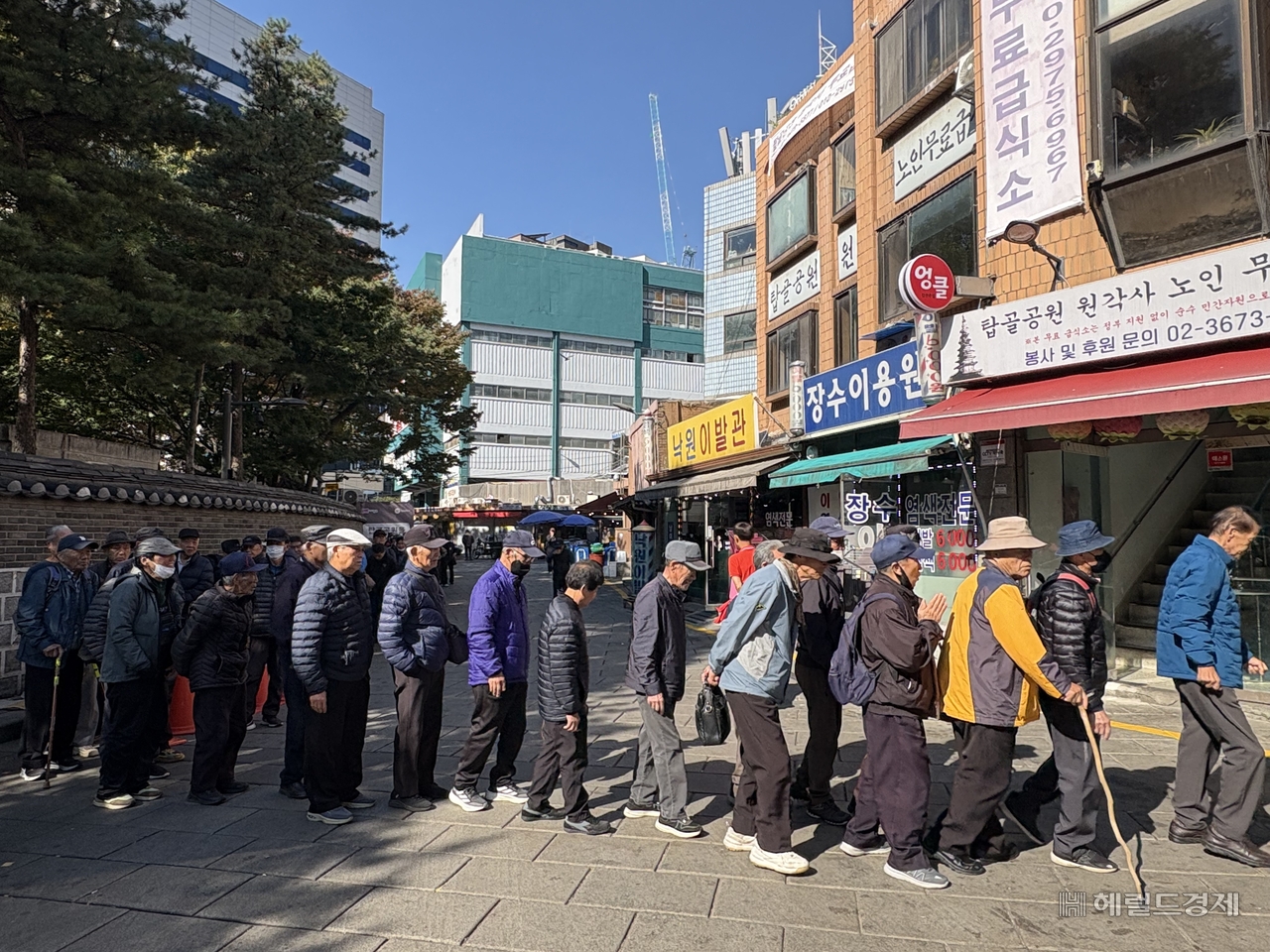
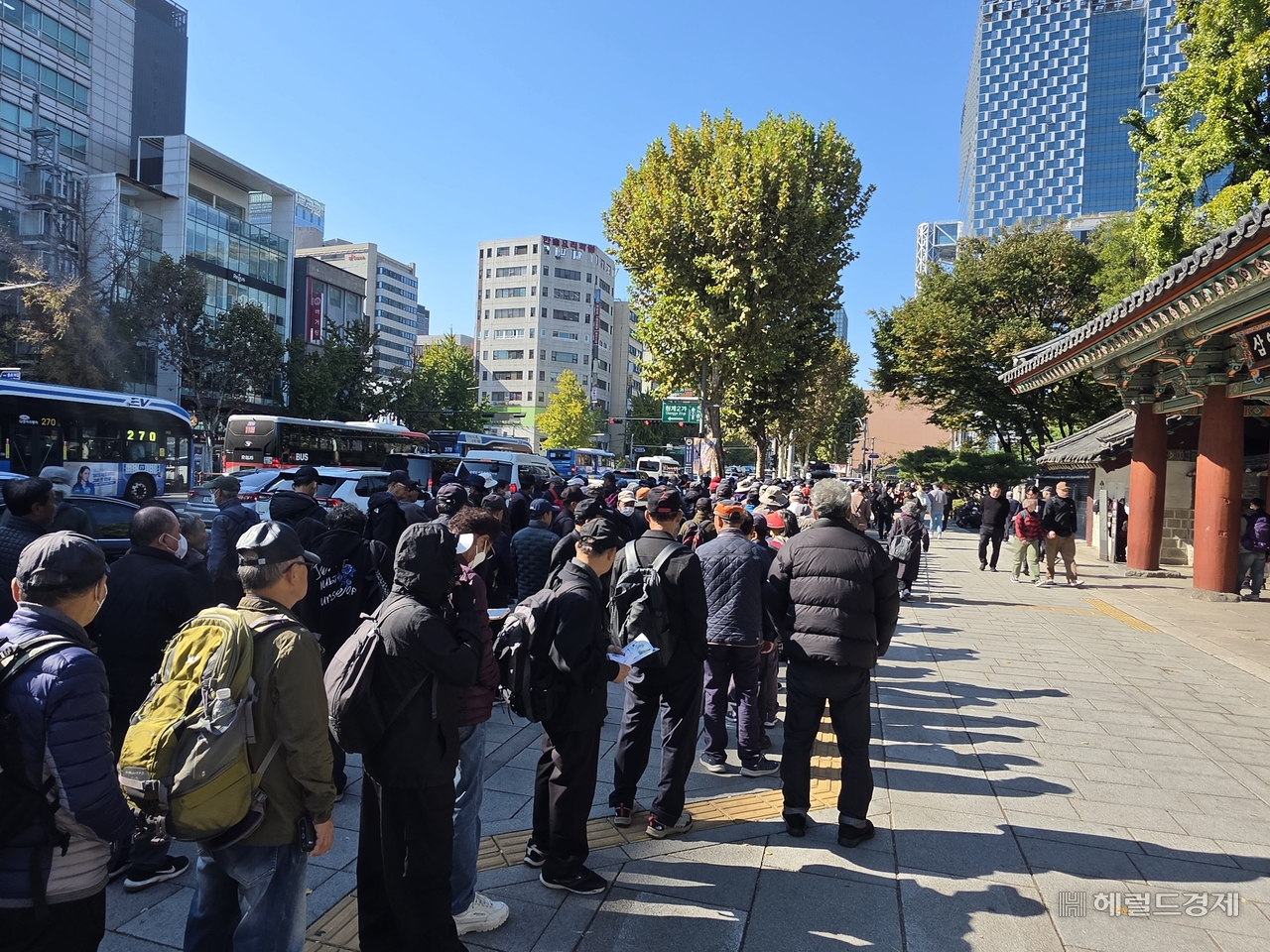
Around 11 a.m. Tuesday, a line had already formed outside a free soup kitchen behind Tapgol Park in Jongno-gu, Seoul — a full 30 minutes before lunch service was set to begin. Nearly 100 meters of elderly visitors snaked along the street, some leaning on canes, others sitting on the curb to wait. Of the 65 people in line, only three were women. By the time service started at 11:30 a.m., the queue had grown to about 100, but only two more women had joined.
A few steps away, the scene in front of Nakwon Arcade was much the same. Nearly 300 people in their 70s through 90s had gathered to receive dosirak — boxed meals distributed by the Haneulgung free meal service — yet only about 20 of those waiting were women. Some elderly visitors were seen carrying their Haneulgung dosirak back to rejoin the Wongaksa soup kitchen line. "I'll eat lunch at Wongaksa and save the dosirak for dinner," one elderly visitor said.
For many regulars, the soup kitchens are more than a meal. Visitors make friends, swap information and, after eating, take walks through Tapgol Park or along Cheonggyecheon, or pass the time at cheap cafes and movie theaters nearby. "On cold days we get coffee at a cafe for 1,000 won, and when we're bored we go to the movie theater for 2,000 won," several elderly visitors told reporters.
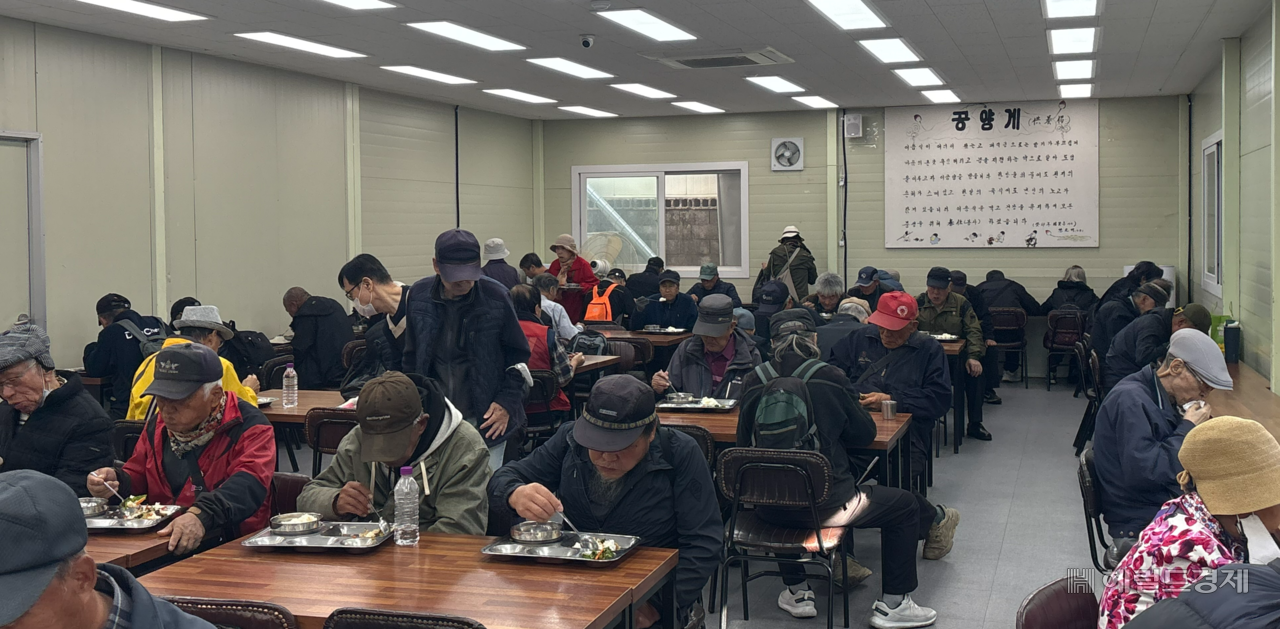
Park, 85, who lives alone, said Park comes to the soup kitchen almost every day. "I come out because it gets lonely sitting at home by myself," Park said. When a reporter noted the overwhelming number of men in the crowd, Park said: "There must be plenty of grandmothers living alone too — I'm curious myself why they aren't here."
A volunteer who has worked at the soup kitchen for three years said the number of daily visitors varies but averages around 400 to 500. "On a busy day, women make up maybe 20 percent of that," the volunteer said.
South Korea's elderly are poor — and older women are worse off than older men. A report released in June by the Korean Women's Development Institute on the retirement income and employment support of elderly women found that personal income among women aged 60 to 79 amounts to just 40.4 percent of that of men in the same age group.
So why do free soup kitchens draw so many more elderly men than women? Reporters gathered accounts from elderly visitors on the scene and assessments from experts.
Elderly women are at work — not in the soup kitchen line
Given their financial hardship, elderly women might be expected to welcome a free meal. A survey by the Korea Senior Human Resources Development Institute on senior employment and social activity programs found that the share of elderly participants who said they spend their activity stipends mainly on food rose from 66.4 percent in 2022 to 78.6 percent in 2025. Women were more likely than men to spend those stipends on food and healthcare — a sign of just how tight their finances are.
Kim Nan-ju, a research fellow at the Korean Women's Development Institute, cited work as one reason fewer elderly women appear at free soup kitchens. The more financially pressed they are, Kim said, the more likely some women are to be working during lunch hours rather than standing in a long queue — or simply skipping the meal or eating something quick at home.
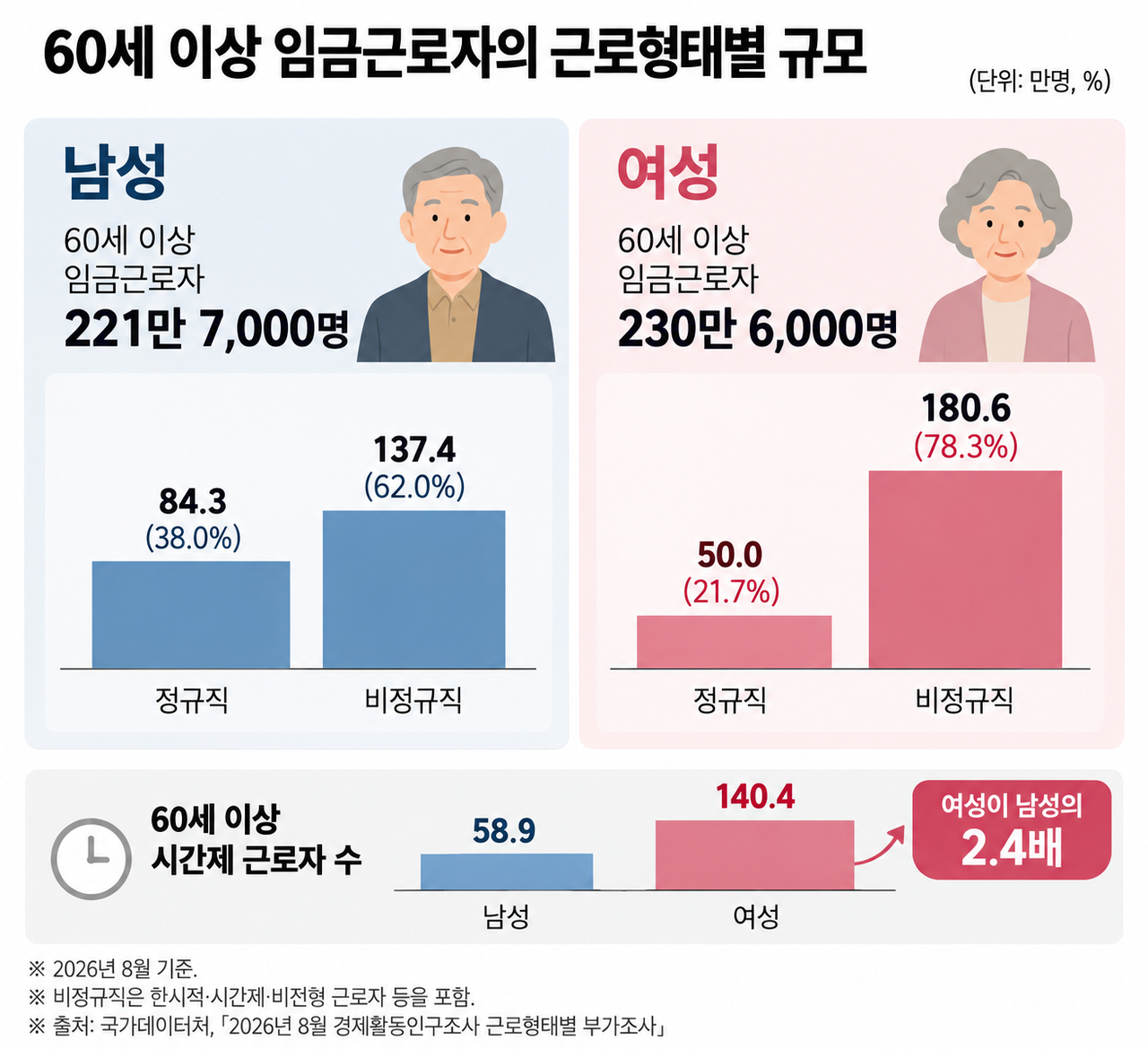
Statistics show that elderly women's work is concentrated more heavily in irregular and part-time jobs than men's. According to the Ministry of Statistics' August 2026 economically active population survey, 1,806,000 of the 2,306,000 female wage workers aged 60 and older — or 78.3 percent — were in non-regular employment. Among men in the same age group, 1,374,000 of 2,217,000 wage workers, or 62 percent, held non-regular positions. Women aged 60 and older working part-time numbered 1,404,000 — 2.4 times the male figure of 589,000.
Jung, 63, a woman from Jamsil-dong in Songpa-gu who was at Tapgol Park that day, said she can make it to the soup kitchen "at most once or twice a week." "The rest of the time I have to go to work, so I usually skip lunch. Coming all the way here for a meal is my way of resting," Jung said.
"The fact that fewer women are seen at free soup kitchens does not mean elderly women face less poverty," Kim said.
Gender differences also show up in how older Koreans approach work in their later years. A 2024 panel survey of work and life among 6,000 Koreans aged 60 to 74, conducted by the Korea Senior Human Resources Development Institute, found that 21.1 percent of men who did not want to work cited being unable to find the kind of work they wanted — compared with 12.5 percent of women.
Cheon Jae-young, a researcher at the Korea Senior Human Resources Development Institute, said some elderly men may tend to hold out for jobs that match their past careers or social standing rather than accept whatever is available. "Women, on the other hand, often continue working even for modest pay," Cheon said. "That difference may also be affecting the gender ratio at free soup kitchens."
Grandmothers travel to Jongno; grandfathers can't cook at home
The elderly women who did show up at Tapgol Park Tuesday had traveled from across Seoul — from Imun-dong and Cheongnyangni in Dongdaemun-gu, from Yangcheon-gu and other neighborhoods — riding the subway to reach Jongno.
Choi, 80, who came from Imun-dong in Dongdaemun-gu, said Choi has lived alone for 10 years. On weekdays, Choi leaves home around 8 a.m. and spends the day in Jongno before returning around 6 p.m. Choi said Jongno suits better than the senior center in the neighborhood. At the local center, residents take turns preparing meals and have to mind what others think of them. At the free soup kitchen, Choi said, "you just show up and get your food."
Kim, 72, from Yangcheon-gu, worked in restaurants for nearly 40 years before retiring and now lives alone. Combined pension and public support payments come to about 750,000 won ($540) a month. Kim applied for meals at a welfare center near home but has been on the waiting list for a year because it is full. That day, Kim collected a Haneulgung dosirak and then ate lunch at Wongaksa, planning to save the boxed meal for dinner. "At the senior center I feel like I'm being watched, and I don't like talking to people I don't know," Kim said.
Some elderly visitors deliberately bypass welfare facilities in their own neighborhoods to come to Jongno. One elderly man said he avoids the welfare center near home because he would be embarrassed to be seen there by people he knows. In Jongno, fewer people recognize him, so the stigma is lighter.
Cheon said the gender gap at free soup kitchens cannot be explained by poverty alone. "Elderly women also face a heavy burden when it comes to food costs," Cheon said, "so this appears to be a complex phenomenon shaped by differences in cooking experience, social relationships and the spaces where older men and women tend to spend their time."
jookapooka@heraldcorp.com
kido@heraldcorp.com




