![Tokyo, Japan [123RF]](https://wimg.heraldcorp.com/news/cms/2026/07/07/news-p.v1.20260701.67de7a50e54a4b92ab967d4510e03269_P1.jpg)
As average apartment prices in central Tokyo surpassed 136 million yen ($839,000), Japan's government is actively considering adopting South Korea's foreign land-transaction permit system. Experts say applying an owner-occupancy requirement to foreign capital through such a permit regime could deliver an immediate effect in curbing speculative demand.
Tokyo average home price hits 1.28 billion won … 'cash flowing in from China, Taiwan'
According to government sources Tuesday, Matsushima Midori, a special adviser to Japan's prime minister on foreign policy — a member of the House of Representatives for Tokyo's 14th district and a former justice minister — met with Kim I-tak, first vice minister of South Korea's Ministry of Land, Infrastructure and Transport, in April and sought detailed advice on South Korea's foreign land-transaction permit system and its owner-occupancy requirement.
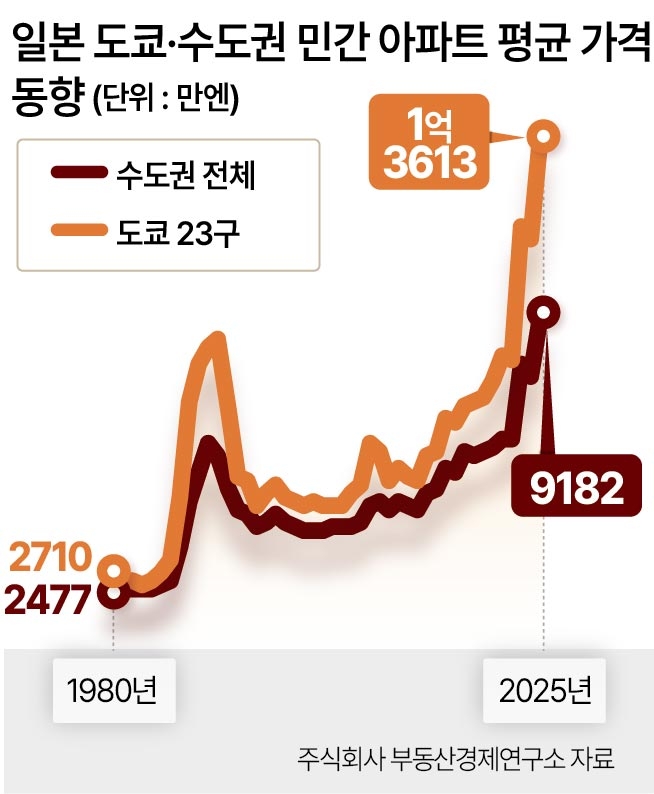
The housing-related consultation was not part of the original agenda for her visit to South Korea but was hastily added because Tokyo's home-price surge has reached a level that is difficult to control. According to the Real Estate Economic Institute, a private Japanese property research firm, the average price of a newly built private apartment in Tokyo's 23 wards stood at 136.13 million yen in 2025 — equivalent to about 1.28 billion won — a 21 percent jump from the year-earlier figure of 111.81 million yen.
Property prices in Tokyo have been surging, with liquidity concentrating in transit-oriented areas and surrounding new towns. Jeon Young-su, a professor at Hanyang University's Graduate School of International Studies and a specialist in the Japanese economy, said that until a few years ago, most Tokyo homes outside ultra-luxury neighborhoods were priced below 1 billion won, meaning a dual-income couple in their 30s could stretch to buy an apartment in central Tokyo. "But prices have risen so much recently that even taking out a long-term mortgage has become a burden," he said.
Japan's government believes a massive influx of capital from foreign investors — particularly from China and Taiwan — has driven up domestic property prices, and that is why it is considering adopting a foreign land-transaction permit system similar to South Korea's. Japan currently operates a notification-based system for land transactions, and the government wants to replace it with a permit-based regime to block foreign speculation, as South Korea has done.
Park Hap-su, an adjunct professor at Konkuk University's Graduate School of Real Estate, said Chinese and Taiwanese investors have been buying apartments in central Tokyo against the backdrop of a weak yen. "As a result, home prices in undervalued cities near Tokyo, such as Yokohama, have also been rising," he said.
An official at the Ministry of Land, Infrastructure and Transport said Japan's government shares the same concern as South Korea's — that foreign buyers may be distorting the property market. "They have been asking us for advice and information on the specific regulatory content of the foreign land-transaction permit system," the official said.
'No permit, no deal' rule delivers immediate results — but Japan urges caution
South Korea itself saw a steady rise in foreign home purchases before the foreign land-transaction permit system was introduced, a trend that contributed to pushing up prices. From 2022, the number of residential property transactions by foreigners grew by an average of about 26 percent each year. As of July last year, just before the permit system took effect, foreign purchases of homes in the greater Seoul metropolitan area were concentrated in Gyeonggi Province (62 percent), Incheon (20 percent) and Seoul (18 percent).
In response, the Ministry of Land, Infrastructure and Transport designated all of Seoul, along with key areas of Gyeonggi Province and Incheon, as foreign land-transaction permit zones in August last year, following a review by the Central Urban Planning Committee. Individuals without South Korean citizenship, foreign corporations and foreign governments must now obtain approval from the relevant city, county or district office before buying detached houses, multi-family homes, apartments, townhouses or multi-unit dwellings in those areas.
Alongside this, the ministry amended the enforcement decree of the Real Estate Transaction Act in February to expand the obligation to submit a funding plan and supporting documentation. The requirement — previously applied only to South Korean nationals buying property in speculative-overheating zones — was extended to foreign buyers as well.
![A view of residential neighborhoods in Seoul as seen from N Seoul Tower on Namsan [Herald DB]](https://wimg.heraldcorp.com/news/cms/2026/07/07/news-p.v1.20260630.39fdba18aa634b1a83feb42bb465e103_P1.jpg)
As restrictions on foreign home purchases tightened, transaction volumes fell. In December last year, foreign residential property transactions in Gyeonggi Province's four most active cities — Ansan, Bucheon, Pyeongtaek and Siheung — showed Bucheon recording the steepest decline, dropping 51 percent from 208 to 102 transactions. In Incheon, Seo-gu saw deals fall from 50 to 27.
By nationality, transactions by Chinese buyers fell 32 percent, from 1,554 to 1,053, while those by American buyers dropped 45 percent, from 377 to 208. Chinese nationals accounted for 71 percent of all foreign residential transactions and Americans for 14 percent, broadly in line with the same period the previous year.
Experts say the system has contributed to stabilizing domestic home prices to a meaningful degree. Park said that in Banpo, Seocho-gu, Seoul, where the previous transaction price was 8 billion won, a single purchase by a foreigner at 10 billion won had an outsized effect on the overall market. "Because there is a system that applies an owner-occupancy requirement even to foreigners, it has been effective in curbing speculative demand," he said.
However, Japan is taking a cautious stance on immediately adopting a foreign land-transaction permit system. According to the Yomiuri Shimbun, the Japanese government plans to submit legislation to the autumn extraordinary session of the National Assembly that would put restrictions on apartment acquisitions by foreigners on hold for the time being.
Some observers note that in Japan's culture of strong respect for private property rights, a land-transaction permit system imposing conditions such as an owner-occupancy requirement could generate public resistance. Jeon said Japan carries a trauma from policy failure rooted in memories of the bubble collapse. "There is a prevailing view that maintaining the status quo is preferable to intervening in private property, so actually implementing such a system immediately could prove too much of a burden," he said.
hss@heraldcorp.com
hwshin@heraldcorp.com