
39 of 47 Gyeonggi districts see apartment prices rise year-on-year
Suwon's Paldal-gu tops province with 27.9% gain over past year
Bundang average climbs from 1.41 billion to 1.72 billion won, up 21.7%
Survival buying and semiconductor-sector liquidity drive southern Gyeonggi surge
![Apartment complexes in Yeongtong-gu, Suwon, Gyeonggi Province. [Yonhap]](https://wimg.heraldcorp.com/news/cms/2026/10/13/rcv.YNA.20251015.PYH2025101512590006100_P1.jpg)
Nearly a year after the Oct. 15 housing market stabilization measures designated all of Seoul and 12 Gyeonggi areas as land transaction permit zones and regulated areas, apartment prices have risen in eight out of every 10 districts across Gyeonggi Province. Bundang in Seongnam saw its average price jump by more than 300 million won ($225,000) over the past year, highlighting a broad price surge across southern Gyeonggi. Analysts attribute the gains to "survival buying" by end-users priced out of Seoul amid soaring jeonse and monthly rent costs, as well as a flood of liquidity from performance bonuses and in-house loans at semiconductor giants Samsung Electronics and SK hynix flowing into the Gyeonggi apartment market.
According to data on Gyeonggi apartment price trends by district commissioned from real estate platform Zigbang, 39 of the province's 47 cities and districts — or 83 percent — posted higher average prices in September compared with September of last year. Price gains were recorded not only in major areas bordering Seoul, such as Gwangmyeong, Guri, Namyangju and Hanam, and in southern Gyeonggi districts, but also in parts of the north including Goyang's Deokyang-gu, Dongducheon, Paju and Yangju.
Suwon's Paldal-gu recorded the sharpest increase, with the average apartment sale price rising 27.9 percent from 566.26 million won in September last year to 723.98 million won in September this year. The regulated district benefits from easy access to Samsung Electronics' Suwon campus and is known as a "shuttle-oriented" transit area, drawing a surge of demand from buyers in their 20s and 30s seeking their first home this year.
Bundang followed with a 21.7 percent gain, its average climbing from 1.41 billion won to 1.72 billion won over the same period. Other districts that posted strong year-on-year gains include Suwon's Jangan-gu, up 19.6 percent from 514.8 million won to 615.89 million won; Osan, up 17.5 percent from 334.07 million won to 392.48 million won; Guri, up 16.2 percent from 659.69 million won to 766.48 million won; and Yongin's Suji-gu, up 16.1 percent from 857.48 million won to 995.25 million won.
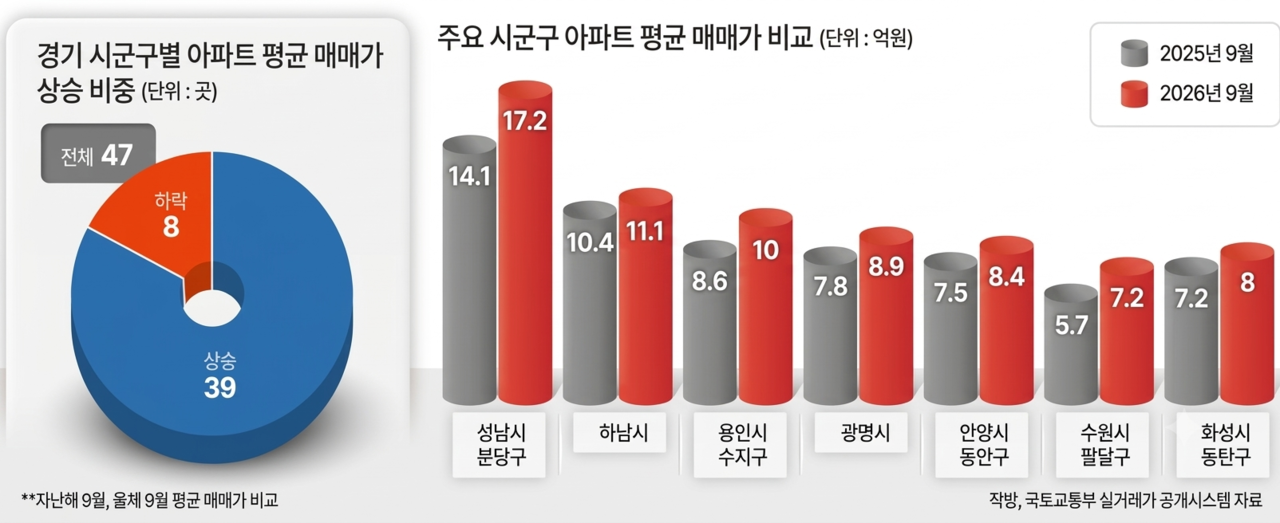
Areas often described as near-Gangnam equivalents also posted gains over the past year: Gwacheon rose from 2.11 billion won to 2.17 billion won, Gwangmyeong from 780.88 million won to 886.05 million won, and Hanam from 1.04 billion won to 1.11 billion won.
Northern Gyeonggi districts also edged up, albeit more modestly. Goyang's Deokyang-gu rose from 553.19 million won to 571.52 million won, Dongducheon from 156.67 million won to 161.98 million won, and Paju from 376.21 million won to 390.79 million won.
The broad-based rise pushed the number of cities and districts with average apartment prices above 500 million won from 20 last year to 24 this year.
The trend reflects a shift in end-user demand toward relatively affordable Gyeonggi areas as Seoul prices climbed, compounded by a tightening of owner-occupancy requirements that worsened the jeonse and monthly rent shortage and nudged renters toward buying — a pattern analysts call "survival buying." Court registry data show that 107,986 people in Gyeonggi Province bought a collective building — including apartments, row houses, multi-family homes and officetels — for the first time in their lives during the first nine months of this year, up 12.4 percent from 96,031 in the same period last year.
The semiconductor boom added further fuel, with high-income employees at Samsung Electronics and SK hynix concentrating their purchases around Suwon, Yongin and Hwaseong — where the two companies operate major campuses — and driving up prices at key complexes across southern Gyeonggi.
"The two forces driving the market right now are scarce jeonse listings and the liquidity effect emanating from southern Gyeonggi," said Nam Hyeok-woo, a real estate researcher at Woori Bank. "The liquidity inflow that was once confined to Suwon is spreading to other popular areas that share the same living zone or have become more price-attractive, and the price strength is broadening." He added that the trend "could reinforce downward price rigidity in the market, making it worth watching how long the liquidity inflow from the semiconductor industry continues."
hwshin@heraldcorp.com




