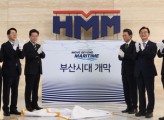
National report on southwestern Korea's advanced industry vision held Monday
800 trillion won earmarked for four semiconductor fabs
New cluster needed to meet surging AI chip demand
SK Telecom, Samsung SDS to build AI data centers
President Lee pledges support after energy requests
Samsung and SK announced plans June 30 to invest 895 trillion won ($578 billion) in southwestern Korea, with Samsung Electronics and SK hynix set to build new semiconductor clusters to establish the region as a major production hub. The investment spans semiconductors, AI data centers and future energy infrastructure.
Industry observers said government follow-through will be more critical than ever following the announcement. Stable power supply is essential to keep semiconductor factories running around the clock. Samsung Electronics CEO Jeon Young-hyun directly called on the government to expand nuclear power capacity and actively pursue power purchase agreements, and President Lee Jae Myung responded with a pledge of support.
Existing semiconductor fabs fall short as companies eye new global production hub
Samsung and SK unveiled the 895 trillion won investment June 30 at the National Report on the Advanced Industry Development Vision for Southwestern Korea, held at the Kim Dae-jung Convention Center in Gwangju.
Samsung will spend 425 trillion won to build two memory chip fabs and a national AI computing center, while SK will invest about 470 trillion won to construct two main memory chip fabs and a 1-gigawatt AI data center. Semiconductor packaging company Amkor Technology will also invest 1 trillion won to expand an advanced packaging fab in Gwangju.
The announcement elaborated on the southwestern Korea semiconductor investment component of the "Three Mega-Projects National Report" that Samsung Electronics Chairman Lee Jae-yong and SK Group Chairman Chey Tae-won unveiled June 29. Samsung and SK selected southwestern Korea as the candidate site for a new semiconductor cluster to meet surging AI chip demand.
"The market's view is that even aggressive investment by chipmakers is not enough to keep up with explosive demand," Lee said. "As a result, the investment timeline for the Yongin national industrial complex — following Giheung, Hwaseong and Pyeongtaek — has been significantly accelerated, and the moment to prepare a new cluster has also moved up." He added that among various regions, Gwangju is being considered as the candidate site given the strong incentives expected there in securing power, water and workforce.
Chey also said June 29 that "it took nine years just to develop the Yongin cluster," underscoring the importance of investing ahead of demand. "Semiconductor factories require large sites, power, water and labor, and we intend to invest 400 trillion won in southwestern Korea, which is expected to meet all those conditions, to build a new cluster," he said.
At the June 30 event, speakers again stressed that existing production facilities alone would not be sufficient to meet future demand.
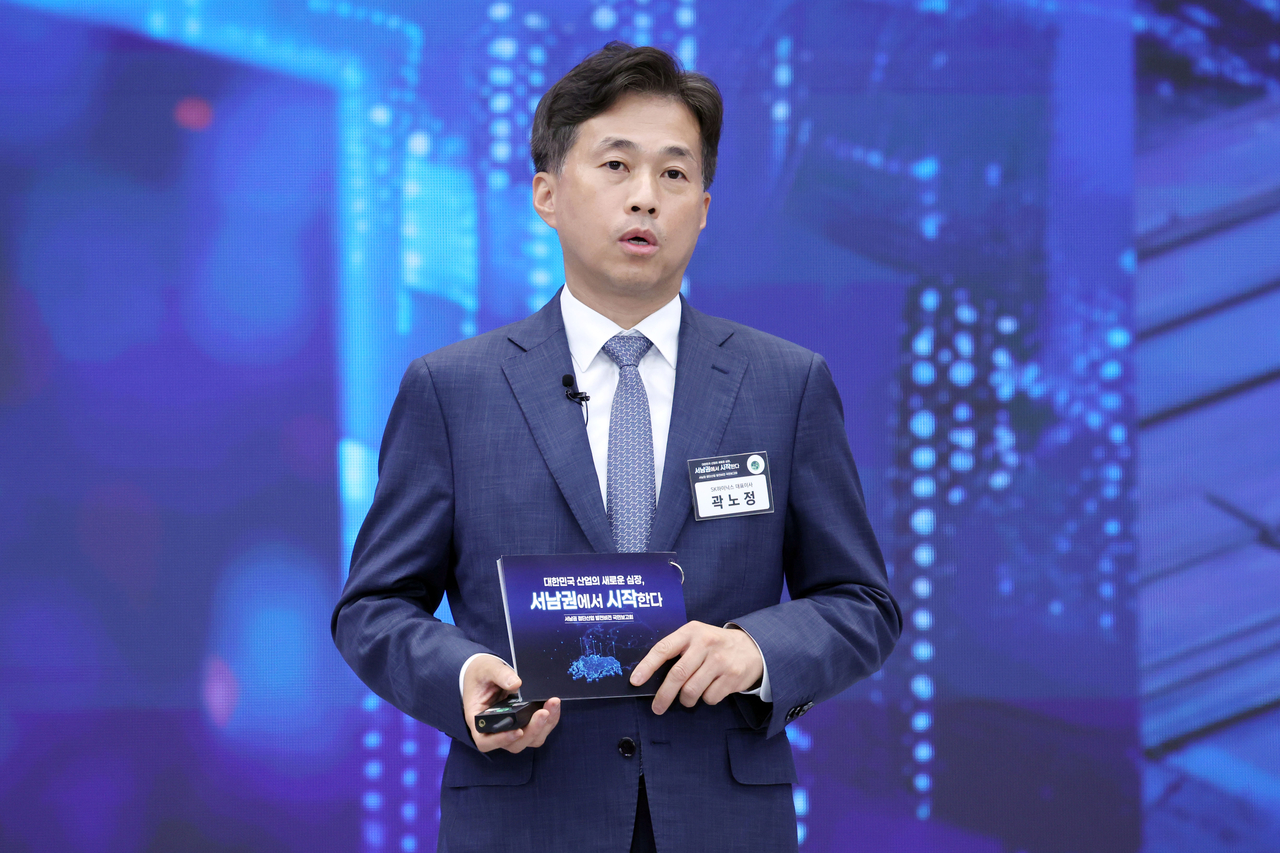
SK hynix CEO Kwak Noh-jung said that given the premise of explosive growth in future semiconductor demand, the Yongin semiconductor cluster alone would not be enough to satisfy it. "Southwestern Korea is a location we expect to meet the conditions needed for a semiconductor cluster, and we intend to build a production base there to respond to global memory demand," he said.
AI data centers to create synergies with semiconductor operations
Beyond the semiconductor clusters, Samsung and SK outlined additional investment plans centered on advanced industries, with AI data centers a key focus.
SK plans to build AI data centers totaling 15 gigawatts of capacity across the country, with 1 gigawatt earmarked for southwestern Korea. The strategy is to generate synergies between semiconductor production and AI computing, with SK Telecom leading the data center buildout.
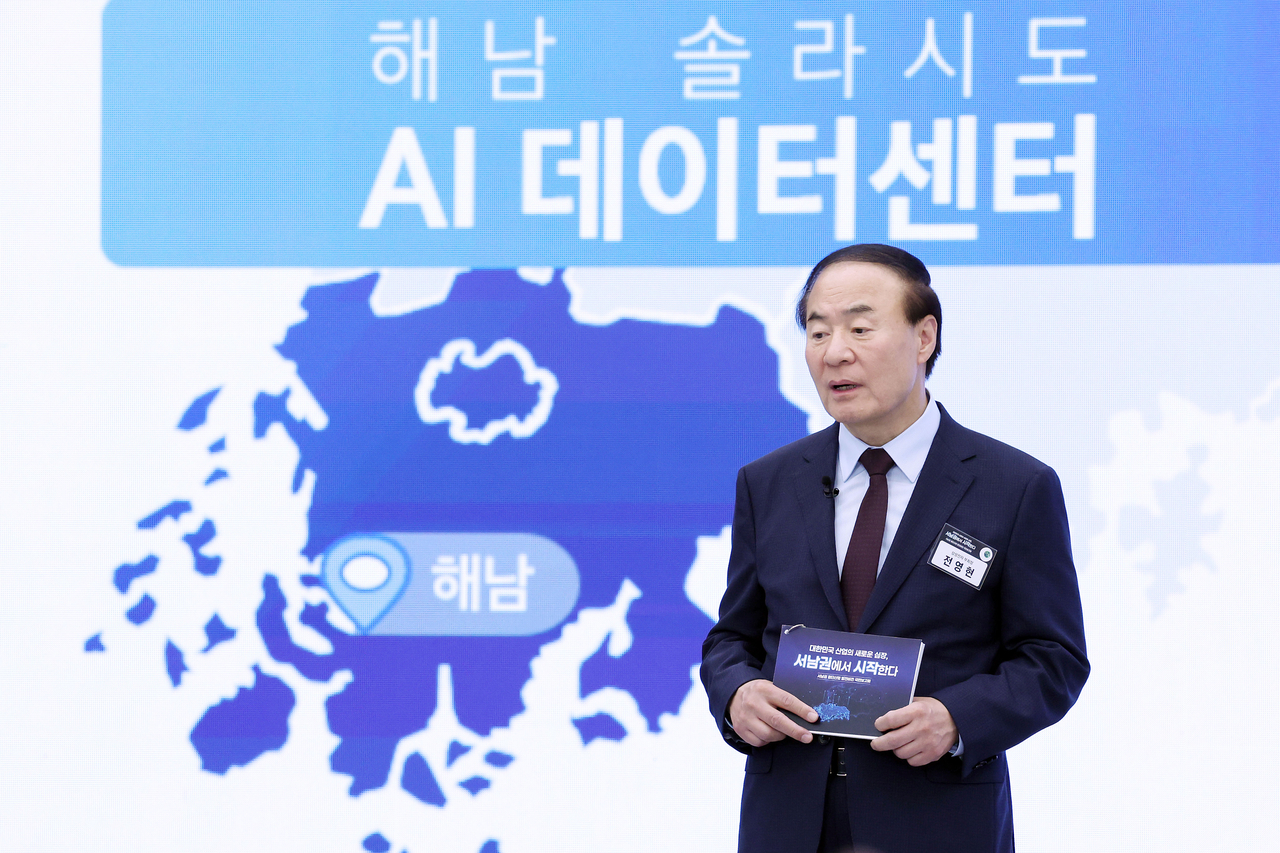
Samsung SDS is planning a 210-megawatt AI data center at Solaseado in Haenam, with construction set to begin in the second half of this year and first operations targeted for 2028. The facility is expected to serve as a headquarters for government AI transformation support — covering finance, defense and public services — while also supporting industrial physical AI applications such as robot AI model training and inference.
Samsung Group will also expand investment in carbon-free future energy, led by Samsung C&T. The company plans to invest in carbon-free power generation including nuclear and renewable energy, energy-efficient systems such as heat pumps and industrial air-conditioning equipment, nuclear-based hydrogen production using water electrolysis facilities in Yeonggwang, and demonstration of green hydrogen production technology using high-temperature solid oxide electrolysis.
Samsung Electronics will build an innovation hub factory based on digital twin technology at its existing Gwangju plant, along with production facilities for heat pumps and air-conditioning equipment, and will develop a state-of-the-art logistics center in Gochang, North Jeolla Province.
Stable power sources essential to offset intermittency of renewable energy
In announcing nearly 900 trillion won in investment for southwestern Korea, both companies stressed that government support to create favorable conditions for fab operations must follow.
Vice Chairman Jeon urged the government to "actively pursue the expansion of nuclear power and power purchase agreements to offset the intermittency of renewable energy," and asked again that LNG combined heat and power generation also be pushed forward without fail.
Semiconductor factories run around the clock and require a stable power supply; even a brief shutdown can cause losses running into hundreds of billions of won. Southwestern Korea has abundant renewable energy resources based on solar and offshore wind, but output is heavily dependent on weather conditions — which is precisely why Jeon raised the issue of intermittency.
Analysts say expanding the range of power sources eligible for power purchase agreements could be part of the solution. A power purchase agreement is a contract between a company and a power generator guaranteeing a stable supply of electricity over an agreed period.
The semiconductor industry procures carbon-free electricity through power purchase agreements to meet carbon neutrality goals, but in South Korea eligible carbon-free sources are currently limited to renewable energy. Voices inside and outside the industry have called for nuclear power to be included as an eligible source, citing overseas precedents.
The government's response was encouraging. President Lee, reacting to Jeon's requests, said he understood Jeon wanted a firm government commitment — "a confirmation shot," as Lee put it — and promised to show that this was "not a political show put on by a politician," affirming the government's intent to deliver on its support.
Requests for other administrative support were also raised. Although Jeon did not mention them directly, the presentation materials included calls to expand the military service exemption program for specialized researchers and to allow the establishment of regionally specialized technical high schools.
jeongwan@heraldcorp.com