Forum on appraisal rights reform held at National Assembly on Wednesday
Experts say granting rights at spin-off stage is excessive prior regulation
Rights should instead be triggered at the point of subsidiary listing
Rapid corporate restructuring seen as urgent amid intensifying global competition
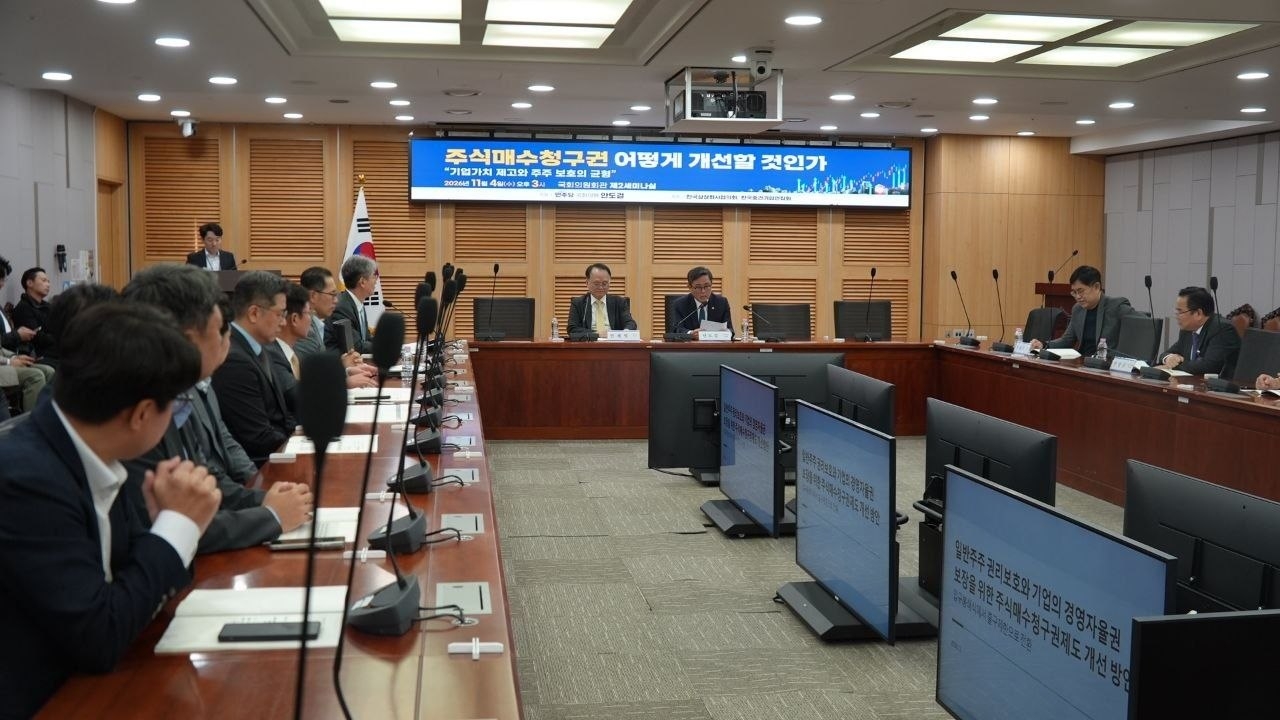
Calls emerged at the National Assembly on Wednesday to reform the shareholder appraisal rights regime that currently grants dissenting shareholders the right to demand share buybacks whenever a listed company undergoes a physical spin-off. Experts argued that the real threat to shareholder value lies not in the spin-off itself but in the subsequent dual listing of a subsidiary — yet the current system blocks restructuring at the spin-off stage.
The business community has warned that the regulation is hampering timely corporate restructuring. The proposed fix is to shift appraisal rights from the spin-off stage to the moment of subsidiary listing — an exit-restriction model rather than an entry-blocking one.
The forum, titled "National Assembly Forum on Shareholder Appraisal Rights," was held Wednesday at the National Assembly and hosted by Democratic Party of Korea lawmaker Ahn Do-geol. Academics and business representatives who attended spoke with one voice on the need to reform the appraisal rights system.
Shin Hyun-han, a professor at Yonsei University who delivered the keynote, described the current system as an entry-blocking form of excessive regulation that effectively prevents physical spin-offs altogether.
"The real problem is dual listing, not the physical spin-off itself, yet the current system grants appraisal rights for every physical spin-off without exception — even minor ones," Shin said. "That is excessive regulation."
Shareholder appraisal rights allow shareholders who oppose a major corporate decision — such as a merger or spin-off — to demand that the company buy back their shares. The rights were extended to physical spin-offs of listed companies after LG Chem's 2022 spin-off of its battery business and the subsequent listing of LG Energy Solution sparked calls to better protect minority shareholders.
However, the rule has drawn criticism for making corporate restructuring difficult by applying to all listed companies pursuing a physical spin-off, regardless of whether the subsidiary is ever listed. Depending on how many shareholders exercise the right, a company can face the burden of paying out a large sum of cash.
Shin said a side effect has emerged in which even shareholders who support a spin-off vote against it in order to preserve their option to exercise appraisal rights later. Shin also flagged the absence of any exemption for small-scale spin-offs as a problem requiring reform.
As an alternative, Shin proposed shifting appraisal rights from the spin-off stage to the point at which a subsidiary pursues a dual listing.
"Changing from an entry-blocking to an exit-restriction model would eliminate the reflexive opposition to spin-offs driven solely by the desire to secure appraisal rights," Shin said. "Requiring shareholder approval for corporate restructuring at a general meeting is out of step with the pace of global competition."
Ahn Tae-jun, a professor at Hanyang University who took part in the discussion, also said the regulation misidentifies both the cause and the cure.
"A physical spin-off does not necessarily lead to a dual listing of the subsidiary, so the current system — which suppresses physical spin-offs in a way that is inconsistent with the original regulatory intent — needs to be abolished or fundamentally reconsidered," Ahn said.
Industry representatives said reform is urgent to help companies respond to intensifying global competition, arguing that obstacles to corporate restructuring must be removed for businesses to survive.
Park Yang-gyun, head of policy at the Korea Federation of Mid-sized Enterprises, cited the US-China rivalry, the spread of protectionism and China's technological advances, saying it is difficult to survive in a crisis using conventional approaches.
"Whether a restructuring succeeds can only be judged after the fact — it cannot be known in advance — so blocking the physical spin-off itself is excessive prior regulation," Park said. "This discussion is not about abandoning shareholder protection; it is about creating conditions that allow companies to restructure swiftly."
Park added that supporting smooth corporate decision-making can, over the long term, help raise corporate value and shareholder returns.
Kwon Jae-yeol, a professor at Kyung Hee University who chaired the forum, examined the legal basis and structural flaws of the current appraisal rights regime. Kwon pointed out that appraisal rights for physical spin-offs were introduced through an enforcement decree without an explicit delegation provision in the Financial Investment Services and Capital Markets Act. Kwon also raised the possibility that appraisal rights could be used as a tool to recover funds from a company ahead of creditors.
"The Ministry of Justice previously reviewed a plan to exempt small-scale physical spin-offs from appraisal rights," Kwon said. "There is ample research material to serve as a basis for National Assembly deliberations."
At the same time, participants said that deregulation must be accompanied by more active shareholder communication, stressing that shareholder protection — the original rationale for introducing appraisal rights — must not be neglected.
"We need to reconsider why a single case — the LG Chem incident — ended up blocking all physical spin-offs," Shin said. "The way companies communicate with shareholders must genuinely change."
"Shareholder meetings still remain a formality," Shin added. "Companies need to engage with shareholders through other means as well, and the accumulated failure to communicate has brought us to where we are today."
Shin called on both individual companies and business associations to expand substantive engagement with shareholders, saying that regulatory reform and corporate self-help efforts must go hand in hand to ensure that swift restructuring and minority shareholder protection can coexist.
jeongwan@heraldcorp.com