
Fines for illegally parked motorcycles to take effect as early as next year
Up to 90,000 won in school zones under proposed revision
Residents welcome the move; riders call for dedicated parking spaces first
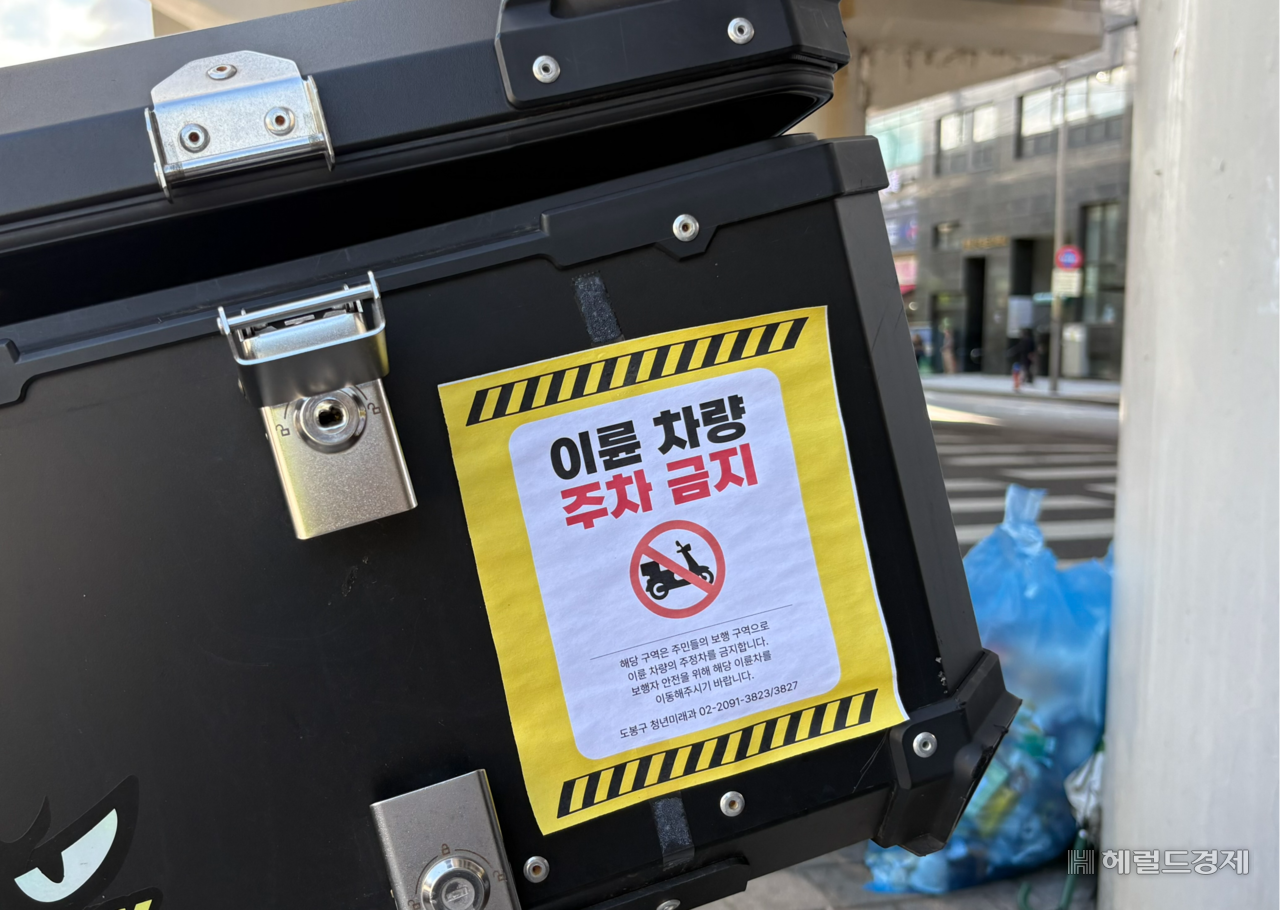
"Please move to the pedestrian zone for the safety of walkers." On Friday morning, seven delivery motorcycles were parked side by side on the sidewalk in front of Exit 1 of Changdong Station in Dobong-gu, Seoul, as commuters streamed past. Some of the motorcycles bore district office notices reading "No motorcycle parking."
Residents pushing strollers or carrying shopping bags had to navigate around the motorcycles, which showed no sign of moving. Some delivery bikes parked haphazardly along the edge of the roadway were also blocking traffic. Such inconsiderate motorcycle parking has become a routine sight, and complaints from residents about disrupted pedestrian flow and safety hazards are on the rise.
Illegally parked motorcycles have long fallen into a blind spot for enforcement, but fines could be imposed as early as next year. The Korean National Police Agency recently announced a proposed partial revision to the enforcement decree of the Road Traffic Act that would allow fines to be levied against illegally parked motorcycles. The agency will accept public comments through July 29, and if the revision is promulgated, it will take effect six months later.
Under the revised rules, fines of 30,000 to 90,000 won ($58) could be imposed on improperly parked motorcycles — 90,000 won in school zones, 60,000 won near fire facilities and in senior or disabled-person protection zones, and 30,000 won in general areas. Parking in the same spot for two hours or more would add 10,000 won to the base amount. The prospect of a legal basis to penalize motorcycle parking that was previously impossible to address has raised hopes that pedestrian inconvenience may finally be eased.
According to the Korean National Police Agency, on-site enforcement cases involving illegally parked motorcycles over the past five years totaled 215 in 2021, 301 in 2022, 253 in 2023, 427 in 2024, 298 in 2025, and 182 as of late May 2026.
"Under the current system, police can only issue a penalty to a rider who is present at the scene, which is why enforcement numbers have been low relative to the actual scale of illegal parking," a Korean National Police Agency official said. "When no rider is present, local governments are supposed to impose fines, but there has been no relevant regulation covering motorcycles, making enforcement in effect impossible."
'Should have been done sooner': residents demand protection for pedestrians
Residents broadly welcomed the proposed measure. Particularly vocal were those living near transit-oriented areas and commercial districts where delivery motorcycles tend to congregate, who said their right to walk safely had been violated.
A woman in her 50s who said she has lived in Dobong-gu for more than 20 years said motorcycles in the area are frequently parked anywhere and everywhere. "Not long ago I saw a motorcycle parked in the middle of the sidewalk being confronted — it was bad enough to actually obstruct pedestrians," she said.
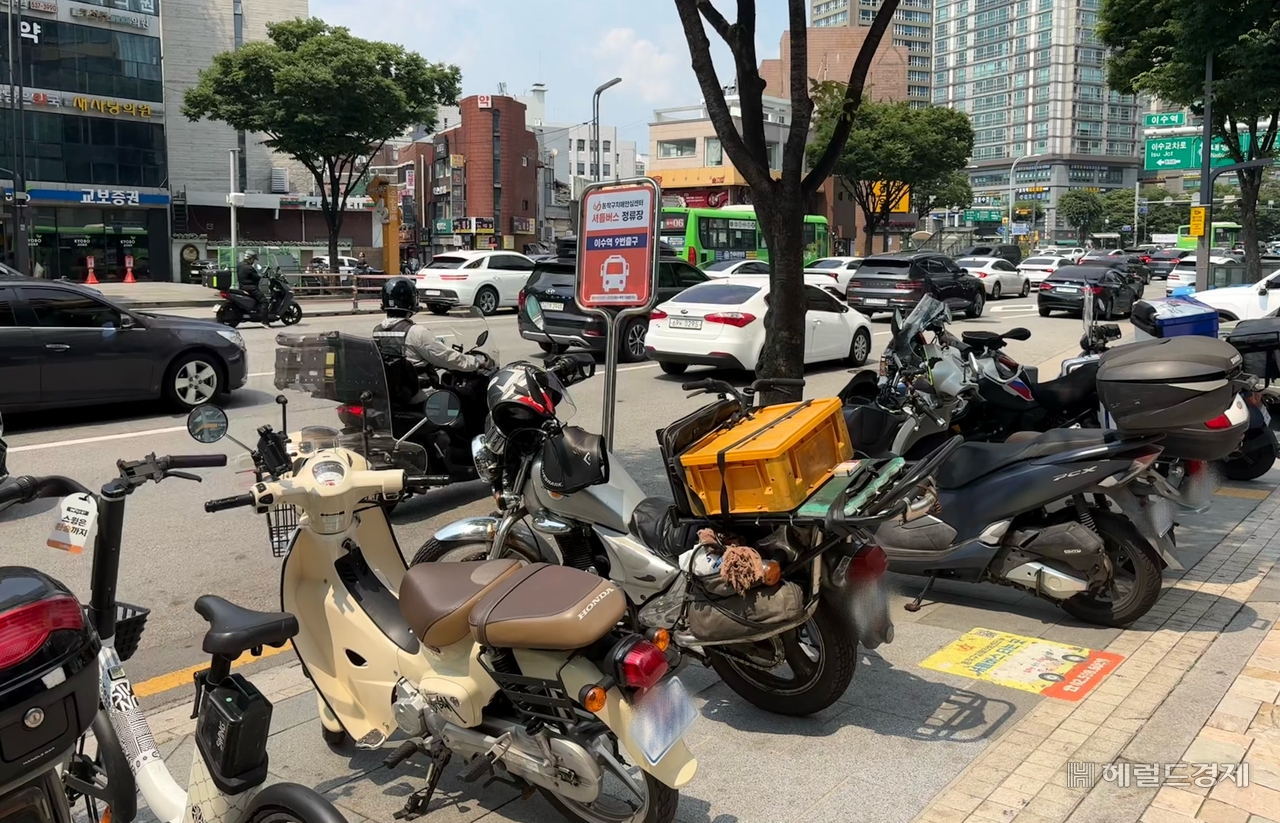
On the same day, six motorcycles were lined up on the sidewalk in front of the shuttle bus stop for the Dongjak-gu Dementia Care Center near Exit 9 of Isu Station in Dongjak-gu, Seoul. Even as reporters watched, delivery motorcycles continued to weave in and out of alleyways and roads without pause.
Im, 54, said the sheer number of restaurants in the area draws a constant stream of motorcycles. "I understand they're in a hurry, but it looks bad and it's dangerous," he said, adding that children who walk while looking at their phones face even greater risk when motorcycles mount the sidewalk.
"They should have been fined long ago," he said. "Even if it's how you make a living, you can't cause harm to others."
Park Seong-jae, 24, a university student living alone in Dongjak-gu, said he frequently sees motorcycles parked on sidewalks or in no-parking zones. "A brief stop is one thing, but when several pile up together it looks like a mess," he said.
Yeom Geon-ung, a professor at Uwon University's department of police and fire administration, said the proposed revision "could raise awareness about illegal motorcycle parking and serve as a turning point in reducing such violations."
'Don't just blame the riders': delivery workers say parking spaces must come first
Those who make their living on motorcycles point to the practical difficulties they face. In a city as short on parking as Seoul, they say, being told to park legally is out of touch with reality. Kim Dong-hu, 43, a delivery rider, called the prospect of fines "frankly terrifying." "There simply is no space to park a motorcycle," he said.
He went on to say that riders often wait 10 to 15 minutes for a single order, and parking far away means having to walk back to the store. "Ultimately the structure forces you to park illegally just to keep up with the time," he said.
Some residents said systemic fixes should come before blanket punishment. One resident who filed a complaint about illegally parked motorcycles last year said brief stops were understandable, but motorcycles left abandoned for days were a real problem. "The government and riders need to find a compromise together," the resident said. "Rather than just handing out fines, the state should set up the systems and spaces first, then allow a grace period."
Cho, 41, who runs a fabric stall at Dongdaemun Comprehensive Market, said business in the area would grind to a halt without motorcycles. "Before imposing fines, even just building one proper motorcycle parking lot would solve most of the problems," he said.
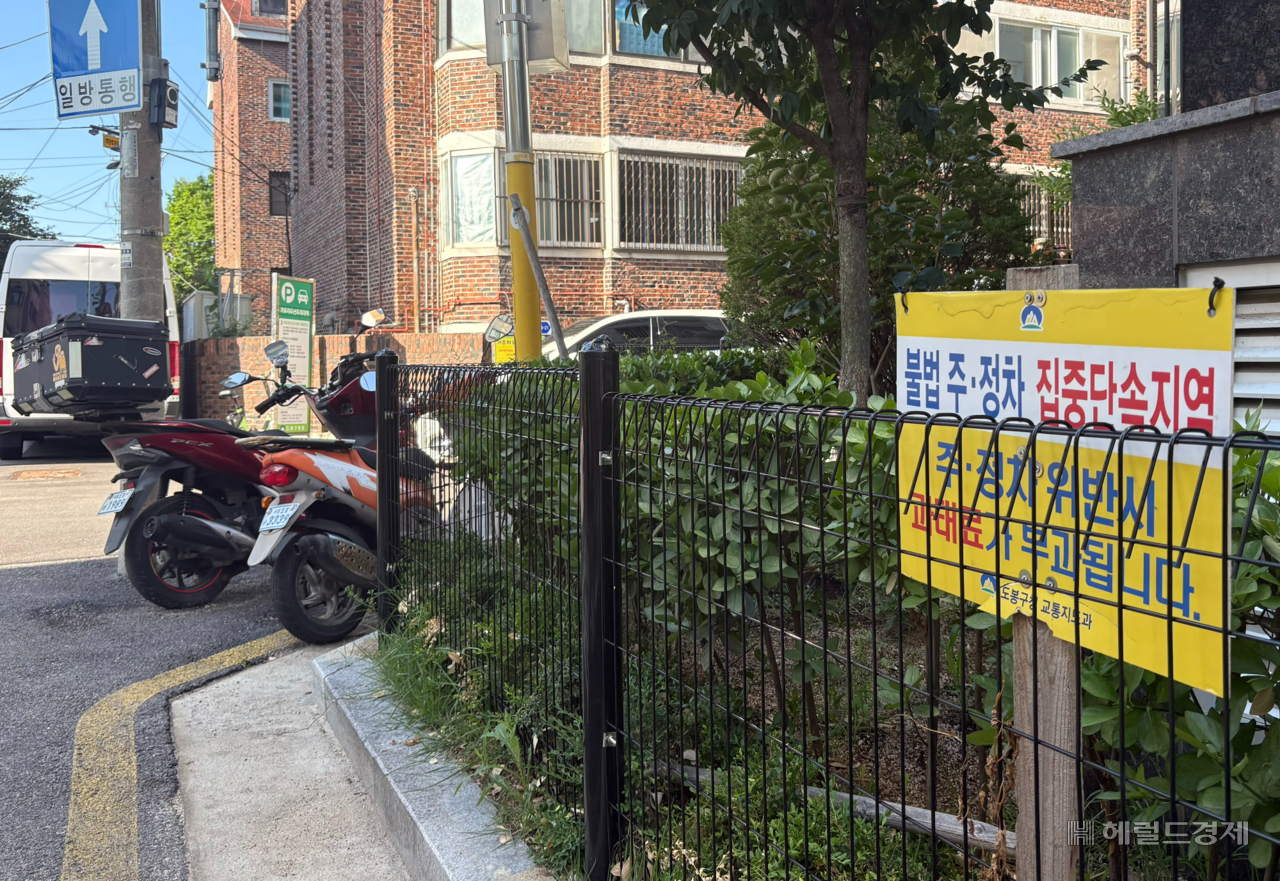
Officers on the ground acknowledged that illegal motorcycle parking is a genuine problem but said it varies considerably by area. Police at local precincts and substations in Dobong-gu said most calls coming in through the 112 emergency line were not about illegal parking per se but about abandoned motorcycles left in place for extended periods. "When motorcycles directly obstruct pedestrians, we take active measures on the scene," they said.
Ko Jun-ho, a professor at Hanyang University's Graduate School of Urban Studies, said the regulation is necessary but should be rolled out in phases — starting in areas with high complaint volumes or serious safety concerns — and paired with complementary measures such as pilot programs and an expansion of dedicated motorcycle parking spaces.
jookapooka@heraldcorp.com
shy@heraldcorp.com




