
Share price up 170% this year; analysts say further gains likely
AI infrastructure investment, LTA expansion boost demand visibility
Wall Street firm sets bold 850,000-won target
Samsung Electronics, South Korea's flagship semiconductor stock, has been overtaking major US tech giants in rapid succession. During intraday trading Monday, it surpassed both Tesla and Meta to claim ninth place in global market capitalization rankings.
According to Korea Exchange, Samsung Electronics' market cap stood at $1.568 trillion as of 10 a.m. Monday, measured in US dollar terms — enough to edge past Tesla ($1.561 trillion) and Meta ($1.524 trillion) for ninth place globally.
The eight companies still ahead of Samsung are Nvidia ($5.434 trillion), Alphabet/Google ($4.513 trillion), Apple ($4.498 trillion), Microsoft ($3.420 trillion), Amazon ($2.810 trillion), TSMC ($2.259 trillion), Broadcom ($2.177 trillion) and Saudi Aramco ($1.763 trillion).
Samsung joined the $1 trillion market cap club on May 6, when its closing market capitalization crossed $1.0397 trillion — making it the second Asian company to reach that threshold, after TSMC.
At the time, Samsung ranked 12th globally, having overtaken Berkshire Hathaway. In less than a month, it has surpassed Tesla and Meta to reach ninth place. Micron ($1.167 trillion) sits at 12th and SK Hynix ($1.083 trillion) at 13th.
As of the same time Monday, Samsung shares were trading up 3.15% from the previous session at 360,000 won, after briefly hitting an intraday high of 377,000 won. The surge follows remarks made Sunday by Nvidia CEO Jensen Huang at the GTC Taipei event in Taiwan, where he said Samsung's high-performance, low-power memory chips would be used in the next-generation AI accelerator "Vera Rubin."
On Sunday, Samsung closed at 349,750 won, pushing its market capitalization above 2,000 trillion won for the first time. It is the first domestically listed company to cross that threshold.
Samsung has been on a steep upward trajectory, driven by expectations of growth in the AI semiconductor market and its milestone of becoming the world's first company to ship samples of next-generation HBM4E chips.
Despite a share price gain of more than 170 percent this year, analysts say Samsung still has room to run, citing growing demand visibility from expanding AI infrastructure investment and the spread of long-term supply agreements (LTA).
Some on Wall Street have floated a target price of 850,000 won per share. According to Bloomberg and other outlets, Susquehanna senior analyst Mehdi Hosseini assigned Samsung a "Positive" rating with an 850,000-won price target on May 29. If that level is reached, Samsung's market capitalization would enter the 5,000 trillion won range.
Among domestic brokerages, SK Securities on Sunday raised its Samsung target price from 500,000 won to 610,000 won. The firm forecast Samsung's operating profit at 378 trillion won this year and 570 trillion won next year.
"Samsung Electronics is significantly undervalued relative to its earnings power, given its full-scale entry into the HBM market and expanding foundry order wins," said Han Dong-hee, an analyst at SK Securities. Kim Dong-won, head of research at KB Securities, said Samsung "represents the starting point for a $2 trillion market cap — roughly 3,000 trillion won — when you consider that the semiconductor upcycle is still in its early stages and the humanoid robot business is expanding."
Nomura Securities last month sharply raised its Samsung target price from 340,000 won to 590,000 won, arguing that surging memory demand and structural growth potential justify applying a TSMC-level valuation. Nomura projected Samsung's operating profit would grow from 307 trillion won this year to 511 trillion won in 2028.
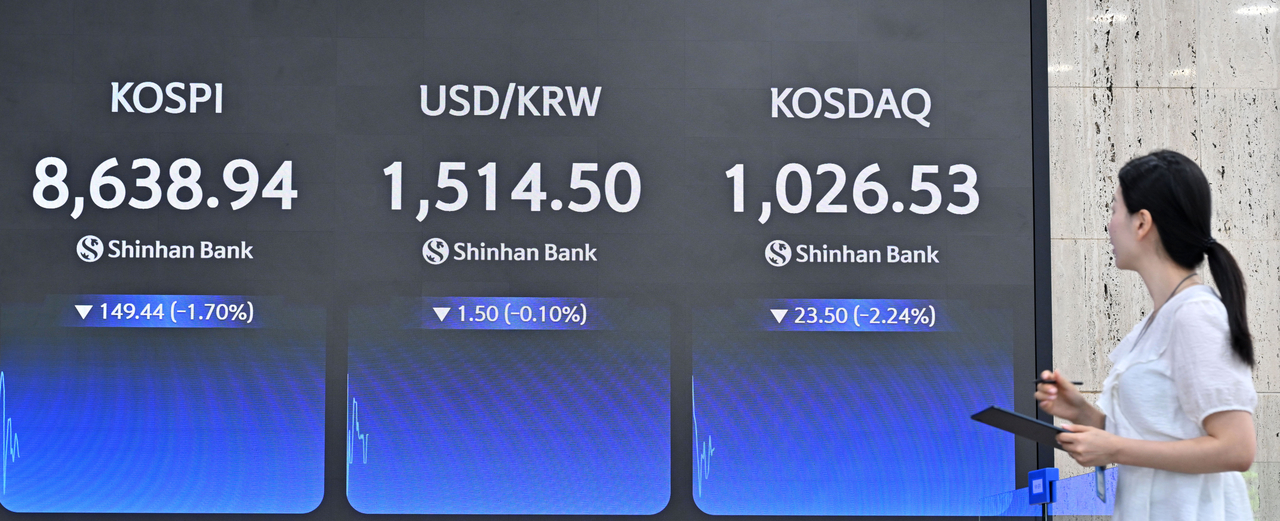
The Kospi opened Monday up 94.81 points, or 1.08 percent, at 8,883.19, immediately surpassing the previous intraday all-time high of 8,874.16 set Sunday. The index extended its gains to 8,933.62, crossing the 8,900 mark for the first time — leaving it just roughly 66 points short of the 9,000 level.
The index then gradually pared its gains, turned negative and recovered, oscillating around the 8,800 level. As of 10:25 a.m., the Kospi was down 1.26 percent at 8,677.89.
(Moon Yi-rim, Song Ha-jun, Hong Tae-hwa)
moon@heraldcorp.com
hajun825@heraldcorp.com
th5@heraldcorp.com




