Kospi hits 4,924.61 at 9:03 a.m., halting trade for 20 minutes
Samsung Electronics, SK hynix lead selloff; Kosdaq sell sidecar activated
US AI stock rout fans fears over semiconductor investment outlook
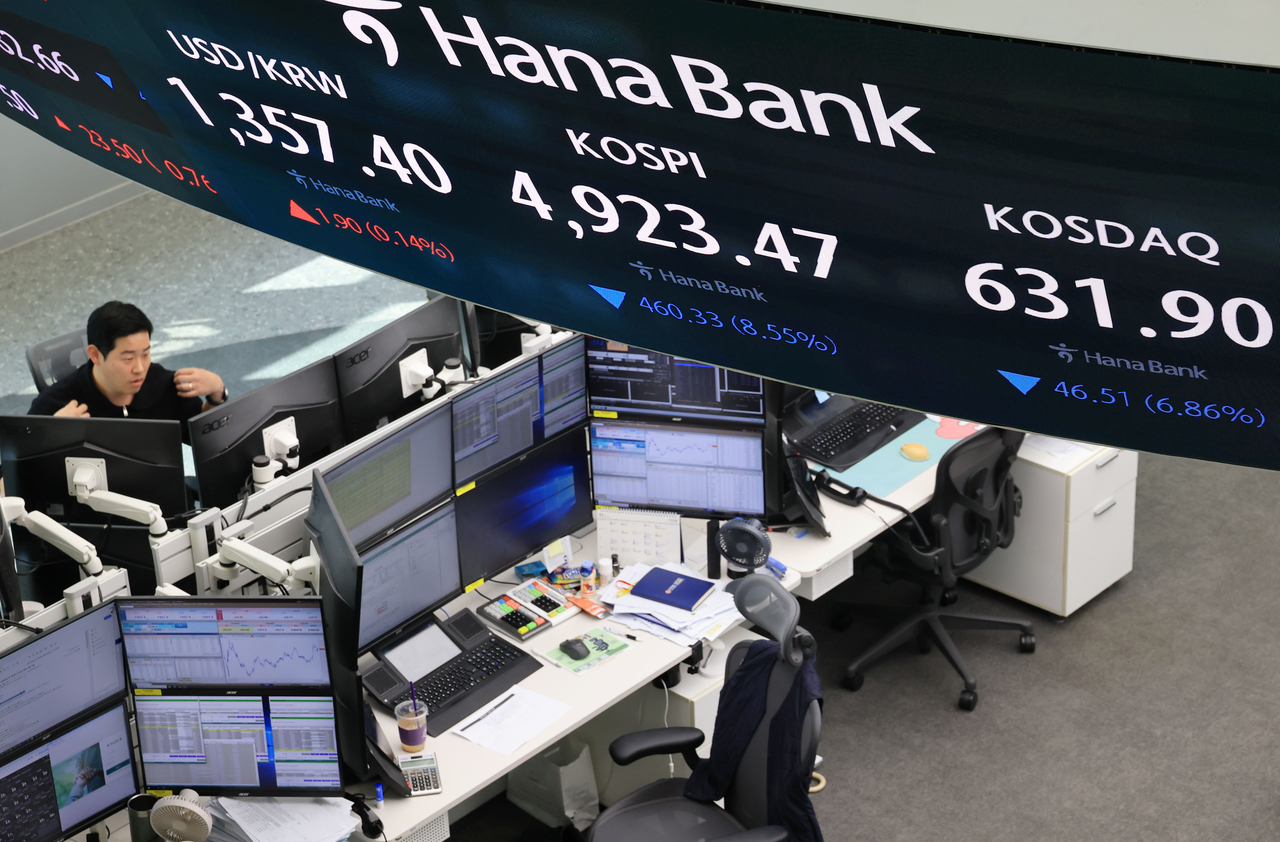
The Kospi plunged more than 8% within three minutes of Friday's open, breaking below the 5,000 mark as a selloff in US semiconductor stocks — driven by fears of a pullback in AI investment — swept into South Korean markets. Korea Exchange activated a circuit breaker on the main bourse, while the Kosdaq market triggered a sell sidecar that temporarily suspended program sell orders.
As of 9:36 a.m., the Kospi was trading at 5,074.25, down 309.55 points, or 5.75%, from the previous session. The index had opened down 120.54 points, or 2.24%, at 5,263.26 before rapidly extending its losses.
Korea Exchange activated a Level 1 circuit breaker at 9:03:33 a.m., after the Kospi tumbled 459.19 points, or 8.52%, to 4,924.61. With the index holding more than 8% below the previous close for a full minute, trading on the main board was suspended for 20 minutes.
Selling was concentrated in large-cap semiconductor stocks. At the time the circuit breaker was triggered, Samsung Electronics had fallen to 181,400 won ($135) and SK hynix to 1.11 million won. As of 9:36 a.m., Samsung Electronics was trading at 187,300 won, down 7.05% from the previous session, while SK hynix was down 8.23% at 1.16 million won.
Top market-capitalization stocks fell across the board. Samsung Electronics preferred shares dropped 6.30%, SK Square fell 9.39%, LG Energy Solution lost 2.89%, Samsung Biologics slipped 0.66%, Samsung Electro-Mechanics tumbled 10.28%, Hyundai Motor fell 7.33%, KB Financial Group dropped 5.92% and Celltrion declined 3.72%. Of the top 30 Kospi stocks by market capitalization, only KT&G rose, gaining 0.41%. On the main board, retail and foreign investors recorded net selling of 87.4 billion won and 15.7 billion won, respectively, while institutions posted net purchases of 82.9 billion won.
The Kosdaq also tumbled sharply. At the same time, the index was at 645.03, down 33.38 points, or 4.92%, from the previous session. It had opened down 23.98 points, or 3.53%, at 654.43.
A sell sidecar was activated on the Kosdaq market at 9:06:02 a.m. At that point, the Kosdaq 150 futures price had fallen 7.84% from the previous session to 1,029.00, while the Kosdaq 150 spot index was down 8.10% at 1,027.12. Program sell orders were suspended for five minutes as a result. On the Kosdaq, institutions and foreign investors recorded net purchases of 25.1 billion won and 31.2 billion won, respectively, while retail investors posted net selling of 57.2 billion won.
The overnight rout in US AI-related stocks weighed heavily on domestic markets. The Dow Jones Industrial Average fell 3.4%, the S&P 500 dropped 4.4% and NASDAQ declined 5.5%. Semiconductor stocks bore the brunt of the selling — Micron lost 17.5%, Nvidia fell 9.3% and AMD dropped 17.3%. Anxiety over a potential reduction in AI investment grew as concerns about tighter US data center regulation combined with a weak earnings outlook at some chipmakers.
Han Ji-young, a researcher at Kiwoom Securities, said the impact of data center regulation would likely be felt more significantly on 2028 projects than on those planned for 2027. "The specific scope of the regulations, whether actual delays will materialize, and any decline in AI demand have yet to be confirmed," Han said. "In that sense, I believe the AI stock selloff on Wall Street overnight was an overreaction."
Han added that semiconductor stocks would likely see elevated volatility for now, caught between bargain-hunting on oversold conditions and stop-loss selling driven by concerns over slowing earnings growth. "Broadening exposure to sectors less affected by US regulatory uncertainty — such as banks, holding companies, construction, transportation and biotech — is also worth considering as an alternative," Han said.

hajun825@heraldcorp.com