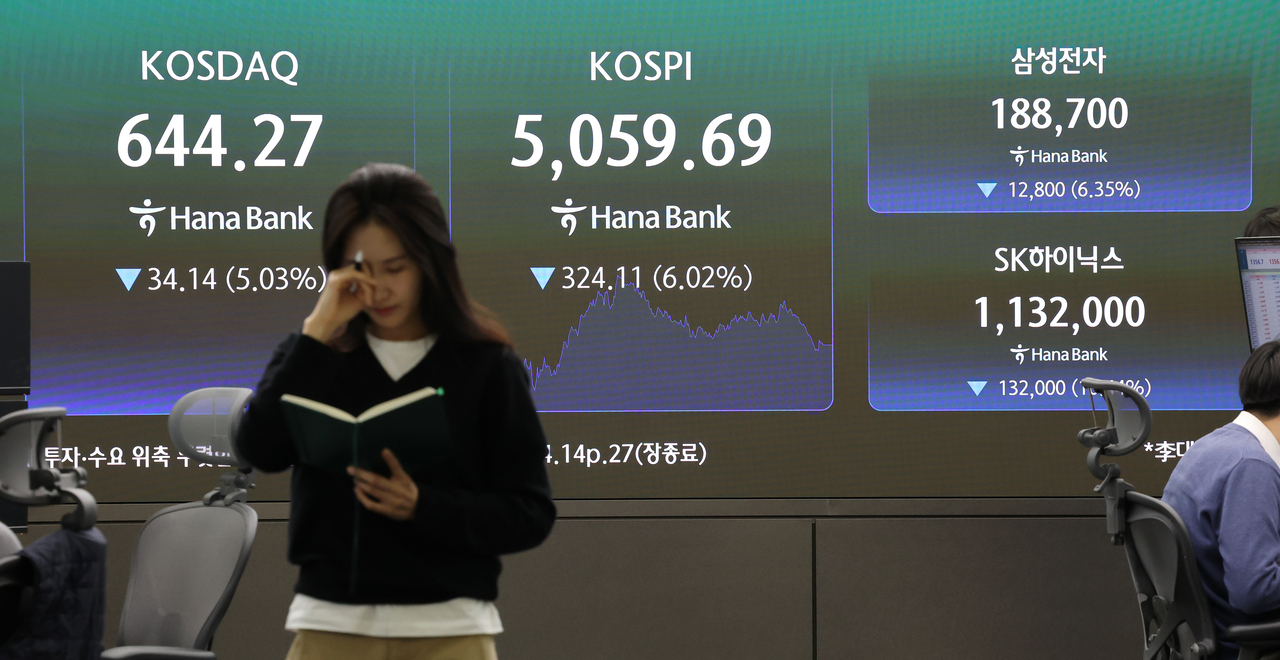
Growing fears of tighter regulation on AI data centers following the US midterm elections sent the Kospi below the 5,000 mark during trading Friday and triggered a circuit breaker. Investors are now looking to next week's US inflation data and earnings from AI infrastructure firm CoreWeave as potential turning points for a market rebound.
According to Korea Exchange, the Kospi closed Friday down 324.11 points, or 6.02 percent, at 5,059.69. The Kosdaq fell 34.14 points, or 5.03 percent, to finish at 644.27. For the week of Nov. 2 through Friday, the Kospi shed 11.71 percent and the Kosdaq dropped 11.06 percent.
The Kospi slipped below 5,000 in early trading Friday, triggering a market-wide circuit breaker. A sell-side sidecar was also activated on the Kosdaq. Concerns that the Democratic Party's sweep of both chambers of Congress could lead to stricter data center regulation spread across AI-related stocks, including semiconductors and power equipment.
"After the Democratic Party secured control of both chambers of Congress, wariness over tighter AI infrastructure regulation centered on data centers spread through the market," said Kim Ju-yeon, a researcher at Mirae Asset Securities. "Not only memory chips but also power, nuclear power plants, ESS and other related sectors all weakened."
Some analysts, however, argue that fears of a pullback in AI investment are overblown. Lee Kyung-min, a researcher at Daishin Securities, said that while the Democrats' landslide victory means markets must brace for potential delays in data center construction and higher costs, "the possibility of a blanket federal halt to construction is limited." Lee added that "with big tech companies maintaining their commitment to expanding AI capital expenditure, the market's reaction to fears of an investment slowdown is excessive."
CoreWeave's third-quarter earnings, due Tuesday (local time), are seen as a pivotal test for a recovery in semiconductor investor sentiment. The stakes are high because recent large-scale corporate bond issuances by big tech firms including Oracle and Meta have raised doubts about their ability to fund AI investment.
"For CoreWeave's results, investors need to look beyond sales growth to cash flow, interest expenses and future financing plans," Lee said. "If the company confirms it can maintain its AI investment plans and has sufficient financing capacity, that could serve as a catalyst for a recovery in semiconductor sentiment — but if debt burdens come back into focus, pressure for further correction could intensify."
A string of US inflation readings is also due next week. The October consumer price index will be released Tuesday (local time), followed by the producer price index on Nov. 13. Markets expect consumer prices and producer prices to rise 0.3 percent and 0.4 percent, respectively, from the prior month. A reading above expectations could push US government bond yields higher and weigh on equities.
"The midterm election outcome has created conditions for government bond yields to stabilize, as fiscal expansion is now more constrained, but if inflation data comes in above expectations, the downward trend in yields could reverse," said Jo Byung-hyun, a researcher at Daol Investment & Securities. "With semiconductor sector volatility elevated, it is important to first confirm whether the Kospi can hold the 5,000 line."
Anthropic's planned initial public offering is also seen as a supply-demand variable for the domestic market next week. The company is expected to begin a roadshow for investors on Tuesday. NH Investment & Securities projected the offering size at around $100 billion, with Anthropic targeting a NASDAQ listing before Thanksgiving on Nov. 26.
"Ahead of Anthropic's large-scale IPO, a global reallocation of funds could weigh on the supply-demand dynamics for domestic semiconductor stocks," said Na Jeong-hwan, a researcher at NH Investment & Securities. "That said, when SpaceX listed, foreign investors turned net buyers on the listing day itself, so the supply-demand pressure should ease once the offering process wraps up."
NH Investment & Securities set its forecast range for the Kospi next week at 5,000 to 6,000 points. It cited an easing of concerns over AI data center regulation and interest rate stabilization on reduced US-Iran war risk as upside factors, and foreign capital outflows as a downside risk.
"The Democratic Party also values winning the AI competition with China, so an outright ban on data center construction is unlikely," Na said. "If a drop in international oil prices helps stabilize US government bond yields, which have surged recently, it would be worth paying attention to the semiconductor sector, which saw heavy losses this week. ESS and power equipment are also worth watching."
hajun825@heraldcorp.com