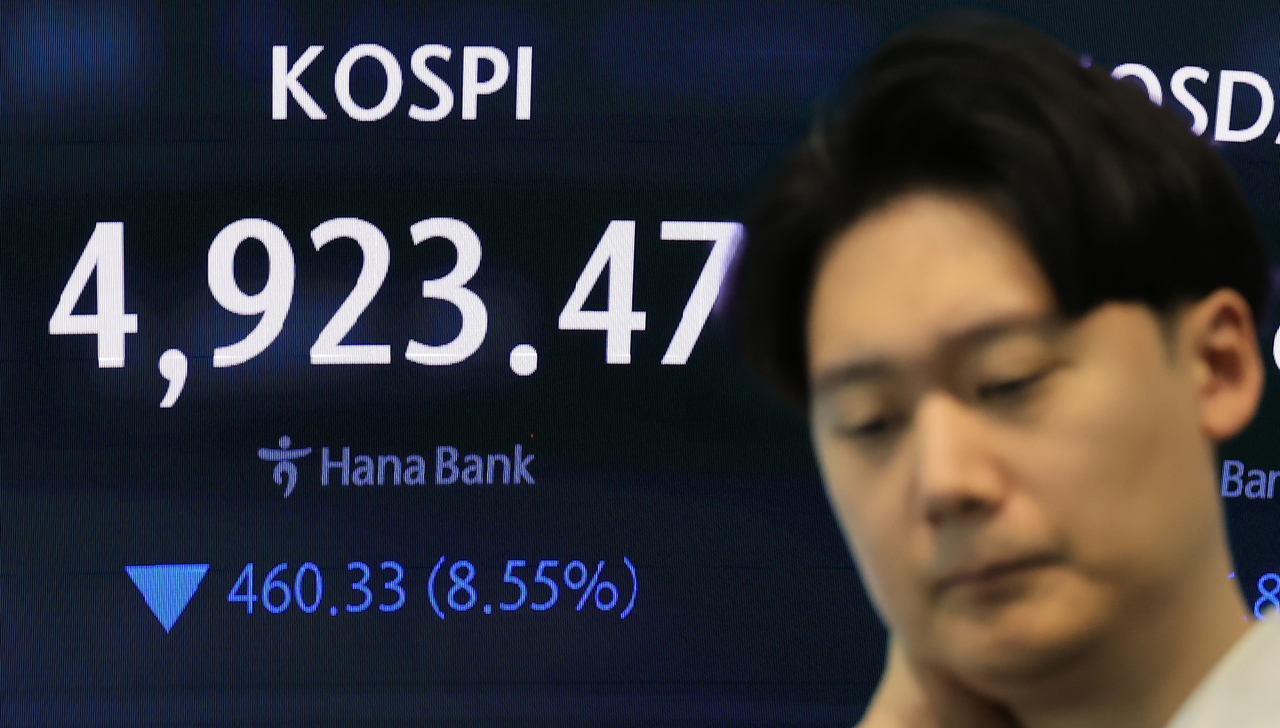
Pension funds have been buying shares on the Kospi for five consecutive trading sessions, accumulating more than 1.4 trillion won ($1.04 billion) in net purchases and providing a floor for the market. With the Kospi slipping below the 5,000 mark in early trading Friday, attention is turning to whether the funds can act as a firewall against relentless foreign selling.
According to Korea Exchange data released Friday, pension funds net-bought 1.41 trillion won worth of Kospi-listed shares between Oct. 30 and Thursday. The buying began with 892.9 billion won on Oct. 30, followed by 169.9 billion won on Monday, 113.8 billion won on Tuesday and 73.9 billion won on Wednesday. Even on Thursday, when the Kospi fell 5 percent, the funds extended their streak with 160.1 billion won in net purchases. As of 9:35 a.m. Friday, they had added another 13 billion won on a net basis.
The Oct. 30 net purchase figure was the largest since approximately 1.2 trillion won recorded on Jan. 27, 2022, and the second-largest on record. The buying marks a sharp reversal: pension funds had been net sellers of domestic shares in August and September, offloading 660.8 billion won and 582.1 billion won, respectively, before pivoting to large-scale buying as the Kospi tumbled.
The buying was concentrated in large-cap semiconductor stocks, particularly Samsung Electronics and SK hynix. Between Oct. 30 and Thursday, pension funds net-bought 275.7 billion won of SK hynix and 232 billion won of Samsung Electronics. The combined net purchase of the two stocks came to 507.7 billion won, accounting for roughly 40.6 percent of total net purchases over the period.
Analysts say the large-scale buying is largely driven by rebalancing in response to falling share prices. Pension funds set target allocations for each asset class and tend to buy against the trend when equity prices fall and their stock weighting drops below target.
The National Pension Service also buys and sells shares mechanically to maintain its asset allocation targets. As of end-August, its domestic equity weighting stood at 25.8 percent, exceeding its target of 20.8 percent by 5 percentage points, though still below the 26.8 percent upper limit under its strategic asset allocation range. With the Kospi having since fallen more than 20 percent from end-August levels, analysts believe the fund's capacity to buy additional domestic shares has expanded considerably.
Daishin Securities Research Center estimated the National Pension Service's domestic equity weighting at 22.5 percent as of Oct. 30. Applying both the 2-percentage-point strategic asset allocation allowance and the 6-percentage-point tactical asset allocation allowance, the fund still has 6.3 percentage points of room before hitting the upper limit — a capacity that translates to roughly 101.2 trillion won in potential additional purchases.
"The National Pension Service's domestic equity weighting fell short of the upper limit at end-August, and it is estimated to have declined further as the Kospi dropped afterward," said Lee Jun-young, a researcher at Eugene Investment & Securities. "The expansion of pension fund buying since Oct. 30 can be seen as a reflection of the increased room available before hitting the upper limit."
Whether the pension funds' buying will be enough to cushion further market declines remains an open question. On Wednesday, their purchases did help the market recover from an intraday slide. The Kospi briefly surpassed 5,800 during the session before tumbling to 5,421.72 under heavy foreign selling, only to rebound on institutional buying led by pension funds, closing up 0.62 percent at 5,683.80.
"With the Kospi being pushed down toward the 4,000 level intraday today, conditions are in place for pension funds to step in with defensive buying," one securities industry official said.
Even so, aggressive foreign selling continues to weigh on the market. Foreign investors net-sold a combined 9.37 trillion won ($6.98 billion) worth of Kospi-listed shares over the five trading sessions from Oct. 30 through Thursday.
Seo Sang-young, a managing director at Mirae Asset Securities, said that as deleveraging and options-hedging selling centered on semiconductors intensified in US markets, a continued simultaneous sell-off in both spot and futures by foreign investors in Korea could amplify the index's decline. "The medium-term outlook that the AI semiconductor cycle is extending has not changed significantly, so the momentum for a future rebound will depend on whether foreign investor flows stabilize," he added.

moon@heraldcorp.com