'New districts must balance jobs, housing and transport — not repeat past mistakes'
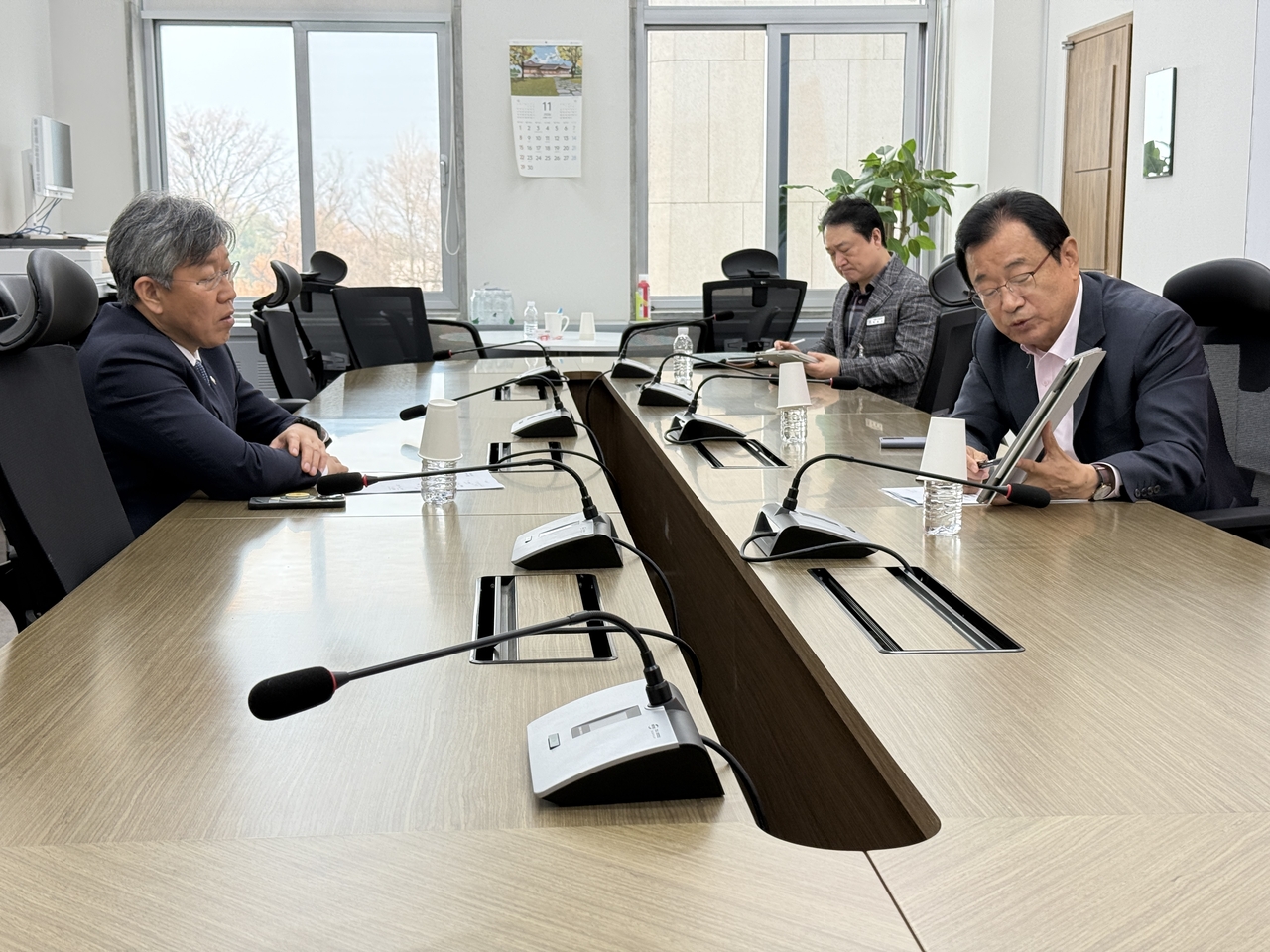
Hanam Mayor Lee Hyeon-jae met with First Vice Minister of Land, Infrastructure and Transport Kim I-tak on Friday to present key concerns and requests regarding two candidate sites for new public housing districts — the Hanam Misa K-Culture Zone and Hanam Gamil District 2 — that the government announced Oct. 29.
The meeting was arranged to prevent a recurrence of problems that emerged during the development of four existing new towns — Misa, Gamil, Wirye and Gyosan — and to lay the groundwork for building the new districts as model cities where jobs, housing and transportation work in harmony.
Lee said the regulations applied to overpopulation-control zones under the Seoul Metropolitan Area Readjustment Planning Act structurally conflict with government policy aimed at strengthening self-sufficiency in new public housing districts in the greater Seoul area. Lee said the central government needs to reform the relevant systems and introduce effective measures to restore public trust in its policies.
On the first point, Lee said securing self-sufficient functions within new towns is essential to breaking the cycle of ever-growing commuter traffic into Seoul. New towns built within overpopulation-control zones produce nothing more than bedroom communities, Lee argued, and called on the government to allocate industrial land quotas and designate urban high-tech industrial complexes when developing new towns, creating a foundation for attracting businesses and generating jobs.
On the second point, Lee expressed gratitude that the K-Culture complex project Hanam has long pursued will proceed as a K-Culture complex within the Misa K-Culture Zone, and asked the government to actively lay the groundwork to attract anchor companies capable of driving self-sufficient economic activity. Lee also flagged that Misa Island has only a single access road, saying the existing road must be widened and additional access routes built, and that the district plan should be expanded to resolve the traffic problem. Lee added that public transit links to Seoul must be secured through an extension of subway Line 3. Regarding Gamil District 2, Lee welcomed the Ministry of Land, Infrastructure and Transport's announcement that it would review improvements to the Seohanam interchange, and asked that transit issues be resolved in advance through additional Line 3 stations and an extension of the Wirye-Sinsa line.
Lee also noted that despite most new-town residents commuting to Seoul, coordinating with the Seoul Metropolitan Government on securing bus routes into the city has been extremely difficult, and asked the ministry to proactively engage Seoul in advance.
Lee said the principle of completing transportation infrastructure before allowing move-ins had not been properly observed during the development of the four existing new towns, leaving residents with persistent commuting difficulties. The existing metropolitan transport improvement plans, drawn up on a town-by-town basis, had proven inadequate for ensuring connectivity between cities, Lee said, and he asked the ministry to review Hanam's metropolitan transport network as a whole and to create a mechanism for Hanam to participate from the earliest stages of drafting any metropolitan transport improvement plan.
On the third point, Lee said he supports the need for rental apartments in principle, but explained that Hanam's fiscal capacity has been stretched by the new towns already built there. He called on the government to supply a variety of housing types — including convertible public rental units — to give young people without homes and newlyweds a greater chance to own property.
On the fourth point, Lee outlined Hanam's situation as a city set to host six new towns and made a strong case for regulatory reform to ensure the new towns and the original city center develop in a mutually beneficial way. He noted in particular that residents of priority-release settlements, where development has stalled for 20 years since the lifting of greenbelt restrictions, need urban management plan revisions, but that the mayor currently lacks the authority to make such changes. Lee asked that mayors — who know their areas best — be granted the authority to revise urban management plans.
Finally, regarding the Gyosan district currently under development, Lee pointed out that not a single metropolitan transport improvement measure has broken ground ahead of the planned 2029 move-in date, and that agreement with the project operator on essential community facilities to be in place before residents arrive has yet to be reached. Lee asked the ministry to support an arrangement under which the operator would install the resident amenities and transfer them to the city free of charge.
Kim said he listened carefully to Hanam's local circumstances and key requests, and said he fully understood the city's position as a place where six new towns are to be built. Kim expressed strong agreement with the need to secure industrial land quotas to create self-sufficient cities, and said the ministry would review the requests submitted.
"The new public housing districts must not repeat the mistakes of existing new towns — they must be developed as new model cities for South Korea, where jobs, housing and transportation are in balance," Lee said. "To that end, we will continue to consult with the central government and actively push for the regulatory reforms needed."
pjh@heraldcorp.com