Biggest drop since January 2023
Tax reform bill triggers flood of distressed listings
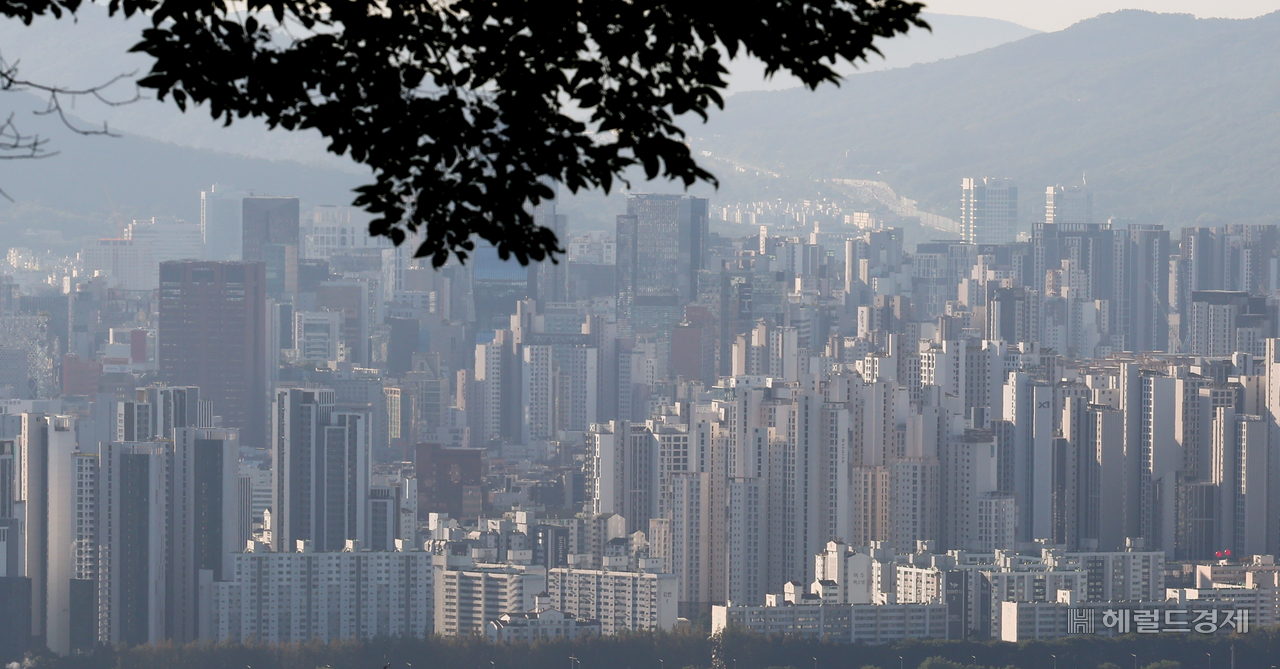
Apartment prices among the top 50 complexes by market capitalization — calculated as price multiplied by number of units — fell at their steepest pace in three years and 10 months. According to KB Real Estate's November national housing price trend report, the market cap change index for the top 50 apartment complexes by market cap stood at 97.8 in November.
That marked a 1.06 percent decline from the previous month. The index has now fallen for three consecutive months since September — its sharpest drop since January 2023, when it fell 2.17 percent.
KB Real Estate attributed the decline to a surge in listings from owners of high-priced reconstruction apartments in the Gangnam area seeking to offload properties ahead of heavier tax burdens. The move follows the government's tax reform proposal unveiled in August, which included measures to ease the comprehensive real estate tax burden on owner-occupants of a single home while reducing tax benefits for owners of high-value or non-owner-occupied properties and those holding multiple homes.
According to Asil (Apartment Actual Transaction Price), a big data platform, the number of Seoul apartments listed for sale stood at 81,932 as of Tuesday — up 21,523 from the 60,409 listings recorded on Aug. 3, when the tax reform proposal was released.
Pessimism spreads over further declines in Gangnam's three districts
Nationwide apartment prices still rose 0.44 percent from the previous month in November, with both Seoul (up 0.68 percent) and the greater metropolitan area (up 0.84 percent) posting gains.
Within Seoul, the three Gangnam districts all declined — Gangnam fell 0.60 percent, Songpa 0.32 percent and Seocho 0.28 percent — while northern Seoul districts posted gains, led by Jungnang (up 1.90 percent), Gangbuk (up 1.75 percent) and Nowon (up 1.73 percent).
In Gyeonggi Province, Hwaseong Dongtan led with a 4.32 percent rise, followed by Suwon Yeongtong at 3.87 percent and Hwaseong Byeongjeom at 3.41 percent. Among major regional cities, Daejeon rose 0.31 percent and Ulsan 0.10 percent, while Daegu fell 0.14 percent, Gwangju 0.10 percent and Busan 0.07 percent.
A forward-looking index gauging expected apartment sale prices three months out — based on sentiment among practicing real estate agents — came in at 97.0 for Seoul, falling 15.8 points from the previous month and dropping below the baseline of 100. A reading below 100 signals that expectations for price declines outweigh those for gains.
It was the first time Seoul's index had fallen below 100 since July last year, when it recorded 98.0 — a gap of one year and four months. A clear divide emerged between northern and southern Seoul: the index for the 14 districts north of the Han River stood at 104.1, indicating a majority expecting price increases, while the 11 Gangnam districts registered 90.8, down 16.6 points from the previous month.
In the broader metropolitan area, Gyeonggi Province's index fell 8.6 points to 108.2 and Incheon's dropped 4.2 points to 98.7. All major regional cities showed strong expectations for price declines: Daejeon at 98.3, Daegu at 95.6, Busan at 92.1, Ulsan at 90.9 and Gwangju at 85.3.
nyang@heraldcorp.com