Sector logs profit for third consecutive quarter, though Q3 standalone earnings fall 27.4%
Deposit rate hikes weigh on profitability despite easing loan-loss provision burden
Delinquency rate dips to 6.2%; funding costs seen rising further in Q4
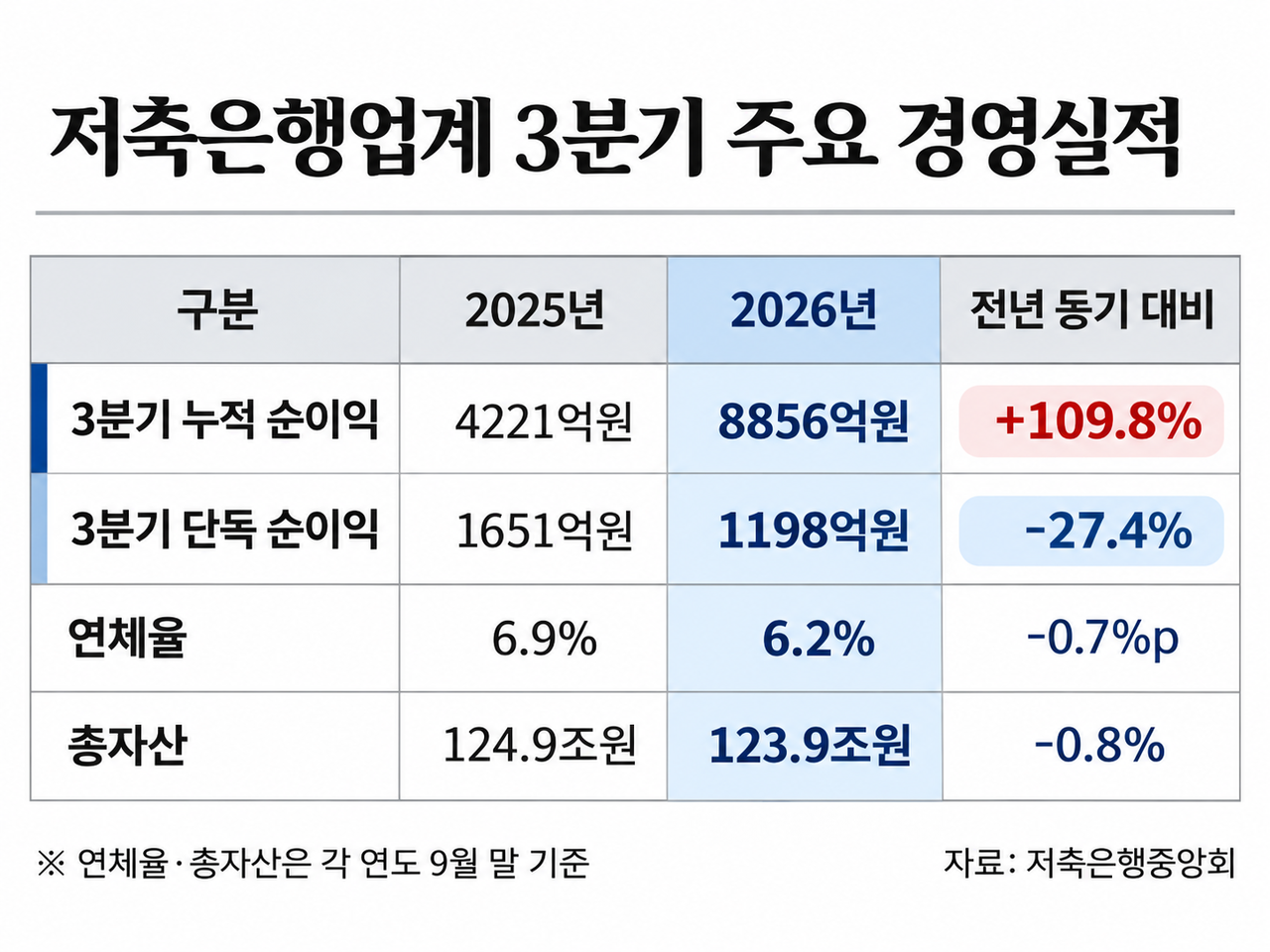
South Korea's savings bank sector more than doubled its cumulative net profit through the third quarter of this year compared with the same period last year, driven by easing loan-loss provision costs and gains on securities holdings. However, rising deposit rates pushed up funding costs and non-interest income turned negative, dragging down standalone third-quarter earnings.
The sector's cumulative net profit through the third quarter reached 885.6 billion won ($660 million), according to preliminary figures released Sunday by the Korea Federation of Savings Banks. The industry posted a profit for the third consecutive quarter this year. The result represents a 109.8 percent increase from the 422.1 billion won recorded in the same period last year.
The primary driver of the improvement was a reduction in loan-loss provision expenses. Quarterly provision charges fell consistently — from 801.8 billion won in the first quarter to 592.4 billion won in the second quarter and 524.8 billion won in the third quarter — as the sector had already built up reserves preemptively against potential bad loans, reducing the need for additional provisioning.
The pace of improvement slowed in the third quarter, however. Standalone net profit for the quarter came to 119.8 billion won, down 27.4 percent from 165.1 billion won in the same quarter last year and 72.3 percent below the 432 billion won recorded in the previous quarter.
Higher deposit rates drove up interest expenses, while non-interest income deteriorated. Interest expenses in the third quarter rose 16.2 percent quarter-on-quarter to 848.4 billion won. Over the same period, non-interest income — which includes gains and losses on securities and fee income — swung from a profit of 142 billion won to a loss of 206.6 billion won.
Asset quality continued to improve. The delinquency rate stood at 6.2 percent as of end-September, down 0.1 percentage point from the end of the previous quarter. Delinquency rates on corporate loans and household loans each fell 0.1 percentage point, to 8.3 percent and 4.5 percent respectively, reflecting ongoing sales and write-offs of non-performing loans as well as growth in total outstanding loan balances.
The substandard-and-below loan ratio also fell 0.2 percentage point to 8.0 percent from the end of the prior quarter. The Bank for International Settlements (BIS) capital adequacy ratio, a key measure of financial soundness, edged down 0.2 percentage point to 15.5 percent but remained well above the statutory minimum.
The sector also expanded in scale. Total assets reached 123.9 trillion won as of end-September, up 2.7 percent from the end of the previous quarter. Outstanding loans grew by 900 billion won to 96.7 trillion won, led by lending to small and medium-sized enterprises and mid-rate loans to the private sector. Deposits rose 3.8 trillion won to 104.2 trillion won, as savings banks built up liquidity in preparation for the maturity of fixed-term deposits in the fourth quarter.
The Korea Federation of Savings Banks said it expects the sector to remain profitable in the fourth quarter. It cautioned, however, that the pace of net profit growth is likely to slow as benchmark interest rate increases push up interest expenses and uncertainty in capital markets reduces securities-related gains.
The savings bank industry plans to maintain asset quality through continued disposal of non-performing loans while diversifying revenue sources by expanding lending to mid-sized enterprises and growing loan products linked to online peer-to-peer lending platforms. The sector also intends to increase the supply of policy finance products and mid-rate loans targeting borrowers with low-to-mid credit scores.
snsd@heraldcorp.com