Fixed deposits at 5 major banks up 19 trillion won this month
Investors shift from risky assets to safe havens
Margin financing balance hits 13-month low
Retail investors turn cautious as Korean market volatility surges
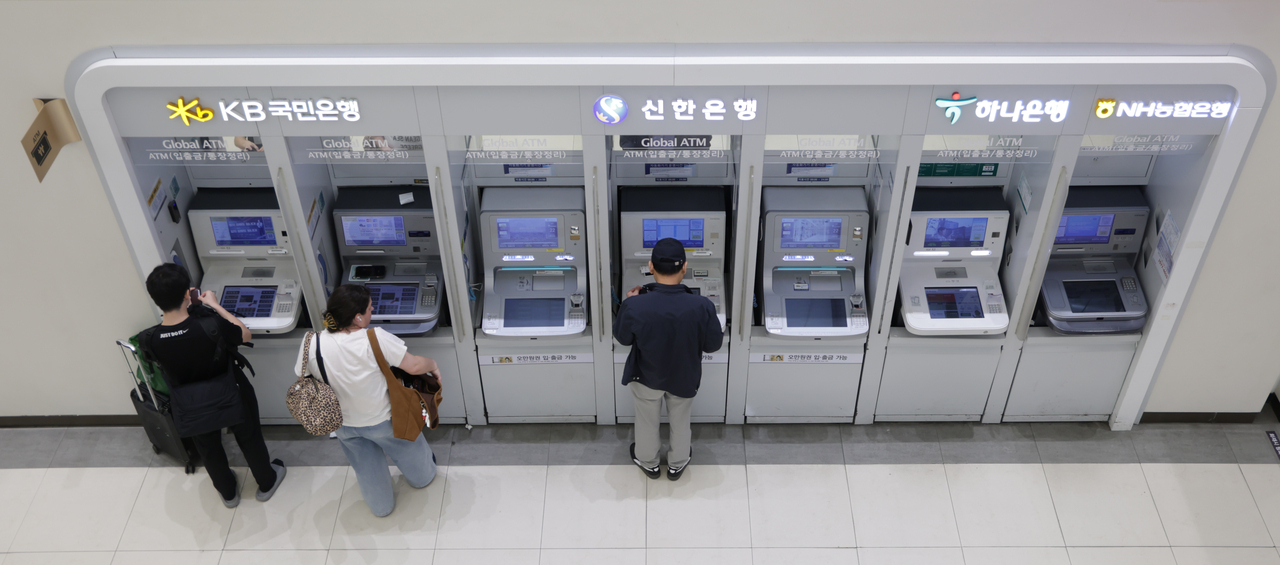
As domestic stock markets have grown increasingly turbulent of late, investors are turning away from shares and toward bank deposits. Fixed deposits at the five major banks grew by more than 19 trillion won ($14.2 billion) this month alone. Rising market volatility, combined with higher borrowing costs following benchmark interest rate increases, has eroded both the means and the willingness to take on more debt to invest. Margin financing balances have also fallen to their lowest level in 13 months, suggesting that retail investors who had been buying on margin have moved to the sidelines.
Fixed deposits at KB Kookmin, Shinhan, Hana, Woori and NH NongHyup — the country's five largest banks — stood at 1,049.5 trillion won as of Friday, up 19.02 trillion won from the end of October, according to financial industry data released Saturday. The rise in bank deposits amid growing stock market volatility reflects a continuing "reverse money move" trend, in which funds flow out of risky assets and into safe havens. However, because corporate funds are also included in bank deposit figures, not all of the increase can be attributed to retail investors pulling money out of the stock market.
Debt-fueled investing has also pulled back. Margin financing balances stood at 25.04 trillion won as of Thursday, the lowest since Oct. 28, 2025, when they reached 24.82 trillion won, according to the Korea Financial Investment Association. Margin financing — the amount investors borrow from brokerages to buy shares — is widely used as a gauge of leveraged investing activity.
Domestic markets swung sharply this week, with circuit breakers triggered on four of the five trading sessions from Monday through Friday. The combination of a falling market and heightened volatility appears to have pushed more investors toward reducing losses and cutting interest costs rather than borrowing further to buy. While a decline in margin financing balances does not necessarily mean investors have exhausted their credit limits, it does indicate that both the capacity and the will to sustain debt-fueled investing are weakening.
The amount forcibly liquidated due to unpaid settlement obligations also declined. Actual forced-sale amounts relative to unsettled purchase balances totaled 44.6 billion won during the week of Nov. 20 through Thursday, down 33.1 percent from 66.7 billion won in the previous week of Nov. 13 through Thursday. Investor deposit balances rose to 85.1 trillion won on Thursday, up 2.12 trillion won from the prior Friday, marking a modest weekly rebound.
Responses in the ETF market were mixed. Demand for volatility hedges drove net inflows of 153.2 billion won and 77.6 billion won into the TIGER Dividend Covered Call Active and KODEX 200 Covered Call Active funds, respectively, during the week of Nov. 20 through Thursday — ranking them third and ninth among all domestically listed ETFs by net inflows. Covered call ETFs invest in underlying assets while selling call options, using the premiums received as a source of distributions. They attract investors seeking regular cash flow, though upside gains can be capped when share prices rise and distributions are not guaranteed.
Bargain-hunting on the downturn also continued. The KODEX Kosdaq150 Leverage and KODEX Kosdaq150 funds led all ETFs in net inflows, drawing 190.5 billion won and 177.8 billion won, respectively. The TIGER US NASDAQ 100 and TIGER US S&P500 funds, which track major American indexes, attracted 131.3 billion won and 127.2 billion won, respectively. Retail investors trading US-listed securities were net buyers of $750.28 million in SOXL — an ETF that seeks to deliver three times the daily return of a semiconductor index — during the week of Nov. 20 through Thursday.
More investors are pausing to catch their breath in deposits, and margin-driven buying is declining, yet some funds continue to flow into ETFs targeting a rebound. The volatile market is simultaneously producing two distinct currents: a shift toward safe assets and reduced leveraged positions on one hand, and opportunistic bargain-hunting on the other.

attom@heraldcorp.com