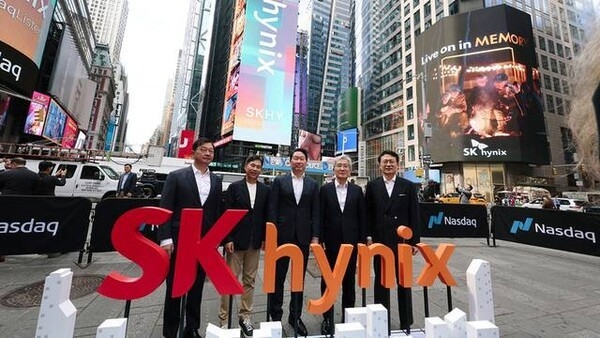
SK hynix is heading into year-end with a pair of significant tailwinds: a massive dividend payout and an increase in its weighting in the MSCI Emerging Markets index. With passive fund inflows expected from the index rebalancing, a 14 trillion won ($10.4 billion) dividend distribution and growing anticipation over the activation of a stock market stabilization fund are adding to the bullish case for the chipmaker's shares in December.
According to the financial investment industry, the latest quarterly MSCI review will raise SK hynix's weighting in the MSCI EM index from 4.49 percent to 4.61 percent. The adjustment will be reflected after the close of trading Monday, with the new weighting taking effect Tuesday. Passive funds that track the index typically rebalance their portfolios quickly to match changes in composition and weighting, meaning the increase is expected to generate mechanical buying demand.
In this MSCI quarterly review, no Korean stocks were added to or removed from the index — only SK hynix's EM weighting rose, by 0.11 percentage points. The change reflects the inclusion of shares issued through an American depositary receipt rights offering last July. The number of SK hynix shares counted by MSCI for index calculation increased from 713 million to 730 million, expanding the float-adjusted market capitalization — the market cap calculated based only on shares available for trading — used in the index.
Taking into account the size of index funds tracking the MSCI EM, exchange rates and the magnitude of the weighting change, industry estimates from Samsung Securities and Korea Investment & Securities project inflows of between 585 billion and 860 billion won. While the expected passive buying in SK hynix amounts to roughly 10 percent of its average daily trading volume, analysts say the more significant point is that hundreds of billions of won in foreign capital will flow in on a near-certain basis.
When a stock's index weighting is adjusted, as in SK hynix's case, funds tracking the index tend to concentrate their trades around the closing price on the last trading day before the change takes effect. When investor front-running and rebalancing-anticipation trades are factored in, the market impact could materialize even earlier.
"Compared with all additions and deletions, SK hynix ranks at the very top among MSCI EM constituents in terms of weighting increase," said Yeom Dong-chan, a researcher at Korea Investment & Securities. "Taking into account the size of MSCI EM-tracking index funds, exchange rates and the weighting change, we estimate buying demand flowing into SK hynix at around 860 billion won."
The third-quarter dividend, which runs into the 14 trillion won range, is another force that cannot be ignored. SK hynix plans to pay 20,000 won per share for the third quarter, for a total of 14.1 trillion won. The record date is Monday, with payment scheduled for sometime in December. Because reinvestment is ultimately the investor's choice, the actual amount flowing back into the market is difficult to predict. Still, given that the dividend pool is more than 20 times the size of the near-certain MSCI-driven demand, expectations for a reinvestment boost to the stock market remain alive.
The anticipated activation of the securities market stabilization fund — for the first time in 18 years since the 2008 global financial crisis — is also a major positive for SK hynix's supply-demand dynamics. Authorities plan to hold an emergency meeting of the fund's investment management committee Sunday, followed Monday by an emergency market stability review convened by Financial Services Commission Chairman Lee Eok-won, with the heads of the five major financial holding companies — KB, Shinhan, Hana, Woori and NongHyup — in attendance, to discuss expanding and activating the over-10-trillion-won stabilization fund.
The securities stabilization fund has been deployed only three times in history — in 1990, 2003 and 2008. Each time, investment was discussed and executed with a focus on major index constituents, leading analysts to expect concentrated buying in SK hynix and Samsung Electronics, which carry dominant weightings in the Kospi by market capitalization and in other key indexes.
Risks remain, however. Upcoming events — including a congressional hearing featuring Nvidia CEO Jensen Huang next week, US employment data due Dec. 4 and the December FOMC meeting — introduce uncertainty. Given that SK hynix is one of Nvidia's key customers, any negative developments could trigger caution in the market.
"With a December interest rate hike becoming a foregone conclusion in the United States as well as South Korea, the burden of capital procurement for companies is bound to grow further," said Kim Seok-hwan, a researcher at Mirae Asset Securities. "It is difficult to say the worst is behind us, and there is still a possibility that high volatility will persist."

kacew@heraldcorp.com